Teslong Borescope Review: Is It Worth It?
Teslong is the borescope brand you see everywhere on Amazon — and for good reason: a wide range at fair prices, from 5-inch-screen inspection cameras to thin articulating probes. Here is an honest look at whether Teslong is worth it, and which model to buy for what.

- 5 picks compared
- Specs checked against maker data
- No paid placements
GaugeGrade is reader-supported. When you buy through links on our site we may earn an affiliate commission at no extra cost to you. We only recommend gear we have researched against verified manufacturer specifications.
- 1Teslong's strength is a full range at value prices, with standalone-screen models and thin 3.9 mm probes for cylinder work.
- 2It is a value brand, not an industrial one — excellent for DIY and automotive, not a replacement for a professional Vividia or Olympus.
- 3Pick by job: dual or triple lens for general work, a 3.9 mm probe for cylinders, a joystick model to steer into blind pockets.
- 1Best all-roundTeslong 5" Dual-Lens Inspection Camera (8 mm, 16.5 ft)
- 2Most coverageTeslong NTS300 Triple-Lens Inspection Camera (7.9 mm, 9.8 ft)
- 3Best for cylindersTeslong 3.9mm 4-Way Articulating Borescope
- 4Best value small-probeTeslong NTS600 Ultra-Thin 3.9mm Endoscope
- 5Best steerableTeslong TF600 4-Way Articulating Borescope (6.5 mm, dual lens)
What we recommend
Compare the key specs side by side, then read the full notes on each pick below.
- Probe dia
- 8mm
- Display
- 5"IPS
- Type
- Dual lens
- Probe dia
- 7.9mm
- Display
- 5"IPS
- Type
- Triple lens
- Probe dia
- 3.9mm
- Display
- 6"IPS
- Type
- 4-way articulating
- Probe dia
- 3.9mm
- Display
- 6"IPS
- Type
- Flexible, no articulation
- Probe dia
- 6.5mm
- Display
- 6"IPS
- Type
- 4-way joystick, dual lens


Teslong 5" Dual-Lens Inspection Camera (8 mm, 16.5 ft)
A do-everything engine-bay scope with its own screen
- Probe dia
- 8 mm
- Display
- 5" IPS
- Type
- Dual lens
- Front and side cameras with separate LEDs
- Standalone 5" screen: no phone or app
- 16.5 ft semi-rigid cable, 5000 mAh battery
- IP67 probe; hook, magnet and mirror included
- Fixed probe (no articulation)
- 8 mm is tight in 12 mm plug holes and may not pass 10 mm ones
A simple scope to live with: switch it on, pick the front or side camera, and look. There's no app and no steering, and the 16.5 ft cable reaches well past the engine bay.
The 8 mm probe is tight in 12 mm plug holes, and the long cable is the one thing Bob Vila's testers found cumbersome.
Based on the maker's specifications and manual and the published reviews linked below, not on our own test of this unit.
Setup, everyday use and what others found
Setup & use · per the maker
- Hold the power button for a few seconds and it opens to a live picture. There is no app or WiFi.
- A button just above the probe's plug cycles between the front and side cameras, one view at a time.
- Photos save at 1920 × 1080 and video at 1280 × 720 to the included 32 GB microSD card. The handle adds 1.5× digital zoom and a 180° image flip.
- Sharpest about 1.2–3.2 in from the front lens and 0.8–2 in from the side lens, so work close.
- Charges over USB-C. Teslong rates the 5000 mAh battery at 4–5 hours of use, and the listing gives about 5 hours to recharge.
- Only the probe is waterproof (IP67, to 1 m for 30 minutes). The handset is IP45: fine for splashes, but never submerge it.
What others found
Bob Vila's testers named this listing their best overall borescope. They used it down a car's spark-plug hole and a shower P-trap, switched to the side lens to check brake-pad wear, and fished a dropped screw out of a drain with the magnet tip. Their one complaint was that the 16-foot cable is cumbersome.
Older reviews on this Amazon listing may describe an earlier version with a 4.5-inch screen, so read them with that in mind.
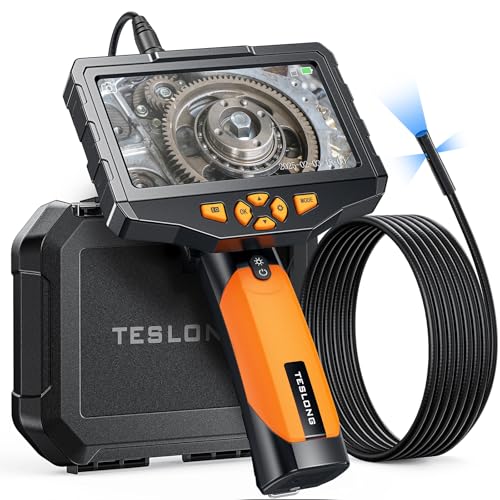


Teslong NTS300 Triple-Lens Inspection Camera (7.9 mm, 9.8 ft)
Front and two side views without steering, for engine bays and general work
- Probe dia
- 7.9 mm
- Display
- 5" IPS
- Type
- Triple lens
- Front camera plus two side-view cameras (one for close focus)
- Standalone 5" IPS screen; 32 GB card included
- 5000 mAh battery, about 4–5 hours
- This listing is the 9.8 ft (3 m) probe
- 7.9 mm is tight in 12 mm plug holes and may not pass 10 mm ones
- Video records at 720p
Three fixed cameras, one ahead, one sideways and a close-focus side lens, give you most of what steering would with no steering section to damage. One button cycles through them.
Video records at 720p, and the 7.9 mm probe is tight in 12 mm plug holes.
Based on the maker's specifications and manual and the published reviews linked below, not on our own test of this unit.
Setup, everyday use and what others found
Setup & use · per the maker
- Press the button above the probe's thread-on plug to cycle through the front, side and close-focus side views. There is no split-screen view.
- Each lens has its own focus band: about 1.2–3.2 in straight ahead, 0.8–2 in to the side and 0.6–1.2 in on the close-focus lens. The front camera has 8 LEDs and each side lens has one.
- Photos save at 1920 × 1080 and video at 1280 × 720 to the included 32 GB microSD card, viewed on a 5-inch IPS screen.
- Charges over USB-C. Teslong rates the 5000 mAh battery at about 4–5 hours.
- The probe is IP67 (to 1 m for 30 minutes). The handset is IP45, so keep it out of water.
- Teslong lists a 32 GB card, USB-C cable, hook and magnet tips and a carrying case in the box. Some retailer listings also show a mirror, so contents may vary by batch.
What others found
We found no independent hands-on test of the triple-lens NTS300, and too few owner reviews outside Amazon to call a pattern.


Teslong 3.9mm 4-Way Articulating Borescope
Cylinder and valve inspection through the spark-plug hole
- Probe dia
- 3.9 mm
- Display
- 6" IPS
- Type
- 4-way articulating
- 3.9 mm probe fits most plug holes
- 4-way (360°) steering
- 6" IPS screen
- Near the top of Teslong's price range
- Fine probe needs a careful hand
The Teslong to buy for looking inside a cylinder: a 3.9 mm probe that passes even 10 mm plug holes, and four-way joystick steering to reach the bore walls and valves.
It's one of Teslong's priciest scopes, and a fine articulating tip needs careful handling.
Based on the maker's specifications and manual and the published reviews linked below, not on our own test of this unit.
Setup, everyday use and what others found
Setup & use · per the maker
- A joystick steers the tip in four directions; Teslong lists 360° of articulation. Center it and make sure the bending section is straight before you pull the probe out, and never force it.
- Single camera with 6 adjustable LEDs, an 80° field of view and a focus range of about 0.8–3.9 in.
- Saves photos and video at up to 1920 × 1080 to the included 32 GB microSD card, although Teslong rates the 3.9 mm camera itself at 1.0 megapixel.
- 6-inch 1920 × 1080 IPS screen, with a mini-HDMI port alongside the USB-C charging port and card slot.
- Teslong rates the 6000 mAh battery at up to 3.5 hours of use.
- The 1.55 m (5.08 ft) probe is IP67, to 1 m for 30 minutes; don't submerge the monitor. Teslong says the probe can't be replaced if it's damaged.
- In the box: monitor, probe, 32 GB card, USB-C cable and a carrying case. The hook and magnet tips come only with the 6.5 mm version.
What others found
We found no independent hands-on test of the 3.9 mm TF600 and no owner reviews outside Amazon. Teslong now also sells the F8 PRO, a pricier model with the same listed specs and a longer warranty.


Teslong NTS600 Ultra-Thin 3.9mm Endoscope
A thin, screen-equipped scope for cylinders without paying for articulation
- Probe dia
- 3.9 mm
- Display
- 6" IPS
- Type
- Flexible, no articulation
- 3.9 mm probe
- 6" IPS screen, big 6000 mAh battery
- 5 ft flexible probe
- No articulation — you aim the whole probe
- Teslong's 3.9 mm probes come without hook, magnet or mirror tips
A 3.9 mm probe and a big 6-inch screen without paying for steering. It gets you inside even small plug holes, and bending and turning the probe does the rest.
It can't look around corners the way the TF600 can, and the 5 ft probe length in the listing isn't one Teslong offers for this model on its own store, so read the listing's details.
Based on the maker's specifications and manual and the published reviews linked below, not on our own test of this unit.
Setup, everyday use and what others found
Setup & use · per the maker
- The listing, which calls it the Teslong NTS600, describes a 6-inch 1280 × 720 IPS screen, a 6000 mAh battery and a 5 ft flexible probe with a 3.9 mm camera and a 78° view, saving photos and video at up to 1080p.
- The listing says it can also stream over WiFi to Teslong's Smart Endoscope app.
- A single forward-facing camera with no articulation: you aim it by shaping the probe and turning the whole cable.
- The probe is IP67; the monitor is only IP54, so keep it out of water.
- Teslong says its 3.9 mm probes come without hook, magnet or mirror tips, and warns against bending the cable tighter than it ships.
What others found
The listing calls it the NTS600, but Teslong's own NTS600 page offers the 3.9 mm probe only in 1 m or 3 m lengths, not 5 ft. We found no independent hands-on test and no owner reviews outside Amazon.


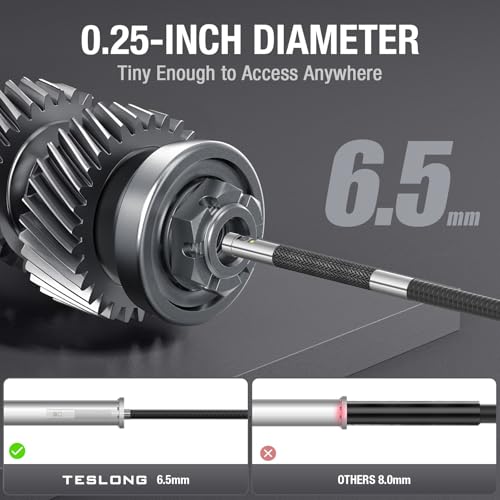


Teslong TF600 4-Way Articulating Borescope (6.5 mm, dual lens)
Steering into blind pockets with joystick control and a big screen
- Probe dia
- 6.5 mm
- Display
- 6" IPS
- Type
- 4-way joystick, dual lens
- 4-way joystick: 360° rotation and 210° bend
- Front and side cameras; 6" 1080p IPS screen
- 6000 mAh battery, 5 ft probe
- Thicker 6.5 mm probe; the 3.9 mm model slips into small openings more easily
- Costs more than the fixed-probe models
Teslong's most capable steerable scope on this page: four-way joystick steering that locks, a side camera, and split-screen on a 6-inch 1080p screen.
It's thicker than the 3.9 mm TF600, and Teslong's own store now sells the F6 PRO as its four-way dual-lens model.
Based on the maker's specifications and manual and the published reviews linked below, not on our own test of this unit.
Setup, everyday use and what others found
Setup & use · per the maker
- A joystick steers the tip four ways and can lock it in position. Center it and let the bending section straighten before you withdraw the probe.
- Front camera with 6 LEDs and a side camera with 1, each 1.0 MP, with split-screen viewing. Photos and video save at up to 1920 × 1080 to the included 32 GB card.
- 6-inch 1920 × 1080 IPS screen, plus a built-in microphone and speaker.
- Charges over USB-C. B&H lists about 4 hours to charge the 6000 mAh battery and up to 4 hours of use.
- The 1.55 m probe is IP67; B&H rates the unit for 0–45 °C (32–113 °F). Teslong says the probe can't be replaced if it's damaged.
- In the box: 32 GB card, USB-C cable, hook and magnet tips and a carrying case.
What others found
We found no independent hands-on test and no owner reviews outside Amazon. B&H no longer lists this dual-lens version, and Teslong's own store now sells the F6 PRO as its four-way dual-lens model.
- Aeronautics diploma
- Engineering degree
- BAMEC (DGCA)
- QC-trained
- ~2 yrs tool management
Why you should trust us
A brand review needs a benchmark, and SK Kutubuddin's comes from over two decades of maintaining and inspecting aircraft, where borescope inspection of turbine and compressor blades was core daily work. The question he asks of any scope is not whether it looks good on a listing, but whether it gives a clear enough view, in the right place, to support a decision about the part in front of you.
This review looks at Teslong as a range rather than a single product. We compared the models across the jobs buyers actually use them for, from general engine-bay work to spark-plug-hole inspection, and checked every probe size, display and lens configuration against Teslong's own specifications and the current listings, as described on our How We Test page. No brand pays for placement on GaugeGrade, Teslong included.
Who this is for
This review is for buyers who have landed on Teslong, usually because the name keeps coming up in search results, and want to know whether it is a sound choice and which model fits their work. It suits DIY mechanics, homeowners and tradespeople who want a dependable scope at a fair price without stepping up to industrial equipment.
If you are not set on a brand, our automotive and engine-inspection pages compare Teslong models against other makers' scopes, pick by pick.
- Buyers comparing Teslong models and unsure which variant to choose
- DIY mechanics who want a standalone screen and a choice of probe sizes
- Anyone who needs a 3.9 mm probe for cylinder work at a value price
- Teslong owners deciding what a second, different scope should be
How we picked
We looked across Teslong's current range and selected one model for each common job, rather than ranking the whole catalog. Every spec was checked against Teslong's specifications and the live listing.
- 01
One pick per job
Teslong sells many similar-looking scopes. We grouped them by job, general automotive work, maximum coverage, cylinder access and blind-pocket steering, and chose the model in each group that answers that job most directly, with no duplicates.
- 02
Probe diameter first
Across our picks, probe size runs from 3.9 mm to 8.0 mm. We made sure the lineup covers both thin probes for spark-plug holes and larger probes for engine bays, and flagged every model that is a tight fit for cylinder access.
- 03
Lens and steering type
We included dual-lens, triple-lens, fixed gooseneck and four-way articulating models, because each solves the problem of seeing off-axis in a different way and at a different price. The spec table names the type for every pick.
- 04
A screen of its own
Every Teslong pick on this page has its own 5 or 6 inch screen, so none of them needs a phone. Teslong also makes WiFi models for phone users; for phone-based scopes, see our iPhone and Android pages.
- 05
Stated trade-offs
Each pick carries its real limits, such as a fixed probe that cannot steer or a price at the top of the range, so the choice is made on what you give up as well as what you get.
What to know before you buy
Is Teslong any good?
For the money, yes. Teslong scopes give you decent 1080p optics, standalone screens, IP67-rated probes and a genuinely wide model range — a big step up from no-name inspection cameras.
What they are not is industrial-grade. If you need certified accuracy, the finest optics or the ruggedness of a professional brand, Teslong is not that. For DIY, automotive and general inspection, it is hard to beat on value.
Which Teslong should you buy?
Match the model to the job:
- General automotive and engine-bay work — the 5" dual-lens or triple-lens model.
- Inside a cylinder — a 3.9 mm probe; the 4-way articulating model to read the walls, the ultra-thin for value.
- Steering into a genuinely blind pocket — the 4-way joystick model.
- Streaming to a phone — Teslong also makes WiFi models (see our iPhone borescope picks).
Choosing the right variant on the listing
Teslong listings often group several versions of a scope under one page, and it is easy to check out with the wrong one. The same product name can cover different probe diameters and cable lengths, and a newer listing can replace an older model with slightly different specs.
Before you buy, confirm these on the option you have actually selected, not just the main photo:
- Probe diameter. If cylinder access is the goal, choose the smallest probe offered and check it against your plug hole.
- Cable length. Longer is not always better; a long cable is harder to guide and to store.
- Lens configuration. Single, dual and triple-lens versions share a family look, so read the option name rather than relying on the picture.
- Screen size. Our Teslong picks come with either a 5 or a 6 inch display, and the larger screen makes fine detail easier to judge.
- The price shown. On a multi-option listing the headline price may belong to a different version, so recheck it after you select the probe and cable you want.
Care and storage that keep a Teslong working
A value scope lasts well if you treat it as a camera rather than a hand tool. Most of the care comes down to the probe, the battery and the screen:
- Clean the probe after every job. Wipe off oil and grime with a soft cloth and a little mild detergent, then clean the lens last with a lens cloth so you do not grind grit into it. Avoid strong solvents, which can attack the cable jacket and seals.
- Let the probe dry fully before coiling it away, and store it in loose loops in its case.
- Look after the battery. If the scope sits in a drawer between jobs, top up the charge every few months rather than leaving it flat, and do not store it in a hot car.
- Protect the screen. Close the case or cover the display before the scope goes into a toolbox with metal tools.
- If the image develops a spot or haze that cleaning does not remove, the lens window may be scratched or its seal damaged. Stop immersing the probe and contact the seller or Teslong for support.
Frequently asked questions
Is Teslong a good borescope brand?
For DIY and automotive use, yes — solid 1080p optics, standalone screens and a wide range at fair prices. It is a value brand, not an industrial one.
Which Teslong is best for engine cylinders?
A 3.9 mm probe fits most spark-plug holes; the 4-way articulating model lets you read the cylinder walls, not just the piston top.
Do Teslong borescopes work with a phone?
The screen models are standalone and need no phone. Teslong also makes WiFi models that stream to an iPhone or Android.
Are Teslong borescopes waterproof?
The probes are IP67-rated so you can dip and wipe them; the rating applies to the probe, not the whole unit.
Teslong vs a cheaper no-name scope?
Teslong's optics, screens, battery life and support are a clear step up from generic scopes at a similar price.
What does IP67 actually mean for a Teslong probe?
IP67 is a standard rating meaning the probe is dust-tight and protected against temporary immersion in water, tested at depths up to 1 meter for 30 minutes. It does not mean the probe can stay submerged indefinitely, and it says nothing about resistance to fuel, solvents or high-pressure spray, so wipe it clean promptly after use.
Should I choose Teslong or another value brand?
Choose by model, not by brand. Value makers such as Teslong and DEPSTECH both offer standalone-screen, WiFi and articulating scopes, and the right choice comes down to probe diameter, how you want to see off-axis and which display you prefer. Our automotive and engine-inspection pages compare models from both side by side.
Can I use a Teslong for jobs around the house?
Yes. The same scopes work in drains, wall cavities, ducts and behind appliances, with the appliance unplugged first. Before probing a wall that may hold wiring, switch off the circuit at the breaker, and never push the probe into an electrical panel or anything energized. Clean the probe thoroughly after drain work.
Related reading
- Aeronautics diploma
- Engineering degree
- BAMEC (DGCA)
- QC-trained
- ~2 yrs tool management
SK spent over two decades in aircraft maintenance, working hands-on with aero-engine systems and flight data recorder systems, borescope-inspecting turbine and compressor blades, and spending almost two years in a dedicated tool bay. He holds a diploma in mechanical engineering (aeronautics), an associate degree in science, an engineering degree and a Basic Aircraft Maintenance Engineer's Certificate (BAMEC) from DGCA, and has completed quality-control and aviation fuels & lubricants training. GaugeGrade applies the same inspection, torque and tool-management standards to the tools everyday mechanics, DIYers and trades actually buy.