The Best Split-Beam Torque Wrenches
A split-beam torque wrench clicks like an ordinary click wrench, but it measures with a beam instead of a preloaded coil spring. You set it with a knob or thumbscrew using fingertip force, and you can leave it at any setting between jobs without winding it down. These are the best split-beam wrenches, from US-made Precision Instruments models to TEKTON's new split-beam set, a Capri and a 3/4-inch wrench for heavy equipment.

GaugeGrade is reader-supported. When you buy through links on our site we may earn an affiliate commission at no extra cost to you. We only recommend gear we have researched against verified manufacturer specifications.
- Best overall: the Precision Instruments C2FR100F, a US-made 3/8-inch, 20–100 ft-lb wrench from the maker whose C line launched the split-beam click wrench market in 1974.
- Split-beam wrenches are typically rated ±4% from 20% of the scale up, and most are rated clockwise only. If you need counter-clockwise torque, check the model.
- The big everyday advantage is storage: nothing is loaded at rest, so you can leave the wrench at your most-used setting.
- Best overallPrecision Instruments C2FR100F 3/8" Split-Beam Torque Wrench
- Best 1/2-inchPrecision Instruments C3FR250F 1/2" Split-Beam Torque Wrench
- Best value setTEKTON TRQ96901 3/8" and 1/2" Split-Beam Torque Wrench Set
- Best budget 1/2-inchCapri Tools CP31600-250FL 1/2" Split-Beam Torque Wrench
- Best inch-poundCDI 502TQFR 3/8" Split-Beam Torque Wrench (120–600 in-lb)
- Best 3/4-inchPrecision Instruments C4D600F 3/4" Split-Beam Torque Wrench
What we recommend
- Range
- 20–100 ft-lb(2 ft-lb steps)
- Head
- Flex ratchet
- Accuracy
- ±4% of reading, CW(20–100%)
- Range
- 40–250 ft-lb(5 ft-lb steps)
- Head
- Flex ratchet
- Accuracy
- ±4% of reading, CW(20–100%)
- Range
- 20–100 and 50–250 ft-lb
- Head
- 90-tooth, 10° flex
- Accuracy
- ±4%CW
- Range
- 50–250 ft-lb(5 ft-lb steps)
- Head
- 72-tooth, flex
- Accuracy
- ±4%CW
- Range
- 120–600 in-lb(10 in-lb steps)
- Head
- Flex ratchet
- Accuracy
- ±4% CW(20–100%)
- Range
- 200–600 ft-lb(10 ft-lb steps)
- Head
- Detachable ratchet
- Accuracy
- ±4% of reading(20–100%)

Precision Instruments C2FR100F 3/8" Split-Beam Torque Wrench
Engine-bay and general work with a US-made wrench you never wind down
- Range
- 20–100 ft-lb (2 ft-lb steps)
- Head
- Flex ratchet
- Accuracy
- ±4% of reading, CW (20–100%)
- Made in the USA by Precision Instruments, whose C line launched the split-beam click wrench market in 1974
- Sets with fingertip force; no need to wind down after use
- Few parts, with the critical ones welded together, per the maker
- Flex ratchet head
- Clockwise only
- The maker sells a calibration certificate as an option

Precision Instruments C3FR250F 1/2" Split-Beam Torque Wrench
Lug nuts, suspension and chassis bolts
- Range
- 40–250 ft-lb (5 ft-lb steps)
- Head
- Flex ratchet
- Accuracy
- ±4% of reading, CW (20–100%)
- Made in the USA
- Covers lug nuts through heavy suspension bolts
- 19-inch effective length for a steady pull
- Clockwise only
- The maker sells a calibration certificate as an option
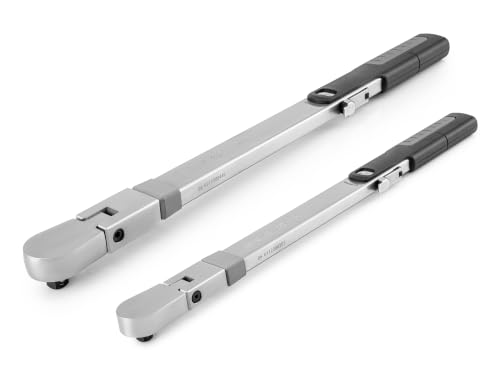
TEKTON TRQ96901 3/8" and 1/2" Split-Beam Torque Wrench Set
Covering engine-bay and wheel work with TEKTON's new split-beam line
- Range
- 20–100 and 50–250 ft-lb
- Head
- 90-tooth, 10° flex
- Accuracy
- ±4% CW
- TRQ61122 (3/8", 2 ft-lb steps) and TRQ62122 (1/2", 5 ft-lb steps), each with its own case
- Meets or exceeds ISO 6789-1:2017 and ASME B107.300-2021, per TEKTON; serialized certificate for each
- 90-tooth ratchet with a 4° swing arc
- Clockwise only
- 50 ft-lb minimum on the 1/2-inch wrench

Capri Tools CP31600-250FL 1/2" Split-Beam Torque Wrench
Wheels and chassis work with a wrench you can leave at your usual setting
- Range
- 50–250 ft-lb (5 ft-lb steps)
- Head
- 72-tooth, flex
- Accuracy
- ±4% CW
- Store it at any setting, per Capri
- Serialized certificate of conformance
- 72-tooth ratchet with a ±10° flex head; fitted case
- Clockwise only
- 50 ft-lb minimum

CDI 502TQFR 3/8" Split-Beam Torque Wrench (120–600 in-lb)
Engine-bay fasteners you want to set in inch-pounds
- Range
- 120–600 in-lb (10 in-lb steps)
- Head
- Flex ratchet
- Accuracy
- ±4% CW (20–100%)
- From CDI, a Snap-on Industrial brand
- 120–600 in-lb is 10–50 ft-lb, set in finer steps
- Flex-head ratchet
- Clockwise only, per CDI's catalog
- 120 in-lb minimum: not for the smallest fasteners

Precision Instruments C4D600F 3/4" Split-Beam Torque Wrench
Trucks, farm and heavy equipment
- Range
- 200–600 ft-lb (10 ft-lb steps)
- Head
- Detachable ratchet
- Accuracy
- ±4% of reading (20–100%)
- Made in the USA
- Ratchet can be flipped over for counter-clockwise use, per the maker
- About 48 in long, for a steady pull at high torque
- Heavy: about 11.8 lb
- The maker gives no accuracy figure for counter-clockwise use
Why you should trust us
SK Kutubuddin spent over two decades in aircraft maintenance and almost two years in a dedicated tool bay, where torque wrenches were issued, returned, checked and sent for calibration on schedule. Split-beam wrenches earn their place in that kind of environment because they are simple, quick to set and do not need winding down, which removes one common way for a wrench to drift.
We compared split-beam wrenches across drive sizes and ranges and checked every range, step size, accuracy figure and direction against the maker's published data and the live listing, per our how-we-test method. Where a listing and the maker disagree, as they do on some certificates, we followed the maker. This is a buying guide built on verified specs, not a lab test.
Who this is for
This page is for mechanics and technicians who change torque settings often, anyone tired of winding a click wrench down after every job, and shops that want a simple, durable wrench.
If you often need counter-clockwise torque, a dual-direction micrometer click wrench or a digital wrench is usually the better choice.
- Shops and mechanics who switch settings all day
- Anyone who wants to leave a wrench at a common setting
- Buyers who prefer a US-made wrench
- Truck and equipment work at 200–600 ft-lb
How we picked
We picked split-beam wrenches across the common drive sizes and verified every figure against the maker's data.
Every common drive size
We covered 3/8-inch, 1/2-inch and 3/4-inch wrenches, plus an inch-pound model, so each range has a pick.
Accuracy, direction and where it applies
We recorded each wrench's rated tolerance, the part of the scale it covers and whether it works counter-clockwise, which most split-beams do not.
Paperwork
We noted which wrenches ship with a serialized certificate and where the maker sells one as an option.
Build and origin
We included US-made Precision Instruments wrenches alongside lower-cost TEKTON and Capri models, and a CDI from Snap-on's industrial line.
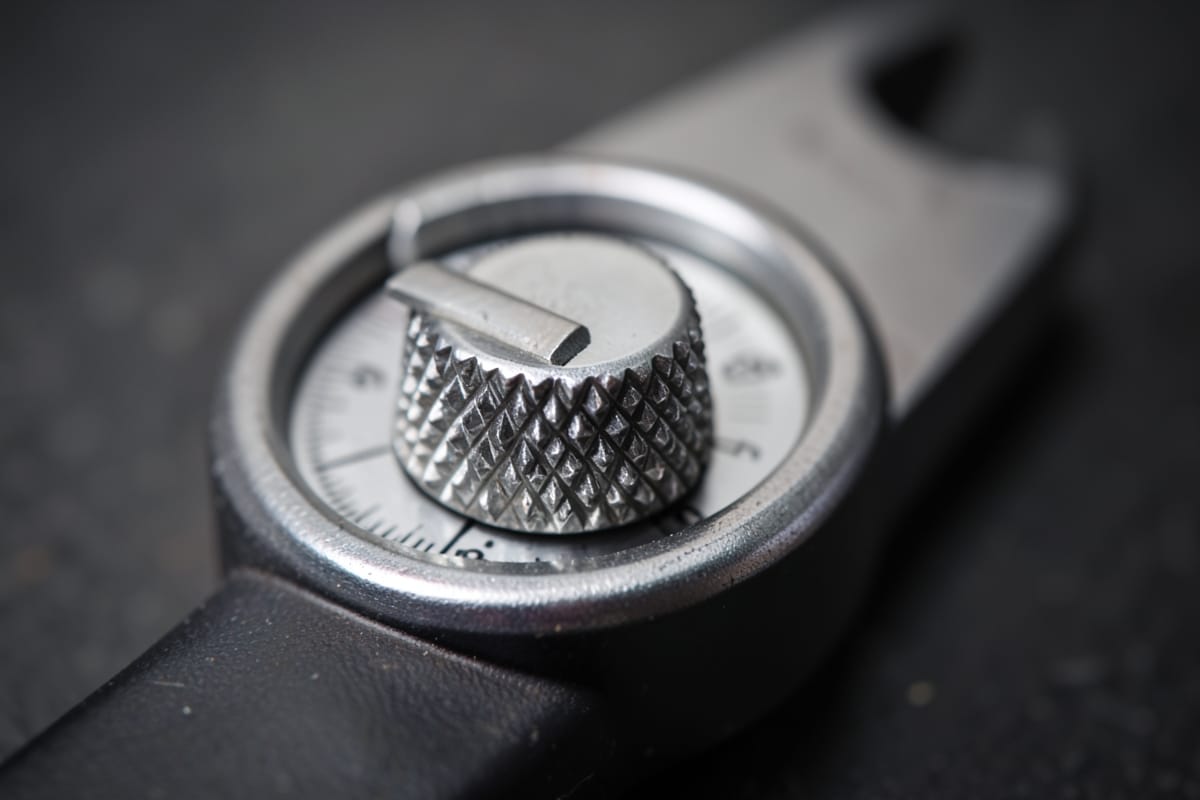
How a split-beam torque wrench works
Instead of compressing a coil spring against a trip mechanism, a split-beam wrench measures how far a beam flexes under load, and clicks when that flex reaches the value you set. Because the setting mechanism is not under load while you adjust it, Precision Instruments says it takes only fingertip force to set, and because there is no coil spring compressed at rest, the wrench can be stored at any setting.
Precision Instruments, whose C line launched the split-beam click wrench market in 1974, also points to the design's few parts, with the critical ones welded together, and says the wrench needs no working-in before first use.
Split-beam or micrometer click?
Both click at a preset value. The differences are practical:
- Storage: a split-beam can be left at any setting; a micrometer click wrench should be wound down to its lowest marked setting.
- Setting: a split-beam sets with a knob or thumbscrew and fingertip force; a micrometer wrench sets by turning the handle.
- Direction: most split-beams are rated clockwise only; many micrometer wrenches, such as TEKTON's current line, are rated in both directions.
- Steps: split-beam scales set in fixed steps, such as 2, 5 or 10 ft-lb; a micrometer wrench's handle scale often has finer graduations.
Check the model number on a TEKTON split-beam
TEKTON released a new split-beam line in 2026: the 3/8-inch TRQ61122 and 1/2-inch TRQ62122, sold together as the TRQ96901 set, with 90-tooth flex heads and a serialized certificate. TEKTON lists the older 3/8-inch TRQ62103 as an old version that does not include a certificate, and the 1/2-inch TRQ62203 as no longer available, though both may still turn up for sale.
Accuracy and calibration
Every split-beam wrench on this page is rated ±4%, typically from 20% of full scale upward and clockwise. That puts the bottom fifth of each scale outside the rating, so choose a range that keeps your common values above it.
Split-beams still need checking. Precision Instruments advises calibrating every wrench at least every six months, and the widely used benchmark from ISO 6789 is every 12 months or 5,000 cycles. Our calibration guide shows how to check a wrench at home.
Using a split-beam wrench
Set the value, lock it if the wrench has a lock, and pull smoothly at the handle, square to the wrench, until it clicks. Stop at the click: pulling on adds torque. A split-beam is for tightening, not for breaking fasteners loose, and on most models only in the clockwise direction.
Frequently asked questions
- What is a split-beam torque wrench?
- A click-type torque wrench that measures with a beam rather than a preloaded coil spring. It clicks at the value you set, sets with fingertip force, and can be stored at any setting.
- Is a split-beam torque wrench better than a click wrench?
- It is more convenient if you change settings often or hate winding a wrench down, and its simple mechanism is durable. A micrometer click wrench is usually the better choice if you need counter-clockwise torque or finer setting steps.
- Do you have to set a split-beam torque wrench to zero?
- No. There is no loaded spring at rest, so Precision Instruments, TEKTON and Capri all say it can be stored at any setting.
- Can a split-beam torque wrench be used counter-clockwise?
- Most are rated clockwise only, including Precision Instruments' C series, CDI's split-beams and TEKTON's. Precision Instruments' 3/4-inch C4D600F is an exception: its ratchet can be flipped over for counter-clockwise use.
- Who makes the best split-beam torque wrench?
- Precision Instruments launched the split-beam click wrench market with its C line in 1974 and still makes its wrenches in the USA. CDI, TEKTON and Capri Tools also make well-documented split-beam wrenches.
- Why are split-beam wrenches clockwise only?
- It is how most are built and calibrated: Precision Instruments, CDI and TEKTON rate theirs for clockwise use. Precision Instruments' 3/4-inch C4D600F is an exception, with a ratchet that flips over for counter-clockwise work.
- Are split-beam torque wrenches accurate at low settings?
- Like most click wrenches, they are typically rated from 20% of full scale upward. Choose a range that keeps your common values above that point.
Related reading
- Aeronautics diploma
- Engineering degree
- BAMEC (DGCA)
- QC-trained
- ~2 yrs tool management
SK spent over two decades in aircraft maintenance, working hands-on with aero-engine systems and flight data recorder systems, borescope-inspecting turbine and compressor blades, and spending almost two years in a dedicated tool bay. He holds a diploma in mechanical engineering (aeronautics), an associate degree in science, an engineering degree and a Basic Aircraft Maintenance Engineer's Certificate (BAMEC) from DGCA, and has completed quality-control and aviation fuels & lubricants training. GaugeGrade applies the same inspection, torque and tool-management standards to the tools everyday mechanics, DIYers and trades actually buy.