The Best Digital Torque Adapters
A digital torque adapter fits between an ordinary ratchet and the socket, reads the torque passing through it and signals at the value you set. It turns ratchets you already own into torque tools, and it's the easiest home reference for checking a click wrench. The catch is the paperwork: at least two makers print a tighter accuracy figure in their marketing than in their own manuals. These are the best, with every figure taken from the manual.

- 6 picks compared
- Specs checked against maker data
- No paid placements
GaugeGrade is reader-supported. When you buy through links on our site we may earn an affiliate commission at no extra cost to you. We only recommend gear we have researched against verified manufacturer specifications.
- 1For most people, the Durofix RM604-4A: 1/2-inch, 25–250 ft-lb, rated ±2% clockwise and ±3% counter-clockwise of the reading from 20% of its scale, with an angle mode for torque-plus-angle bolts.
- 2Because an adapter sits in line with the drive, it reads the torque reaching the socket whatever you turn it with, so a longer ratchet or breaker bar doesn't change the reading.
- 3Checking a click wrench? These adapters offer peak and trace, not the first-peak mode professional testers use, so peak can catch the overshoot after the click and read the wrench high. Use one to spot drift, not as a calibration; our calibration guide shows the method.
- 1Best overallDurofix RM604-4A 1/2" Digital Torque Adapter with Angle
- 2Best mid-range 1/2"ACDelco ARM602-4 1/2" Digital Torque Adapter
- 3Best for small fastenersACDelco ARM602-3 3/8" Digital Torque Adapter
- 4Best valueNEIKO 20742A 3/8" Digital Torque Adapter
- 5Best with a check blockPowerbuilt 940962 1/2" Digital Torque Adapter
- 6Best for heavy workNEIKO 20743A 3/4" Digital Torque Adapter
What we recommend
Compare the key specs side by side, then read the full notes on each pick below.
- Drive
- 1/2"
- Range
- 25–250ft-lb
- Rated accuracy
- ±2% CW, ±3% CCW(20–100% of scale)
- Drive
- 1/2"
- Range
- 14.8–147.6ft-lb
- Rated accuracy
- ±2% CW, ±3% CCW(20–100% of scale)
- Drive
- 3/8"
- Range
- 5.9–59ft-lb
- Rated accuracy
- ±2% CW, ±3% CCW(20–100% of scale)
- Drive
- 3/8"
- Range
- 14.7–99.6ft-lb
- Rated accuracy
- ±2%(no direction or range stated)
- Drive
- 1/2"
- Range
- 30–150 ft-lb(manual)
- Rated accuracy
- ±2% per manual(box says ±1%)
- Drive
- 3/4"
- Range
- 150–750ft-lb
- Rated accuracy
- ±2%(no direction or range stated)

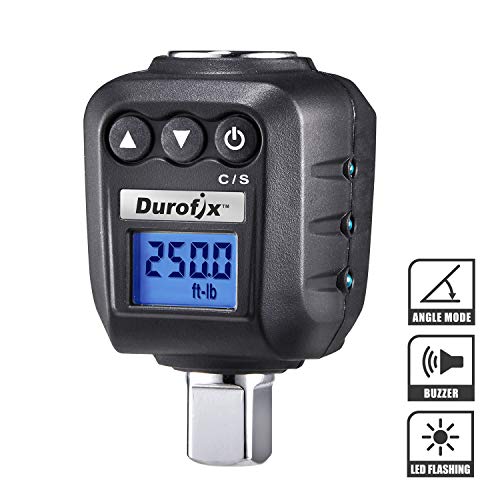


Durofix RM604-4A 1/2" Digital Torque Adapter with Angle
Wheels, suspension and engine work, including torque-plus-angle bolts
- Drive
- 1/2"
- Range
- 25–250 ft-lb
- Rated accuracy
- ±2% CW, ±3% CCW (20–100% of scale)
- Angle mode up to 720° as well as peak and trace torque
- Accuracy stated with direction and scale range, the same on the maker's page, manual and listing
- Serialized, with a calibration certificate Durofix describes as NIST-traceable
- No published angle accuracy, and no alarm in angle mode
- Torque rated only from about 50 ft-lb (20% of scale) up
The adapter to buy if you want one tool for wheels, suspension and engine work. It covers 25–250 ft-lb on a 1/2-inch drive, adds an angle mode for torque-plus-angle bolts, and it is the best-documented adapter here: Durofix rates it ±2% clockwise and ±3% counter-clockwise of the indicated value, from 20% to 100% of the scale, and says the same thing on its product page, in its manual and on the listing.
Two gaps. Durofix publishes no accuracy figure for the angle mode, and its quick-start guide says angle mode has no alarm, so you watch the display. And the torque rating starts at about 50 ft-lb; below that the reading is unrated.
Based on the maker's specifications and manual and the published reviews linked below, not on our own test of this unit.
Setup, everyday use and what others found
Setup & use · per the maker
- 25.1–250.8 ft-lb (34–340 N·m), read in ft-lb, in-lb, N·m or kg·cm at a resolution of 0.1 ft-lb. Peak, trace and angle modes; angle reads from 1° to 720°.
- Rated ±2% clockwise and ±3% counter-clockwise of the indicated value, from 20% to 100% of full scale. Durofix says it meets ASME B107.14-2004 and ISO 6789 and is individually serialized, with a certificate of calibration traceable to NIST.
- A buzzer and LED signal the target in the torque modes. Durofix's quick-start guide says the angle mode does not support the alarm setting.
- Runs on two CR2032 coin cells, included, and switches off after a minute of no use. The body is polished stainless steel, 1.5 inches long and 0.44 lb.
- It shows an error on start-up after an over-torque, which Durofix defines as more than 110% of the stated maximum. Durofix says recalibration is for a test lab with proper equipment, and that attempting it yourself can make the tool inoperable and voids the warranty.
- Durofix's own pages disagree on the warranty term: its store lists a three-year limited warranty, while its customer-service page describes one year as standard, with longer terms on selected products.
What others found
We found no independent test and no owner reviews of the RM604-4A outside Amazon, so this rests on Durofix's published specifications, manual and quick-start guide.

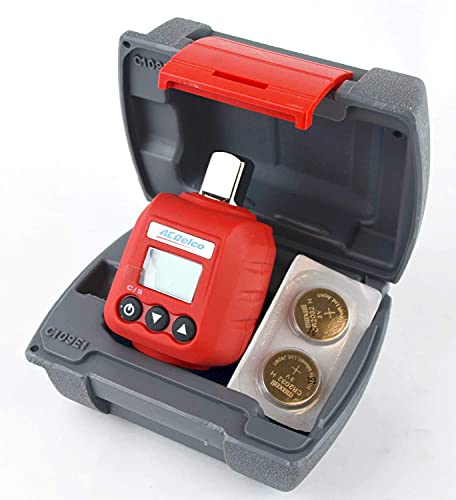

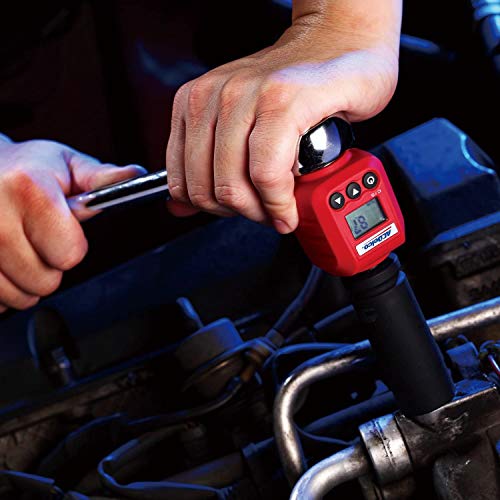
ACDelco ARM602-4 1/2" Digital Torque Adapter
Brake, suspension and engine fasteners from about 30 to 150 ft-lb
- Drive
- 1/2"
- Range
- 14.8–147.6 ft-lb
- Rated accuracy
- ±2% CW, ±3% CCW (20–100% of scale)
- Rated from about 30 ft-lb, lower than the 25–250 ft-lb adapters
- Warning buzzer from 90% of the target, a high-frequency tone at it
- Keeps its mode and unit through a battery change, and counts cycles
- Tops out at 147.6 ft-lb, short of heavy-truck lug nuts
- No angle mode
The 1/2-inch adapter for the range most chassis and engine fasteners fall in. It reads 14.8–147.6 ft-lb and is rated from 20% of that scale, about 30 ft-lb, which puts common brake and suspension values inside its rating, where the 25–250 ft-lb adapters are not rated until about 50.
ACDelco states its accuracy properly, with a direction and a scale range: ±2% clockwise and ±3% counter-clockwise from 20% to 100%. It has no angle mode, and it stops short of heavy-truck lug nuts.
Based on the maker's specifications and manual and the published reviews linked below, not on our own test of this unit.
Setup, everyday use and what others found
Setup & use · per the maker
- 14.8–147.6 ft-lb on a 1/2-inch drive, read in N·m, kg·cm, ft-lb or in-lb.
- Trace mode shows the torque live; peak mode holds the highest reading until you press the power button to clear it.
- An intermittent buzzer starts at 90% of the target, and a high-frequency buzzer sounds when you reach it. Above 120% of the maximum, the display shows "999" and the buzzer sounds.
- It keeps your last mode and unit through a battery change, and counts how many times it has reached the target, up to 999,000.
- Runs on two CR2032 coin cells and switches off after 60 seconds of no use.
- Rated ±2% clockwise and ±3% counter-clockwise from 20% to 100% of full scale, per the listing and ACDelco's manual for the ARM602 series. ACDelco Tools UK lists a one-year warranty and excludes torque adapters from its extended cover.
What others found
In a BobIsTheOilGuy thread on digital adapters, an owner says his ACDelco adapters "have served me well". He doesn't name the model or give any measurements.
Garage Journal posters describe ACDelco's adapters as coming in a good case but a little bulky for tight spaces, and one advises taking the battery out for storage.
One BobIsTheOilGuy owner set his click wrench to 100 ft-lb and saw his ACDelco adapter read 116 when the wrench clicked. With neither tool freshly calibrated, that shows the two disagreed, not which one was wrong.
We found no independent test with measurements of the ARM602-4.


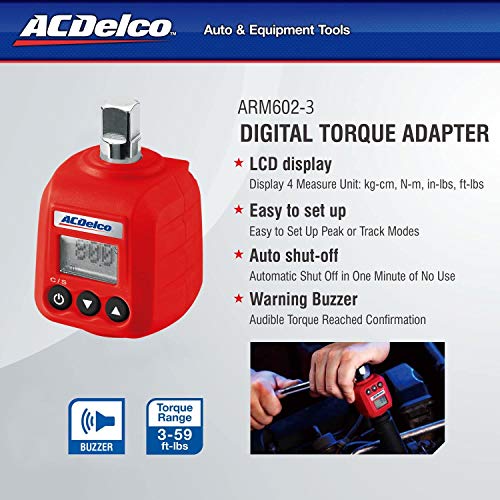

ACDelco ARM602-3 3/8" Digital Torque Adapter
Covers, brackets and engine-bay fasteners from about 12 to 59 ft-lb
- Drive
- 3/8"
- Range
- 5.9–59 ft-lb
- Rated accuracy
- ±2% CW, ±3% CCW (20–100% of scale)
- The lowest range here, on a 3/8-inch drive for engine-bay sockets
- Same modes, alerts and accuracy statement as ACDelco's 1/2-inch ARM602-4
- Runs on two CR2032 coin cells
- Rated only from about 12 ft-lb up
- Its Amazon listing carries almost no detail; specs come from ACDelco's series manual and the listing title
The adapter for small fasteners: 5.9–59 ft-lb on a 3/8-inch drive, which suits valve covers, brackets, sensors and most engine-bay hardware. ACDelco sells it as the 3/8-inch version of the ARM602 series, with the same modes, alerts and accuracy statement as the 1/2-inch ARM602-4: ±2% clockwise and ±3% counter-clockwise from 20% of its scale.
That puts its rated floor near 12 ft-lb. Below that, small covers into aluminum at single-digit values, use an inch-pound wrench. Its own Amazon listing is almost empty, so everything here comes from ACDelco's series manual and the listing's title.
Based on the maker's specifications and manual and the published reviews linked below, not on our own test of this unit.
Setup, everyday use and what others found
Setup & use · per the maker
- 5.9–59 ft-lb (8–80 N·m) on a 3/8-inch drive, per the listing.
- Trace and peak modes, a warning buzzer from 90% of the target and a high-frequency tone at it, as described for the ARM602 series.
- Rated ±2% clockwise and ±3% counter-clockwise from 20% to 100% of full scale, which puts the bottom of its rating near 12 ft-lb.
- Runs on two CR2032 coin cells, with automatic power-off.
- The listing's title says it includes an ISO 6789 calibration certificate. ACDelco's manual doesn't mention one, so check the box when it arrives.
What others found
We found no independent test and no owner reports that name the ARM602-3.


NEIKO 20742A 3/8" Digital Torque Adapter
A first adapter for engine-bay work and checking 3/8-inch wrenches
- Drive
- 3/8"
- Range
- 14.7–99.6 ft-lb
- Rated accuracy
- ±2% (no direction or range stated)
- Peak and trace modes, clockwise and counter-clockwise
- Progressive three-LED alert plus buzzer; stores 50 readings
- Runs on two AA batteries, included
- NEIKO gives ±2% with no direction or scale range
- No warranty term published
The adapter to start with if you want a 3/8-inch reference for engine-bay work and for checking your own wrenches. It reads 14.7–99.6 ft-lb in both directions, with peak and trace modes, a progressive three-LED alert and a 50-reading memory, and it's the adapter our calibration guide suggests for checking 3/8-inch wrenches.
What it lacks is a full specification. NEIKO states "±2%" and nothing more: no direction, and no statement of which part of the scale it covers. It also publishes no warranty term.
Based on the maker's specifications and manual and the published reviews linked below, not on our own test of this unit.
Setup, everyday use and what others found
Setup & use · per the maker
- 14.7–99.6 ft-lb (20–135 N·m) on a 3/8-inch drive, clockwise and counter-clockwise, in ft-lb, N·m or kg·m.
- Peak mode holds the highest torque reached; trace mode shows it live.
- Three LEDs light in turn as you approach the target, with a buzzer at it. It stores 50 readings.
- Runs on two AA batteries, included, and switches off after 80 seconds.
- NEIKO's product page states "±2%" with no direction or scale range. Its support page offers a general satisfaction promise but no warranty term.
What others found
We found no independent test and no owner reports of the 20742A outside Amazon, and NEIKO's manual for it wasn't available to us.

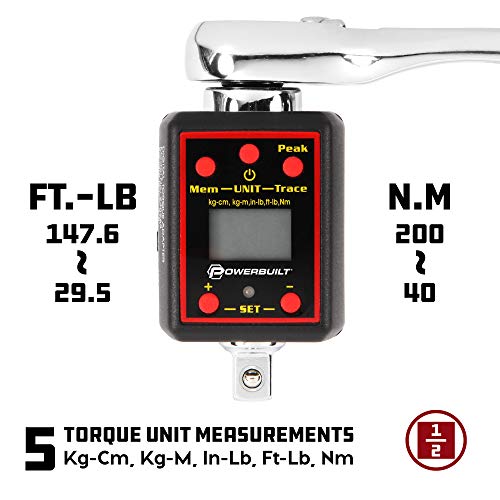


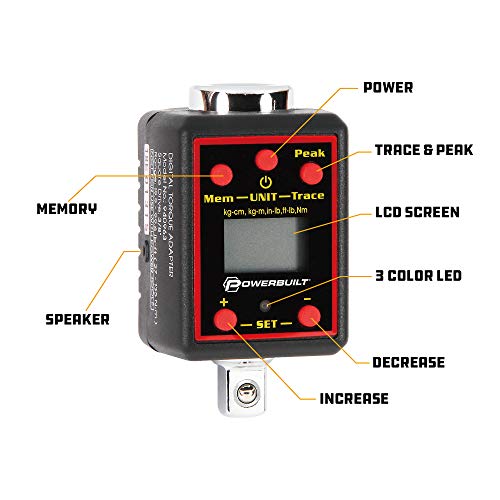

Powerbuilt 940962 1/2" Digital Torque Adapter
Comparing a click wrench against a reading, in a bench vise
- Drive
- 1/2"
- Range
- 30–150 ft-lb (manual)
- Rated accuracy
- ±2% per manual (box says ±1%)
- Steel check block clamps in a vise for comparing wrenches against the adapter
- Peak and trace modes in five units
- Blow-molded case
- Powerbuilt's own manual rates it ±2%, not the ±1% on the product page
- Neither figure says which direction or which part of the scale
The adapter that comes with a way to use it as a checker: a steel block with a square drive that clamps in a bench vise, so you can pull a click wrench against the adapter and compare its reading with your setting. It's a 1/2-inch adapter with peak and trace modes in five units.
Its accuracy claim doesn't hold up on paper. Powerbuilt's product page and the listing say ±1%; Powerbuilt's own manual says ±2%, and neither figure says which direction or which part of the scale it covers. We've printed the manual's figure.
Based on the maker's specifications and manual and the published reviews linked below, not on our own test of this unit.
Setup, everyday use and what others found
Setup & use · per the maker
- The manual gives 30–150 ft-lb (40–200 N·m) for the 1/2-inch adapter; the listing says 29–147. Units: ft-lb, in-lb, kg·cm, kg·m and N·m.
- Peak mode stores the highest torque applied; trace mode shows it live. Audible and LED alerts signal the target. The manual lists a 0.1 display resolution, a 50-reading memory and an 80-second auto shut-off.
- The check block clamps in a bench vise. Set your wrench, program the same value on the adapter, pull until the wrench clicks and read the peak. The manual calls this calibrating a wrench; it is a comparison against the adapter, not a calibration.
- The manual specifies one CR2032 coin cell; the product page says two AAA. Check the compartment before you buy spares.
- Operating temperature is −10 to 60 °C per the manual. Powerbuilt's product page lists a one-year warranty; retailers quote different terms. It comes in a blow-molded case.
What others found
etrailer's staff handled one on camera and, comparing it with the torque wrenches they use, said it is "going to be a little bit off, it's not as accurate", but worth having. They describe a beep as you approach the target and a higher-pitched one at it.
A Garage Journal member who owns three Powerbuilt adapters calls them "extremely accurate", without giving measurements.
Neither report includes a measured figure, and we found no independent test that does.


NEIKO 20743A 3/4" Digital Torque Adapter
Truck, tractor and equipment fasteners above 150 ft-lb
- Drive
- 3/4"
- Range
- 150–750 ft-lb
- Rated accuracy
- ±2% (no direction or range stated)
- Covers 150–750 ft-lb on a 3/4-inch drive
- Same peak and trace modes, alerts and 50-reading memory as NEIKO's smaller adapters
- Runs on two AA batteries
- Nothing below 150 ft-lb
- No manual or warranty term published for this model
The adapter for the big stuff: 150–750 ft-lb on a 3/4-inch drive, for truck, tractor and equipment fasteners that a 1/2-inch tool can't reach. It has the same peak and trace modes, progressive LED alert and 50-reading memory as NEIKO's smaller adapters.
Its documentation is the thinnest here. NEIKO states "±2%" with no direction or scale range, we found no manual for the 3/4-inch model, and NEIKO publishes no warranty term.
Based on the maker's specifications and manual and the published reviews linked below, not on our own test of this unit.
Setup, everyday use and what others found
Setup & use · per the maker
- 150–750 ft-lb (200–1000 N·m) on a 3/4-inch drive, clockwise and counter-clockwise, in ft-lb, N·m or kg·m.
- Peak and trace modes; three progressive LEDs and a buzzer at the target; a 50-reading memory; auto shut-off after 80 seconds.
- Runs on two AA batteries.
- NEIKO states "±2%" with no direction or scale range. We found no manual for this model, and NEIKO publishes no warranty term.
What others found
We found no independent test and no owner reports of the 20743A outside Amazon.
- Aeronautics diploma
- Engineering degree
- BAMEC (DGCA)
- QC-trained
- ~2 yrs tool management
Why you should trust us
SK Kutubuddin spent almost two years in a dedicated tool bay during over two decades of aircraft maintenance, where every torque tool carried a calibration label and its paperwork was read before the tool was trusted. That habit is how this page was built: for each adapter we read the maker's manual against the maker's marketing, and where the two disagreed, we printed the manual's figure.
Every range, accuracy figure, mode and battery below was checked against the manufacturer's product page, its manual where one exists, and the current Amazon listing, per our how-we-test method. We found no independent test with measurements for any adapter here, and we say so on each one. This is a buying guide built on verified specs and inspection experience, not a lab test.
Who this is for
A digital torque adapter suits anyone who already owns good ratchets and wants torque readings without buying a separate wrench for every drive size, and anyone who wants a reference for checking the click wrenches they already have.
If you tighten to the same few values all day, a click wrench is simpler and needs no batteries. If your work is inspected and needs a traceable calibration, an adapter is no substitute for a lab; our calibration guide explains what a proper check involves.
- Home mechanics who want torque readings on the ratchets they already own
- Owners of click wrenches who want to spot drift between lab calibrations
- Engine builders who need torque-plus-angle without buying a new wrench
- Work in tight spaces where a long torque wrench won't swing, if there is room for the adapter's extra height
How we picked
We read each adapter's manual before its marketing, then sorted the field by drive size and range so every common job has a pick.
- 01
Accuracy stated properly
A tolerance means little without a direction and the part of the scale it covers. We gave credit to makers who state both, as Durofix and ACDelco do, and printed each card's figure exactly as the manual gives it, including where NEIKO and Powerbuilt give neither.
- 02
Manual over marketing
Where a maker's product page and its manual disagree, we used the manual. Powerbuilt's page says ±1% and its manual ±2%; ACDelco's selection guide and manual disagree on its 25–250 ft-lb ARM602-4A.
- 03
Coverage by drive and range
We covered 3/8, 1/2 and 3/4-inch drives, from about 6 ft-lb to 750 ft-lb, and noted where each adapter's rating actually starts, which is usually 20% of its scale rather than the bottom of it.
- 04
Modes that do a job
Peak and trace are standard. We looked for what goes beyond them: an angle mode for torque-plus-angle bolts, an early warning before the target, and a way to use the adapter as a wrench checker.
What to know before you buy
How a digital torque adapter reads torque
An adapter is a short, strain-gauged shaft that fits between the ratchet and the socket and measures the torque passing through it. Because it sits in line with the drive, it reads the torque going to the socket whatever you turn it with: a stubby ratchet, a long breaker bar, or your hand anywhere along either. A click wrench is different. It is set for a load applied at a marked point on its handle, which is why effective length matters on a wrench and not on an in-line adapter.
That independence holds only while everything stays in line. A straight socket extension is fine. A universal joint should stay within about 15 degrees of straight, the limit Snap-on gives for its electronic wrenches. A crowfoot or offset adapter below the reader moves the fastener off the drive axis, and the display no longer matches the fastener; our extension calculator works out the corrected target.
Read the accuracy line, not the headline
"±2%" on a box can mean very different things. A full specification gives three things: the tolerance, the direction, and the part of the scale it holds over. Durofix's, for example, is ±2% clockwise and ±3% counter-clockwise of the indicated value, from 20% to 100% of full scale. Below that 20% point the tool is unrated, and the number on the display carries no promise.
Durofix and ACDelco state their adapters that way. NEIKO and Powerbuilt give a single figure with neither direction nor range. And two makers print a tighter figure in their marketing than in their own manuals: Powerbuilt's product page says ±1% where its manual says ±2%, and ACDelco's selection guide and UK site give ±1.5% clockwise for its 25–250 ft-lb ARM602-4A while the manual in the box says ±2%. Where they disagree, we've used the manual.
What an "ISO 6789 certificate" does and doesn't mean
Several listings here promise an ISO 6789 calibration certificate. Durofix's own wording is more careful: its adapters meet ASME B107.14 and ISO 6789 standards and are individually serialized, with a certificate of calibration traceable to NIST. That is a record of how one unit read when it left the factory, and it's worth having as a starting point. It isn't a lab calibration of your adapter today.
ISO 6789 is written for hand torque tools. The US standard written for electronic torque instruments, including the testers used to check torque wrenches, is ASME B107.300, which absorbed the older B107.14 that Durofix cites.
Using an adapter to check a click wrench
Fix a bolt or a check block in a vise, fit the adapter, set your click wrench and pull slowly until it clicks. The adapter tells you what the wrench delivered. Our calibration guide covers the full method, including which settings to test.
Know what the mode is measuring. Professional torque testers offer a first-peak mode that catches the moment a click wrench releases. The adapters here offer peak and trace instead, and peak holds the highest torque reached, including any overshoot after the click if your hand keeps moving. So an adapter tends to read a click wrench slightly high, by an amount that depends on how quickly you stop. Pull slowly and stop at the click.
Then keep the result in proportion. A ±2% adapter checking a ±4% wrench is a 2:1 ratio, where calibration practice has traditionally asked for a reference four times better than the tool it checks. An adapter is good at telling you a wrench has drifted since the last check. It can't tell you a wrench is in specification.
Care and limits
A digital adapter is a measuring instrument that happens to sit in a drive train. Treat it like one.
- Pull slowly and smoothly. A fast or jerky pull overshoots the target before you can react.
- Never use one on an impact wrench. A sensor built for a steady load can't follow short hammer blows, and peak mode records the spikes rather than the torque on the fastener.
- Stay under the maximum. Durofix treats more than 110% of capacity as an over-torque, and ACDelco's display shows "999" above 120%. Either is a reason to have the adapter checked.
- Change the batteries at the first warning or dim display, and take them out for long storage.
- Keep the ratchet square. A cocked handle puts a bending load on the gauge that it isn't there to measure.
Picking a range: keep your values off the bottom
Choose the adapter whose rated range brackets the values you use most, not the one with the biggest number. Most are rated from 20% of their full scale: a 25–250 ft-lb adapter from about 50 ft-lb, a 14.8–147.6 ft-lb adapter from about 30, and a 5.9–59 ft-lb adapter from about 12. Below that point the display still shows a number, but the maker hasn't promised it.
For lug nuts on cars and light trucks, a 1/2-inch adapter with a 150 or 250 ft-lb top covers the usual values. For engine-bay work, a 3/8-inch adapter that tops out near 60 or 100 ft-lb keeps small values off the floor. Below about 12 ft-lb, use an inch-pound wrench or a torque screwdriver.
Frequently asked questions
Are digital torque adapters accurate?
The better ones are rated ±2% clockwise and ±3% counter-clockwise of the reading, from 20% to 100% of their scale, which is tighter than the ±4% typical of a click wrench. Below 20% of the scale they're unrated, and some makers give a single figure with no direction or range at all. We found no independent test that measured any of the adapters here.
Digital torque adapter or torque wrench: which is better?
An adapter turns ratchets you already own into torque tools, reads the same whatever the ratchet's length, and doubles as a wrench checker. A torque wrench adds no height under the ratchet, and a click wrench needs no batteries. If you work to many specs across drive sizes, an adapter is the more flexible choice; if you tighten the same few fasteners all the time, a click wrench is simpler.
Can I use a digital torque adapter with an impact wrench?
No. These adapters are built for a steady hand pull. Their sensors can't follow the short blows of an impact wrench, peak mode records the spikes rather than the torque that reaches the fastener, and the shock can damage the gauge. Run fasteners down with the impact if you like, then finish on a hand ratchet with the adapter.
Do digital torque adapters need to be calibrated?
Yes, on the same kind of schedule as a torque wrench, and straight away after a drop or an over-torque. Durofix says recalibration is a job for a test lab with proper equipment, and that attempting it yourself voids the warranty.
Does ratchet length affect a digital torque adapter?
No. The adapter reads the torque passing through it, so a short ratchet and a long breaker bar give the same reading for the same torque on the socket. A longer handle only means you pull less hard.
Can a digital torque adapter measure angle?
Some can. The Durofix RM604-4A reads angle from 1° to 720° as well as torque. Durofix publishes no angle accuracy for it, and its angle mode has no alarm, so you watch the display.
Can I use a digital torque adapter on a breaker bar?
Yes. It reads the torque passing through it, so the bar's length doesn't change the reading; it only changes how hard you pull. Keep the bar square to the fastener and pull smoothly.
Do digital torque adapters work counter-clockwise?
Most read in both directions. Durofix and ACDelco rate counter-clockwise at ±3% against ±2% clockwise; NEIKO and Powerbuilt don't give a separate figure for either direction.
What batteries do digital torque adapters use?
The Durofix and ACDelco adapters here use two CR2032 coin cells, and NEIKO's use two AA. Powerbuilt's manual specifies one CR2032 while its product page says two AAA, so check the compartment.
Can I put a crowfoot or extension under a digital adapter?
A straight extension in line with the drive is fine. A crowfoot or offset adapter below the reader moves the fastener off the drive axis, so the torque at the fastener no longer matches the display. Our extension calculator works out the corrected target; use the distance from the drive to your hand on the ratchet as the length.
Related reading
- Aeronautics diploma
- Engineering degree
- BAMEC (DGCA)
- QC-trained
- ~2 yrs tool management
SK spent over two decades in aircraft maintenance, working hands-on with aero-engine systems and flight data recorder systems, borescope-inspecting turbine and compressor blades, and spending almost two years in a dedicated tool bay. He holds a diploma in mechanical engineering (aeronautics), an associate degree in science, an engineering degree and a Basic Aircraft Maintenance Engineer's Certificate (BAMEC) from DGCA, and has completed quality-control and aviation fuels & lubricants training. GaugeGrade applies the same inspection, torque and tool-management standards to the tools everyday mechanics, DIYers and trades actually buy.