Beam vs Click vs Digital Torque Wrenches (and the Best Beam Wrenches)
A hand torque wrench tells you when to stop in one of three ways. A beam wrench shows the torque on a scale as you pull; a click wrench breaks with a click at the value you set; a digital wrench measures electronically and alerts you at the target. All three can be accurate enough for most work when they are used properly, so the right one depends on how and where you work. For one type, the humble beam, the case is stronger than most people think.

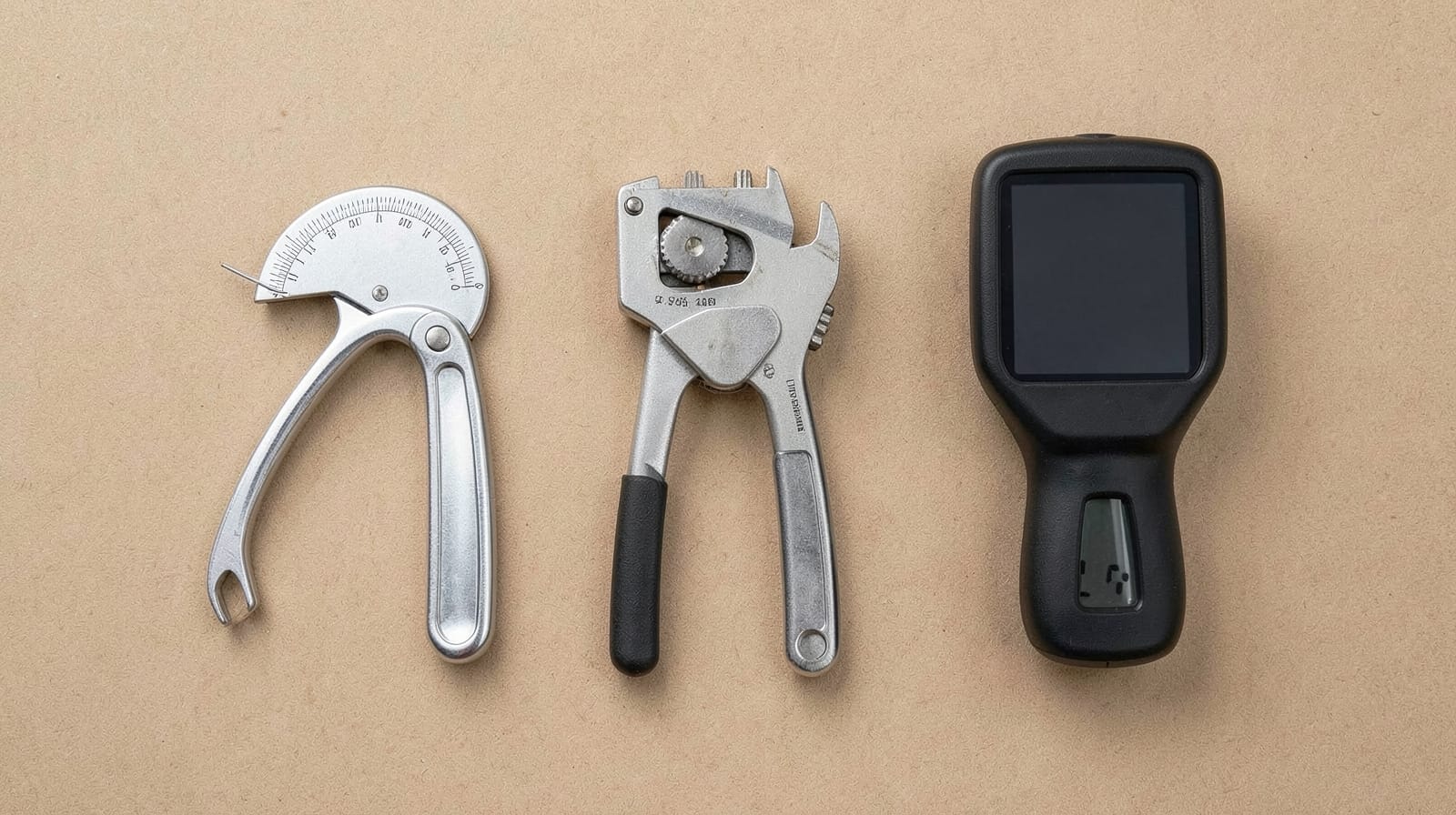
A beam wrench is the simplest design. Its main beam bends as you pull, while a separate pointer, fixed at the head and loaded by nothing, stays straight and points to the torque on a scale near the handle. There is no spring to wear or take a set, and most beam wrenches read in both directions, but you have to watch the scale while you pull.
A click wrench sets the value in advance and releases with a click you can feel and hear. A split-beam wrench is a click wrench that measures with a beam instead of a preloaded coil spring, so it can be stored at any setting. A digital wrench measures with an electronic sensor and adds a live readout, target alerts and, often, an angle mode.
How to choose the right type
Start with where you will be working
If you can see the wrench as you pull, on a bench, a bicycle in a stand or an engine on a stand, a beam or dial wrench works well. If the scale will be hidden, under a car or behind a component, you need a wrench that tells you when to stop: a click or a digital.
Match the range to your fasteners
Every type is most trustworthy in the middle of its range. Many makers rate accuracy only from 20% of full scale upward, and ratings differ more than people expect: beam wrenches here run from ±2% on a dial type to ±4% on most beams, and GEARWRENCH rates its 2956N beam at ±7% clockwise. Choose a range that puts your common values well inside the scale.
Check the direction you need
Left-hand threads and some loosening checks need a wrench rated counter-clockwise. Most beam and dial wrenches read both ways. Click wrenches vary: TEKTON's current micrometer wrenches are rated in both directions, while split-beam wrenches from TEKTON and Capri are rated clockwise only.
Decide whether you need angle
Torque-to-yield bolts, common on cylinder heads and other engine parts, are tightened to a torque and then turned through a specified angle. A digital wrench with an angle mode does both in one tool; with a beam or click wrench you need a separate angle gauge.
Think about care and storage
A coil-spring click wrench should be wound down to its lowest marked setting after use. A split-beam can be left at any setting. A beam needs no adjustment, but check that its pointer rests on zero before each job. A digital wrench needs batteries and, like every type, periodic calibration.
The best beam torque wrenches
Every wrench here states its accuracy, which matters: beam wrenches are often assumed to be accurate by design, but their ratings vary. We have added a pro dial wrench and a split-beam click wrench for comparison.
GaugeGrade is reader-supported. When you buy through links on our site we may earn an affiliate commission at no extra cost to you. We only recommend gear we have researched against verified manufacturer specifications.

ARES 70214 3/8" Beam Torque Wrench
General engine-bay, bench and small-engine work where you can see the scale
- Drive
- 3/8"
- Range
- 0–800 in-lb (0–90 N·m)
- Accuracy
- ±4%
- Reads clockwise and counter-clockwise
- Inch-pound and N·m scales
- 0–800 in-lb covers up to about 67 ft-lb
- You have to watch the scale as you pull
- Scale marked in 25 in-lb steps

Performance Tool W3001C 1/2" Beam Torque Wrench
Lug nuts and chassis bolts on a budget, where you can see the scale
- Drive
- 1/2"
- Range
- 0–150 ft-lb
- Accuracy
- ±4%
- 0–150 ft-lb covers typical car lug-nut values
- Nothing to wind down or reset between jobs
- Torque specification table printed on the package
- Only a 90-day warranty
- Hard to read the scale under a car

Neiko 03727A 1/4" Beam Torque Wrench
Small fasteners on bicycles, trim and small engines
- Drive
- 1/4"
- Range
- 0–80 in-lb (0–9 N·m)
- Accuracy
- ±4%
- Scale reads in 1 in-lb steps
- Works clockwise and counter-clockwise
- Ball-end handle for a steady pull
- Tops out at 80 in-lb, about 6.7 ft-lb
- Small scale: read it square-on

Park Tool TW-2.2 Beam Torque Wrench
Bicycle cranks, bottom brackets and other higher-torque bike parts
- Drive
- 3/8"
- Range
- 0–60 N·m (about 0–44 ft-lb)
- Accuracy
- ±4% (per Park Tool's instructions)
- Fits Park Tool's bicycle sockets, bits and crowfoot wrenches
- Reads right- and left-hand threads
- 450 mm (17.75 in) long for a steady pull
- One-year warranty
- For stems and carbon parts, Park's TW-1.2 (0–14 N·m) reads finer

Precision Instruments D2F150HM 3/8" Dial Torque Wrench
Precise low-range work where you want to read and record the peak
- Drive
- 3/8"
- Range
- 30–150 in-lb
- Accuracy
- ±2% of reading, CW and CCW (20–100%)
- Memory pointer holds the peak reading
- Maker says hand position does not affect the reading
- Made in the USA
- Narrow, low 30–150 in-lb range
- Calibration certificate is an extra-cost option

Capri Tools CP31600-250FL 1/2" Split-Beam Torque Wrench
A click wrench you can leave at your most-used setting
- Drive
- 1/2"
- Range
- 50–250 ft-lb
- Accuracy
- ±4% CW
- Store it at any setting, per Capri
- 72-tooth ratchet with a flex head
- Serialized certificate of conformance
- Rated clockwise only
- 50 ft-lb minimum
How accurate is each type?
Going by makers' published ratings, the types overlap more than their reputations suggest:
- Beam: ±4% is typical (ARES, NEIKO, Performance Tool, Park Tool), but GEARWRENCH rates its 2956N at ±7% clockwise from 20% of scale.
- Dial: the Precision Instruments D2F150HM is rated ±2% of reading, both directions, from 20% of scale.
- Click (micrometer): ±3–4% is typical. TEKTON's current line is ±3% both ways; CDI's 3/8-inch 1002MFRMH is ±4% clockwise and ±6% counter-clockwise from 20% of scale.
- Split-beam: ±4% clockwise for the TEKTON and Capri models we cover.
- Digital: ±2% is common, such as the TEKTON TRQ81122 in both directions and the GEARWRENCH 85077 clockwise.
Why a beam wrench stays accurate, and when it does not
A beam wrench has no spring to weaken and no trip mechanism to wear, which is why makers such as ARES say a deflecting beam will not wear or fatigue. Park Tool's advice is simple: with the wrench at rest, the pointer should sit on zero, and if it does not, the pointer shaft can be bent back without affecting accuracy. Damage to the beam itself is another matter, and does affect accuracy.
That does not make a beam wrench exempt from checks. Precision Instruments advises calibrating every wrench at least every six months, and the ISO 6789 benchmark is every 12 months or 5,000 cycles. A beam wrench that reads zero at rest and checks out against a reference is as trustworthy as any click wrench.
Where each type falls short
Beam: you must see the scale, read it square-on to avoid parallax, and stop smoothly at the value, which is hard in a cramped space. Click: the spring needs winding down after use, the click can be hard to feel at low values, and pulling on after the click over-tightens the fastener. Digital: it depends on batteries and electronics, and it usually costs more. None of them should ever be used to break a tight fastener loose.
Reading a beam wrench correctly
Read the scale square-on, with your eye directly above the pointer rather than off to one side; many beam wrenches have a graduated pointer tip to reduce parallax error. Pull at the handle, smoothly, and stop as the pointer reaches the value, since a jerky pull overshoots. Before each job, check that the pointer rests on zero.
Why beam wrenches suit bicycles and bench work
Bicycle parts and small fasteners are often tightened with the work in a stand or on a bench, where the scale is in plain view, and many values are low enough that a click is hard to feel. A beam wrench reads there without fuss, and because nothing inside it is preloaded, it can sit in a drawer between jobs.
Why you should trust us
Over two decades of aircraft maintenance, SK Kutubuddin used torque tools of every type, and spent almost two years in a dedicated tool bay where they were issued, returned, checked and sent for calibration. The lesson that carries over to a home garage is that no type is accurate by default: a wrench is only as good as its rating, its last check and the way it is used.
This guide explains how each type works and where it falls short, using makers' own published ratings. Every product spec was checked against the manufacturer's data and the live listing, per our how-we-test method. It is a buying guide, not a lab test.
Frequently asked questions
- Is a beam torque wrench more accurate than a click wrench?
- Not by definition. Both are typically rated around ±4%, and some click wrenches are rated ±3%. A beam's advantage is that it has no spring to take a set, so it tends to hold its accuracy with little care.
- What is a split-beam torque wrench?
- A click-type wrench that measures with a beam rather than a preloaded coil spring. You set it with a knob or thumbscrew, it clicks at the value, and because nothing is loaded at rest it can be stored at any setting.
- Digital or click torque wrench: which is better?
- A click wrench is simpler, needs no batteries and is ideal for repeated values such as lug nuts. A digital wrench suits many different specs and torque-plus-angle procedures, and shows you the value as it builds.
- Do beam torque wrenches need calibration?
- They need checking. Confirm the pointer rests on zero before each job, and check the wrench against a reference periodically; Precision Instruments advises every six months, and ISO 6789 uses 12 months or 5,000 cycles as a benchmark.
- Can a beam torque wrench be used on left-hand threads?
- Usually. Most beam wrenches read in both directions, including the ARES, NEIKO and Park Tool beams on this page; check the listing for any other model.
- Why is my beam torque wrench not reading zero?
- The pointer shaft has usually been bent slightly. Park Tool says it can be bent back to zero without affecting accuracy; if the beam itself is bent or damaged, replace the wrench.
- Is a dial torque wrench the same as a beam wrench?
- It is an indicating wrench like a beam: it shows the torque as you pull instead of clicking at a preset value. The Precision Instruments dial on this page uses a torsion bar and a memory pointer that holds the peak reading.
- How do I convert torque between N·m and ft-lb?
- 1 ft-lb is about 1.356 N·m, and 1 N·m is about 8.85 in-lb. Most beam wrenches carry both scales, so you rarely need to convert.
Related reading
- Aeronautics diploma
- Engineering degree
- BAMEC (DGCA)
- QC-trained
- ~2 yrs tool management
SK spent over two decades in aircraft maintenance, working hands-on with aero-engine systems and flight data recorder systems, borescope-inspecting turbine and compressor blades, and spending almost two years in a dedicated tool bay. He holds a diploma in mechanical engineering (aeronautics), an associate degree in science, an engineering degree and a Basic Aircraft Maintenance Engineer's Certificate (BAMEC) from DGCA, and has completed quality-control and aviation fuels & lubricants training. GaugeGrade applies the same inspection, torque and tool-management standards to the tools everyday mechanics, DIYers and trades actually buy.