The Best Open-End Torque Wrenches
An open-end torque wrench tightens the nuts a socket can't reach: the flare nuts on a ductless mini-split and the tube nuts on brake, fuel and hydraulic lines. Get it wrong and a flare leaks now, or cracks later. The right one has heads that fit your nuts, a range that brackets the torque in your manual, a published accuracy figure, and clear rules for when a head changes the setting. These are the best, with every spec checked against the maker's documents and the gaps noted.

- 6 picks compared
- Specs checked against maker data
- No paid placements
GaugeGrade is reader-supported. When you buy through links on our site we may earn an affiliate commission at no extra cost to you. We only recommend gear we have researched against verified manufacturer specifications.
- 1For most mini-split installs, the Yellow Jacket 60650: 10–80 N·m, six open-end heads from 17 to 29 mm, and Yellow Jacket says it stays within 4% whichever head is fitted.
- 2Want one jaw and a readout? CPS's BlackMAX BTLDTW opens from 5 to 35 mm and is rated ±2% both ways. US-made line set with SAE nuts? CPS's TLTWSAE has six SAE heads from 5/8 to 1-5/16 inch.
- 3Check your nuts and your manual first. A 3/4-inch line on metric fittings takes a 36 mm nut that none of these kits fits, and flare torque varies by brand, so use your unit's own values.
- 1Best overallYellow Jacket 60650 Six-Head Precision Torque Wrench Kit
- 2Best digitalCPS BlackMAX BTLDTW Digital Torque Wrench, Adjustable Jaw
- 3Best for SAE flare nutsCPS PRO-SET TLTWSAE SAE Torque Wrench Set (6 heads)
- 4Best premium HVAC kitWera 9530 Torque Wrench Set for Heat Pumps and Air Conditioning
- 5Best for metric line fittingsWera Click-Torque X 2 Torque Wrench for Insert Tools, 10–50 N·m
- 6Best SAE interchangeable-head systemCDI 75MFIMHSS Interchangeable-Head Micrometer Torque Wrench, 5–75 ft-lb
What we recommend
Compare the key specs side by side, then read the full notes on each pick below.
- Range
- 10–80 N·m(7.4–59 ft-lb)
- Heads
- 6 open-end, 17–29 mm
- Accuracy
- Within 4%, any head
- Range
- 8–85 N·m(6–63 ft-lb)
- Heads
- Adjustable jaw, 5–35 mm
- Accuracy
- ±2%, both directions
- Range
- 5–80 ft-lb(60–960 in-lb)
- Heads
- 6 open-end, 5/8–1-5/16 in
- Accuracy
- ±4%,all settings
- Range
- 10–100 N·m(8–73 lbf·ft)
- Heads
- 3 self-setting jaws, 16–32 mm
- Accuracy
- ±4%(ISO 6789-1)
- Range
- 10–50 N·m(8–36 lbf·ft)
- Heads
- 9×12 mm inserts, sold separately
- Accuracy
- ±3%(ISO 6789-1)
- 6
 Best SAE interchangeable-head systemCDI 75MFIMHSS Interchangeable-Head Micrometer Torque Wrench, 5–75 ft-lb
- Range
- 5–75 ft-lb, 0.5 ft-lb steps
- Heads
- CDI J-shank heads, sold separately
- Accuracy
- ±3–4% from 20% of scale(resellers)


Yellow Jacket 60650 Six-Head Precision Torque Wrench Kit
Mini-split flare nuts on 1/4 to 5/8-inch lines with metric fittings
- Range
- 10–80 N·m (7.4–59 ft-lb)
- Heads
- 6 open-end, 17–29 mm
- Accuracy
- Within 4%, any head
- Six open-end heads: 17, 22, 24, 26, 27 and 29 mm
- Yellow Jacket says it's within 4% regardless of the head fitted
- N·m and ft-lb scales on the barrel, with a lock ring
- Blow-molded case; one-year warranty
- No 36 mm head for a 3/4-inch metric flare nut
- The 17 and 22 mm heads don't properly fit SAE nuts; the eight-head 60652 adds 16 and 21 mm
The kit to buy for most mini-split installs. Six open-end heads cover the 17, 22, 26 and 29 mm nuts in Mitsubishi's and Fujitsu's manuals plus the 24 and 27 mm sizes some lines take, the 10–80 N·m range brackets Mitsubishi's and Fujitsu's values for 1/4 to 5/8-inch lines, and Yellow Jacket says it stays within 4% whichever head is fitted, so there's no correction to work out.
Know its limits. There's no 36 mm head for a 3/4-inch metric nut, and Yellow Jacket's own bulletin says the 17 and 22 mm heads are not a proper fit on the SAE nuts of US-made line sets. Its eight-head 60652 kit adds 16 and 21 mm heads, stamped metric, that Yellow Jacket says fit 5/8 and 13/16-inch SAE nuts.
Based on the maker's specifications and manual and the published reviews linked below, not on our own test of this unit.
Setup, everyday use and what others found
Setup & use · per the maker
- A micrometer-type click wrench, 10–80 N·m (7.4–59 ft-lb), with both scales marked on the barrel and a lock ring to hold the setting.
- Six interchangeable open-end heads: 17, 22, 24, 26, 27 and 29 mm. Replacement heads are sold singly; Yellow Jacket doesn't publish the head interface.
- Yellow Jacket's accuracy statement: "Accurate within 4% when measured per BSEN 26789 & ISO 6789 & ASME B107.14M & DIN3122 regardless of the open end adapter head used."
- 16 in (406 mm) long with a head fitted, in a blow-molded case. Yellow Jacket says to set the wrench to its lowest setting when it's not in use.
- Warranty: Yellow Jacket's standard one year against defects in material and workmanship.
What others found
We found no independent test of this kit, and no dated owner review we could attribute to it.

CPS BlackMAX BTLDTW Digital Torque Wrench, Adjustable Jaw
One jaw for every flare nut up to 35 mm, with a readout and presets
- Range
- 8–85 N·m (6–63 ft-lb)
- Heads
- Adjustable jaw, 5–35 mm
- Accuracy
- ±2%, both directions
- ±2% clockwise and counter-clockwise, from 10% to 100% of range
- Adjustable jaw from 5 to 35 mm fits metric and SAE nuts
- Five factory and five user presets; peak and track modes
- Tone, LED and vibration alerts; batteries and case included
- Jaw stops at 35 mm, just short of a 36 mm nut
- Runs on two AAA batteries
The digital pick, and the one-head answer. Its adjustable jaw opens from 5 to 35 mm, so the same wrench fits the metric and SAE flare nuts on 1/4 to 5/8-inch lines, and CPS rates it ±2% clockwise and counter-clockwise from 10% to 100% of its 8–85 N·m range. Presets, a live readout and tone, light and vibration alerts make it hard to overshoot.
It stops just short of a 36 mm nut, it runs on two AAA batteries, and one forum member's endorsement is the only owner report we found.
Based on the maker's specifications and manual and the published reviews linked below, not on our own test of this unit.
Setup, everyday use and what others found
Setup & use · per the maker
- Range 8–85 N·m (6–63 lbf·ft, 71–752 lbf·in), read to 0.1 N·m.
- Accuracy ±2% of reading, clockwise and counter-clockwise, from 10% to 100% of full scale, per CPS's manual.
- Adjustable jaw, 5–35 mm. CPS's manual gives 3/16 to 1-3/8 in; its product page says 1-7/16 in.
- Five factory and five user-defined presets, peak and track modes, and audible, LED and vibration alerts as you approach and reach the target.
- 15.25 in (0.387 m) long, and 2.79 lb with its case, per CPS. It runs on two AAA batteries (supplied); CPS gives about 120 hours with the display on.
- Storage case included. CPS guarantees it against manufacturing and material defects for one year.
What others found
In a Garage Journal thread about torque wrenches for mini-splits in September 2020, one member wrote: "I use a CPS black max torque wrench, the head is the same as a crescent wrench so it fits all sizes."
Garage Journal: torque wrenches for mini splits, September 2020
That's the only owner report we found, and we found no independent test.


CPS PRO-SET TLTWSAE SAE Torque Wrench Set (6 heads)
US-made line sets with SAE flare nuts
- Range
- 5–80 ft-lb (60–960 in-lb)
- Heads
- 6 open-end, 5/8–1-5/16 in
- Accuracy
- ±4%, all settings
- SAE heads: 5/8, 11/16, 13/16, 15/16, 1-1/16 and 1-5/16 in
- Foot-pound and inch-pound scales
- CPS states ±4% at all settings
- Handle, heads and storage case in one kit
- Wrong kit for metric nuts; CPS sells the metric TLTWSM separately
- CPS says to use it only for tightening, never for loosening
The kit for US-made line sets. Yellow Jacket says it has heard that many contractors buy line sets with SAE flare nuts, 5/8 inch on 1/4-inch line and 13/16 inch on 3/8, and that metric 17 and 22 mm heads are not a proper fit on them. This CPS set has six SAE heads, from 5/8 to 1-5/16 inch, on a 5–80 ft-lb click wrench that CPS rates ±4% at all settings.
It's the wrong kit for metric nuts, which CPS covers with its TLTWSM, and CPS says to use it only for tightening. We found no owner reports for this SAE set.
Based on the maker's specifications and manual and the published reviews linked below, not on our own test of this unit.
Setup, everyday use and what others found
Setup & use · per the maker
- A click-type wrench with a foot-pound scale (5–80, a mark every 1/2 ft-lb) and an inch-pound scale (60–960, a mark every 6 in-lb).
- Six open-end heads: 5/8, 11/16, 13/16, 15/16, 1-1/16 and 1-5/16 in. The Amazon listing gives the same six sizes.
- Accuracy "+/- 4% (All Settings)", per CPS's manual.
- Handle, heads and a storage case in one kit.
- CPS's manual: "To retain wrench accuracy, DO NOT LOOSEN nuts, bolts, etc. USE ONLY FOR TIGHTENING." The manual gives no warranty terms.
What others found
We found no independent test and no owner reviews of this SAE kit.


Wera 9530 Torque Wrench Set for Heat Pumps and Air Conditioning
Installers who meet both metric and SAE nuts
- Range
- 10–100 N·m (8–73 lbf·ft)
- Heads
- 3 self-setting jaws, 16–32 mm
- Accuracy
- ±4% (ISO 6789-1)
- Click-Torque X 7 on a 14×18 mm holder, clicks in both directions
- Three Joker self-setting jaws cover 16–32 mm, which Wera lists as 5/8 to 1-1/4 in
- QR codes open Wera's web tool, which gives the corrected setting
- Rated ±4% to DIN EN ISO 6789-1:2017
- The long Joker jaws mean every setting needs Wera's correction
- No 36 mm jaw in the set
The premium kit, and the one to buy if you meet both metric and SAE nuts. Three self-setting Joker jaws cover 16 to 32 mm, which Wera lists as 5/8 to 1-1/4 inch, on a Click-Torque X 7 rated ±4% from 10 to 100 N·m that clicks in both directions.
The catch is the correction. The Jokers are far longer than the wrench's 25.5 mm reference, so every setting has to be corrected; Wera's QR codes open a web page that does it. By our arithmetic from Wera's figures, skipping it puts about 6% too much torque on a 17 mm nut and about 12% too much on a 27 mm nut. There's no 36 mm jaw in the set.
Based on the maker's specifications and manual and the published reviews linked below, not on our own test of this unit.
Setup, everyday use and what others found
Setup & use · per the maker
- Click-Torque X 7: 14×18 mm holder, a 10–100 N·m main scale in 5 N·m steps with an 8–73 lbf·ft subscale, ±4% as per DIN EN ISO 6789-1:2017, clockwise and anticlockwise, with an audible and tactile click.
- Three 7880 Joker self-setting open-end jaws: L 16–19 mm (5/8–3/4 in), XL 19–24 mm (3/4–15/16 in) and XXL 24–32 mm (15/16–1-1/4 in).
- Wera publishes each Joker's gauge length S by jaw size, from 44.4 to 70.4 mm, against the X 7's reference Sk of 25.5 mm and lk of 343 mm.
- Scan the laser-engraved QR codes on the wrench and the jaw: "A website opens automatically which recognizes the scanned tools (no app needed!). Then enter the required torque value; the corrected value is determined automatically."
- Or work it yourself with Wera's formula: setting = target × lk ÷ (lk + (S − Sk)).
- Wera's Click-Torque X manual calls for a calibration check after 5,000 load cycles or about a year after first use, then annually.
What others found
We found no independent review of this kit.

Wera Click-Torque X 2 Torque Wrench for Insert Tools, 10–50 N·m
Metric brake, fuel and small hydraulic line nuts, with flare-nut inserts
- Range
- 10–50 N·m (8–36 lbf·ft)
- Heads
- 9×12 mm inserts, sold separately
- Accuracy
- ±3% (ISO 6789-1)
- Rated ±3%, clockwise and counter-clockwise
- Wera's 7775 open-ring (flare-nut) inserts come in nine metric sizes from 10 to 22 mm
- Wera's 7775 and 7770 inserts sit at the reference length, so no correction
- Ratchet inserts turn it into a 1/4 or 3/8-inch drive wrench
- Body only, and Wera's inserts come in metric sizes only
- Stops at 50 N·m, too low for 1/2 and 5/8-inch flare nuts
The wrench to build a metric line-fitting kit around. At 10–50 N·m it brackets the 16 and 18 N·m Tesla gives for brake-pipe nuts and the 1/4 and 3/8-inch flare values in most mini-split manuals, and Wera rates it ±3% in both directions. Its 9×12 mm holder takes Wera's 7775 open-ring inserts, a flare-nut profile in nine metric sizes from 10 to 22 mm, and those and the 7770 open-ends sit at the 17.5 mm reference length, so there's nothing to correct.
You pay again for every insert, and the inserts come in metric sizes only, so SAE tube nuts need another system. It stops at 50 N·m, too low for 1/2 and 5/8-inch flare nuts, and Wera's 9×12 inserts stop at 22 mm anyway. For lower torques the X 1 runs 2.5–25 N·m, and for higher ones the X 3 runs 20–100 N·m, on the same inserts.
Based on the maker's specifications and manual and the published reviews linked below, not on our own test of this unit.
Setup, everyday use and what others found
Setup & use · per the maker
- Click-Torque X 2: 9×12 mm holder, 10–50 N·m with an 8–36 lbf·ft subscale.
- ±3% as per DIN EN ISO 6789-1:2017-07, clockwise and counter-clockwise, with an audible and tactile release.
- Inserts sold separately: 7775 open-ring in 10–14, 17–19 and 22 mm; 7770 open-end from 7 to 19 mm; and 7772 reversible ratchet inserts in 1/4 and 3/8-inch drive.
- Wera's reference insert dimension for 9×12 is Sk = 17.5 mm, with lk = 285 mm on the X 2. Inserts at 17.5 mm need no correction; for any other, Wera's manual gives setting = target × lk ÷ (lk + (S − Sk)).
- Wera's manual: hold the wrench in the middle of the handle, never extend it with a pipe, and have calibration checked after 5,000 load cycles or about a year, then annually.
What others found
In a 2022 Garage Journal thread on Wera's Click-Torque wrenches, one member wrote: "5 years in daily used still calibrates perfectly." Another recalled that "in some test (project farm?) the wera came outside the 3% maximum torque difference."
Garage Journal: thoughts on current Wera torque wrenches, November 2022
Neither comment names the X 2, and we found no independent test of it.
CDI 75MFIMHSS Interchangeable-Head Micrometer Torque Wrench, 5–75 ft-lb
SAE tube and hose fittings from about 15 to 60 ft-lb
- Range
- 5–75 ft-lb, 0.5 ft-lb steps
- Heads
- CDI J-shank heads, sold separately
- Accuracy
- ±3–4% from 20% of scale (resellers)
- J heads in open-end, 6- and 12-point flare-nut and ratchet styles
- CDI's catalogue gives its J-series heads a 2.50 in pin-to-fastener distance
- Micrometer setting with a pull-down lock ring
- Zoro and Toolsource list a calibration certificate
- Body only; CDI's J open-end heads are rated to 60 ft-lb at most
- Amazon's listing says Y shank, but CDI's catalogue says J, so buy J heads
The interchangeable-head wrench for SAE tube and hose fittings. CDI's J-shank heads come in open-end, 6- and 12-point flare-nut and ratchet styles, and CDI's catalogue gives its J-series heads a 2.50-inch distance from the retaining pin to the fastener center, the same as Snap-on's J heads, which Snap-on says need no adjustment calculations. The micrometer body sets from 5 to 75 ft-lb in half-pound steps.
Read the fine print. Amazon's listing says it takes Y-shank heads, but CDI's catalogue, Zoro and the Williams-branded twin all say J, so buy J heads. We couldn't read CDI's own accuracy figure; resellers give ±3% or ±4% from 20% of full scale, which starts at 15 ft-lb, so small aluminum B-nuts need an inch-pound wrench instead.
Based on the maker's specifications and manual and the published reviews linked below, not on our own test of this unit.
Setup, everyday use and what others found
Setup & use · per the maker
- Micrometer-adjustable click wrench, 5–75 ft-lb in 0.5 ft-lb increments, with a pull-down lock ring and an audible click-and-feel signal.
- J shank (0.425 in), per CDI's catalogue, Zoro and the Williams twin. Amazon's bullet "Uses standard Y shank head" contradicts CDI's catalogue.
- Heads sold separately: SAE open-end from 1/4 to 1-5/8 in and metric from 6 to 27 mm, 6- and 12-point flare-nut heads, and ratchet heads. CDI rates J open-end heads at 60 ft-lb at most, and less in small sizes.
- Accuracy as resellers publish it: ±4% from 20% to 100% of full scale (MRM; Zoro adds ±6% counter-clockwise), or ±3% (Toolsource, clockwise, and Williams for its twin).
- Zoro and Toolsource list a calibration certificate; Toolsource says it's serialized and NIST-traceable. CDI's current warranty terms couldn't be read; its 2008 catalogue gave 12 months plus a warranty on initial, out-of-box calibration.
- For its pre-set wrenches, CDI recommends calibrating with the head you'll actually use, because some interchangeable heads vary in length.
What others found
In a 2020 Garage Journal thread about fitting a Snap-on ratchet head to a CDI wrench, one member warned: "The added length could make it impossible to have it properly calibrated."
Garage Journal: CDI torque wrench with Snap-on ratchet head, September 2020
We found no independent test of this wrench.
- Aeronautics diploma
- Engineering degree
- BAMEC (DGCA)
- QC-trained
- ~2 yrs tool management
Why you should trust us
On aircraft, fuel, oil and hydraulic tube fittings are torqued to published values in places a socket can't reach, and that's where open-end, crowfoot and flare-nut heads earn their keep. Over two decades of aero-engine maintenance, including almost two years in a dedicated tool bay where every torque tool carried a calibration label, SK Kutubuddin applied crowfoot corrections to fitting torques as routine work. That's the standard behind this page: a head that fits the nut, a range that brackets the value, and a setting corrected when the head changes.
Every range, head size and accuracy figure below was checked against the maker's product page, manual or catalogue where we could read one, and against the current Amazon listing, per our how-we-test method. Where a maker's documents disagree, or a listing disagrees with the maker, we say so. We found no independent test with measurements for any wrench here. This is a buying guide built on verified specs, installation manuals, FAA guidance and maintenance experience, not a lab test.
Who this is for
This page is for HVAC installers and DIYers fitting ductless mini-splits, mechanics tightening brake, fuel and hydraulic line nuts, and aircraft maintainers working to fitting torques: anyone who needs a torque wrench that goes on from the side.
If a socket fits, you don't need one of these; a regular 3/8-inch torque wrench does the job. If you already own a torque wrench, a crowfoot and our extension calculator may be all you need.
- Tightening mini-split flare nuts to the installation manual's torque
- US-made line sets with SAE flare nuts
- Brake, fuel and hydraulic tube nuts where a socket won't fit
- Building an interchangeable-head kit around one wrench body
How we picked
We started from the nuts these wrenches meet and the values their manuals give, then checked each candidate against its maker's own documents.
- 01
Heads that fit the nut
We gave weight to kits with the metric sizes mini-split manuals list, to SAE heads for US-made line sets, and to flare-nut heads, which grip more flats than an open end.
- 02
A range that brackets the value
Mini-split flare values run from about 14 N·m for a 1/4-inch line to 78 N·m for 5/8 in Mitsubishi's manual. We noted where each wrench stops, and where its stated accuracy starts.
- 03
A published accuracy figure
We printed each maker's figure and the part of the scale it covers, and said so where sources disagree or, as for CDI's 75MFIMHSS, only resellers publish one.
- 04
Clear rules when the head changes
A head that changes the lever arm changes the torque. We favored makers who say whether their heads need a correction, and how to make it.
What to know before you buy
Open-end, flare-nut or adjustable jaw
An open-end head slips over a tube where a socket can't, which is why mini-split flare nuts and brake, fuel and hydraulic line nuts get one. The price is grip. Unior's Jack Arnold puts it simply: "An open-end wrench pushes on two flats of a nut and lets the corners take the strain, while a flare nut wrench surrounds five of the six flats, so a soft fitting keeps its shape under real torque." BrakeQuip adds that an open end's two-point contact can round the corners of the hex before a tight nut breaks free.
So there are three ways to put torque on a nut from the side. Kits with fixed open-end heads, like Yellow Jacket's and CPS's, carry one head per nut size. A digital wrench with an adjustable jaw, like CPS's BlackMAX, fits every nut in its range with one head. And interchangeable-head systems take open-end, flare-nut (open-ring) and ratchet heads on one wrench body. Many use rectangular 9×12 mm or 14×18 mm holders, as Wera, Stahlwille, GEARWRENCH and Capri do; CDI and Snap-on use round J, Y, X and Z shanks. A head fits only a wrench with the same holder.
Heads carry their own torque limits too. CDI rates its J-shank open-end heads at 60 ft-lb at most, and less in small sizes, below the 75 ft-lb top of its 75MFIMHSS wrench, and Snap-on prints a maximum recommended working torque for each open-end head size. Check the head's rating as well as the wrench's.
When a head changes the torque
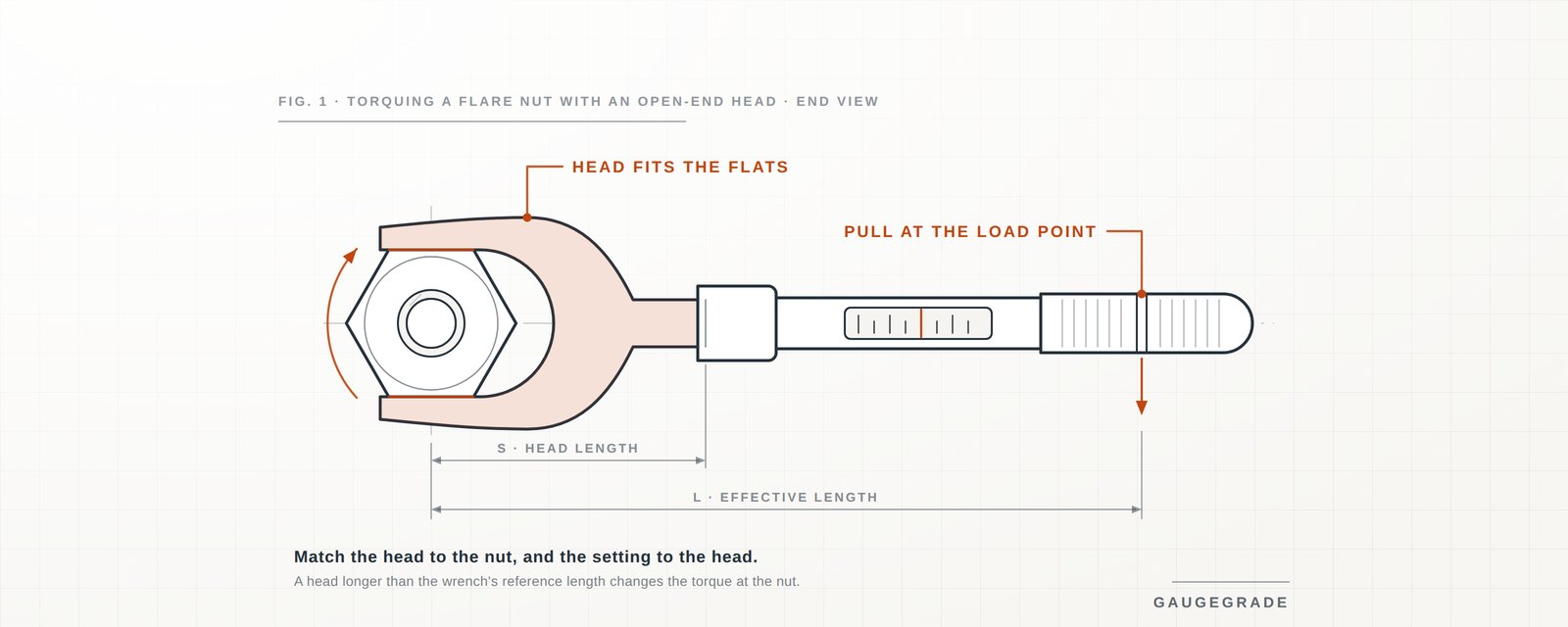
A torque wrench is calibrated with a head of a particular length. Change the distance from the wrench to the nut and the torque at the nut changes, even though the click comes at the same setting. The FAA's AC 43.13-1B puts it plainly: if special adapters change the effective length of the torque wrench, "the final torque indication or wrench setting must be adjusted accordingly."
How much depends on the system. Wera and Stahlwille build their 9×12 mm wrenches around a 17.5 mm reference insert, and an insert at that length needs no correction; Wera lists its 7775 open-ring and 7770 open-end inserts at exactly 17.5 mm. Longer inserts need Wera's formula: setting = target × lk ÷ (lk + (S − Sk)), where lk is the distance from the hand position to the measuring point and S − Sk is how much longer the insert is than the reference. Wera's worked example sets an X 4 to 118.1 N·m for a 120 N·m target with a 32.5 mm insert. CDI's catalogue gives its J-series heads a 2.50-inch distance from the retaining pin to the fastener center, the same as Snap-on's J heads, and Snap-on says its own heads, sized that way, need no adjustment calculations. CDI's pre-set wrench manual still recommends calibrating with the head you'll use, because some heads vary in length.
Kits either settle it for you or tell you how. Yellow Jacket says its 60650 is accurate within 4% "regardless of the open end adapter head used." Its digital 60648 goes the other way, with a multiplier for each head in the manual: 0.775 for the ratchet head and 1.05 for the large 8–41 mm jaw. Wera's 9530 kit uses long self-setting Joker jaws, so every value needs correcting; scan the QR codes on the wrench and the jaw, and Wera's website works out the setting. By our arithmetic from Wera's figures, skipping it puts about 12% too much torque on a 27 mm nut.
A crowfoot on an ordinary torque wrench works the same way, and our extension and crowfoot calculator does the arithmetic. For anything unusual, Stahlwille's warning applies: "There is no formula for laterally offset special tools – the correction factor in these cases will have to be determined empirically e.g. by means of a reference measurement."
Mini-split flare nuts: sizes and torque values
Most mini-split makers use metric flare nuts. Mitsubishi's and Fujitsu's manuals give 17 mm on a 1/4-inch line, 22 mm on 3/8, 26 mm on 1/2 and 29 mm on 5/8, and Fujitsu's and Mitsubishi's City Multi manuals give 36 mm on a 3/4-inch line. Yellow Jacket notes that 1/2 and 5/8-inch lines can also take 24 and 27 mm nuts, and its kit carries both. US-made line sets are different. Yellow Jacket says it has heard that many contractors buy them, with 5/8-inch and 13/16-inch SAE nuts on 1/4 and 3/8-inch lines, and that 17 and 22 mm heads are "not a proper fit" on those. Measure your nuts before you choose the wrench.
Torque values vary by brand. For a 3/8-inch line, Mitsubishi gives 34.3–41.2 N·m, Daikin 32.7–39.9, Fujitsu 32–42 and LG 33.3–41.2, but New York's Clean Heat program lists Carrier at 15–18 ft-lb, about 20–24 N·m, on its R-410A chart. For a 1/4-inch line, LG gives 17.6–24.5 N·m against Mitsubishi's 13.7–17.7. That chart itself says it "should only be used as a reference" and to check the manual for the unit being installed. Set the wrench from your unit's installation manual, not a generic sticker.
Then check the wrench's range against every size you'll tighten. Mitsubishi's 5/8-inch value reaches 78.4 N·m and LG's 80.4 N·m, at or just past the top of an 80 N·m kit. A 3/4-inch line goes further: Fujitsu gives 90–110 N·m and Mitsubishi's City Multi manual 100–120 N·m on a 36 mm nut, and none of the mini-split kits here has both the range and a 36 mm head for that.
Tightening a flare nut
The installation manuals agree on more than they disagree. Before and during the pull:
- Start the nut by hand. Daikin says to run flare nuts 3 or 4 turns by hand, then tighten them fully with a spanner and a torque wrench.
- Use a backup wrench. Mitsubishi, Fujitsu and Daikin all call for a second wrench on the fitting while the torque wrench turns the nut.
- Oil only where your manual says. Mitsubishi oils the flared ends but not the threads; Daikin only the inner surface of the flare; Fujitsu the matching surfaces of flare and union. If there's lubricant on the threads, HVAC School's advice is to stay on the low side of the torque rating.
- Pull at the grip and stop at the click. Wera and Stahlwille both say to hold the handle in the middle, Wera says to avoid any further tightening once the click has triggered, and LG says to tighten in the direction of the arrow on the wrench.
- Don't chase a leak with torque. Mitsubishi warns that an over-tightened flare nut may eventually break and leak, Fujitsu that one not tightened with a torque wrench as specified could break after a prolonged period, and HVAC School says a flare that still leaks when properly torqued was made incorrectly.
Aircraft B-nuts, hydraulic and brake lines
Aircraft tube fittings are torqued to published values too, and they run low. The FAA's AC 43.13-1B lists wrench torque for AN-818 flare nuts in its Table 9-2: 50–65 in-lb for a -4 (1/4-inch) nut on aluminum-alloy tubing and 135–150 in-lb on steel, rising to 110–130 and 270–300 in-lb for a -6. For hydraulic lines, it says to use hydraulic fluid as a lubricant and then tighten, and warns that over-tightening will damage the tube or fitting while under-tightening may cause leakage. Values that low sit at the bottom of a foot-pound wrench's scale or below it, so small B-nuts call for an inch-pound torque wrench with a flare-nut crowfoot or head.
For its 37° flare hydraulic fittings, Parker recommends a different method wherever possible: flats from wrench resistance, turning the nut a set number of flats once it's snug, because plating, lubrication and surface finish change the torque a joint needs. Parker says its torque method "should not be used for lubricated or oily parts". For brake lines, carmakers publish both the value and the tool: Tesla's Model Y manual, for example, gives 16 and 18 N·m for brake-pipe nuts and specifies a 12 mm 6-point flare-nut wrench for several of them.
Calibration and care
Wera says to have its Click-Torque wrenches checked after 5,000 load cycles or about a year after first use, then annually, and more often under heavy use. Stahlwille says approximately 5,000 uses or 12 months, whichever is shorter. For aircraft work, the FAA says to calibrate at least once a year, or immediately after a wrench has been abused or dropped. Our calibration guide covers how a wrench is checked.
Storage advice differs, so follow your wrench's maker. Yellow Jacket says to set the 60650 to its lowest setting when it's not in use, and CDI says the same for its pre-set wrenches, adding never to force the handle below it; Norbar Australia says you don't need to wind a wrench back to zero after every use. Loosening differs too: CPS tells TLTWSAE owners to use it only for tightening and CDI says never to use a torque wrench to break fasteners loose, while Wera sells its Click-Torque X insert-tool wrenches for tightening and loosening.
Where the guidance comes from
The installation and fitting guidance on this page comes from these documents. Product sources are listed under each pick.
- Installation manuals: Mitsubishi Electric MSZ-FS (JG79J820H01) and City Multi PCFY (BG79U668H01); Daikin R410A split series (RN002-U); Fujitsu compact cassette (9379124133); LG wall-mounted (MFL67647124).
- New York Clean Heat Connect, flare fitting tightening torque chart for R-410A.
- Yellow Jacket Product Update Bulletin 14, SAE line set torque wrench heads (2013).
- HVAC School: Jeremy Smith, Why You Need a Torque Wrench (or Two…) (2017), and Bryan Orr's flare tips (2026).
- FAA AC 43.13-1B, paragraphs 7-40 and 9-30 and Table 9-2.
- Parker Hannifin Catalog 4300, assembly and installation of 37° flare fittings.
- Tesla Model Y service manual, brake torque specifications.
- Wera Click-Torque X manual and Torque Advisor; Stahlwille MANOSKOP 721/730 operating instructions, its article on extension and point of application of force (2022) and its torque tools catalogue; CDI Torque Products catalogue and pre-set wrench manual; Snap-on Industrial catalogue; Yellow Jacket 60648/60624 digital torque wrench manual.
- Unior USA (2026) and BrakeQuip (2026) on flare-nut wrenches.
- Norbar and Norbar Australia (2024) on calibration and storage.
Frequently asked questions
What is the best open-end torque wrench?
For mini-split flare nuts, the Yellow Jacket 60650: 10–80 N·m with six open-end heads from 17 to 29 mm, and Yellow Jacket says it's within 4% with any of them. For one adjustable jaw and a readout, CPS's BlackMAX BTLDTW; for metric brake and fuel line nuts, a 9×12 mm system such as Wera's Click-Torque X 2 with open-ring inserts.
What size are mini-split flare nuts?
On metric fittings, Mitsubishi's and Fujitsu's manuals give 17 mm for a 1/4-inch line, 22 mm for 3/8, 26 mm for 1/2 and 29 mm for 5/8, and 36 mm for 3/4; some 1/2 and 5/8-inch nuts are 24 and 27 mm. US-made line sets use SAE nuts, 5/8 inch on 1/4-inch line and 13/16 inch on 3/8, per Yellow Jacket.
What torque should I use for a 3/8-inch flare nut?
The value in your unit's installation manual. For a 3/8-inch line, Mitsubishi gives 34.3–41.2 N·m, Daikin 32.7–39.9 and LG 33.3–41.2, but New York's Clean Heat chart lists Carrier at 15–18 ft-lb, about 20–24 N·m, so one brand's value can be wrong for another.
Do I need to change the setting when I change torque wrench heads?
Only if the head's length differs from the one the wrench is calibrated for. Wera's and Stahlwille's 9×12 mm inserts at the 17.5 mm reference length need no correction, and Yellow Jacket says its 60650 is within 4% with any of its heads. Longer heads, like Wera's Joker jaws, need the maker's correction formula or calculator.
Can I use a crowfoot with a regular torque wrench instead?
Yes. HVAC School's Jeremy Smith calls crowfoot wrenches an easy way to torque flare fittings with a regular torque wrench. Keep the crowfoot at 90° to the handle and the setting doesn't change; pointed along the handle, it changes the lever arm and the setting has to be corrected.
How often should an open-end torque wrench be calibrated?
Wera says after 5,000 load cycles or about a year after first use, then annually; Stahlwille says about 5,000 uses or 12 months, whichever is shorter. For aircraft work, the FAA says at least once a year, or straight away after the wrench has been dropped or abused.
Should I oil a flare before tightening it?
Follow your unit's manual, because the makers disagree. Mitsubishi oils the flared ends but not the threads, Daikin only the inner surface of the flare, and Fujitsu the matching surfaces of flare and union. If there's oil on the threads, HVAC School advises staying on the low side of the torque range.
Can I use an open-end torque wrench to loosen nuts?
Check your wrench's manual. CPS tells TLTWSAE owners to use it only for tightening and CDI says never to use a torque wrench to break fasteners loose, while Wera sells its Click-Torque X insert-tool wrenches for tightening and loosening. For a seized nut, use a plain wrench.
Related reading
- Aeronautics diploma
- Engineering degree
- BAMEC (DGCA)
- QC-trained
- ~2 yrs tool management
SK spent over two decades in aircraft maintenance, working hands-on with aero-engine systems and flight data recorder systems, borescope-inspecting turbine and compressor blades, and spending almost two years in a dedicated tool bay. He holds a diploma in mechanical engineering (aeronautics), an associate degree in science, an engineering degree and a Basic Aircraft Maintenance Engineer's Certificate (BAMEC) from DGCA, and has completed quality-control and aviation fuels & lubricants training. GaugeGrade applies the same inspection, torque and tool-management standards to the tools everyday mechanics, DIYers and trades actually buy.