The Best HVAC Duct Inspection Cameras
The EPA calls a thorough visual inspection the best way to check that a heating and cooling system is clean, and most of a duct system is out of sight. A duct camera lets you check a cleaner's claims before and after the job, find the crushed or disconnected run that's wasting air, and look down a dryer vent or chimney flue without taking anything apart. The right one has a long cable stiff enough to push, a view of the duct walls and light you can turn down. These are the best, with every spec checked against the maker's documents.

- 5 picks compared
- Specs checked against maker data
- No paid placements
GaugeGrade is reader-supported. When you buy through links on our site we may earn an affiliate commission at no extra cost to you. We only recommend gear we have researched against verified manufacturer specifications.
- 1For most homes, the VEVOR SC16: 32.8 ft of cable VEVOR calls ultra-rigid, a front camera plus two side cameras to read the duct walls, and its own 5-inch screen.
- 2Longer runs? VEVOR's 49.2 ft triple-lens model. Looking around the first bend from a register? Teslong's TD450S steers its tip up to 210°.
- 3For dryer vents and chimney flues, a push camera: VEVOR's 98 ft sewer camera is listed for straight pipe from 1.18 to 7.87 in. It's no substitute for a chimney sweep's video inspection.
- 1Best overallVEVOR SC16 Triple-Lens Endoscope (32.8 ft rigid cable)
- 2Best long reachVEVOR Triple-Lens Endoscope, 49.2 ft Semi-Rigid Cable (model 5003)
- 3Easiest to useTeslong NTS300 Dual-Lens Inspection Camera (8 mm, 16.5 ft)
- 4Best for looking around bendsTeslong TD450S Articulating Borescope (8.5 mm, single lens)
- 5Best for dryer vents and chimneysVEVOR 98 ft Sewer Camera (7" screen)
What we recommend
Compare the key specs side by side, then read the full notes on each pick below.
- Reach
- 32.8 ft, ultra-rigid
- Camera
- 8 mm, front + 2 side
- Screen
- 5"(854×480)
- Reach
- 49.2ft, semi-rigid
- Camera
- 8 mm lens, front + 2 side
- Screen
- 5"IPS
- Reach
- 16.5ft
- Camera
- 8 mm, front + side
- Screen
- 5"IPS
- Reach
- 5.08ft
- Camera
- 8.5 mm, steers up to 210°
- Screen
- 4.5" IPS(854×480)
- Reach
- 98ft push cable
- Camera
- 25 mm head, 130° view
- Screen
- 7"(480p)


VEVOR SC16 Triple-Lens Endoscope (32.8 ft rigid cable)
Trunk lines and branch runs in most homes
- Reach
- 32.8 ft, ultra-rigid
- Camera
- 8 mm, front + 2 side
- Screen
- 5" (854×480)
- 32.8 ft cable VEVOR calls ultra-rigid, to push down long runs
- Front and two side cameras to read the duct walls
- 8 + 2 LEDs in three brightness levels
- 5000 mAh battery, up to 5–6 hours; 32 GB card
- Can't steer around a tight elbow
- Records video at 720p (photos at 1080p)
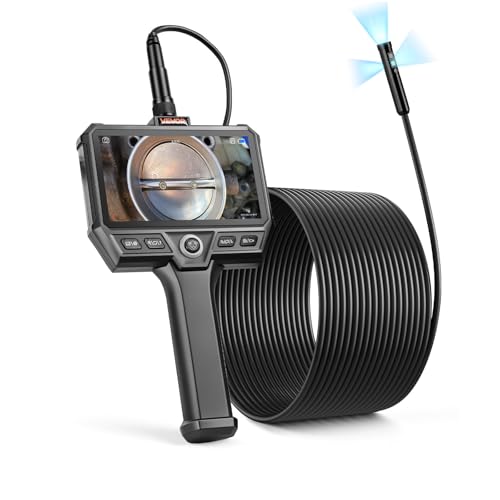
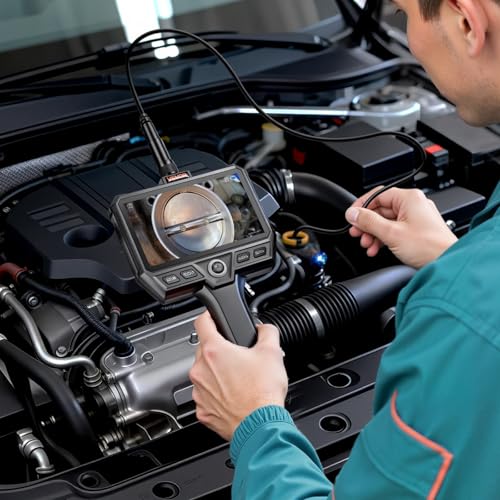
The duct camera to buy for most homes. Its 32.8 ft cable, which VEVOR calls ultra-rigid and says gives stable push force, is built for long runs, two side cameras read the duct walls as you pass, and the 5-inch screen means no phone to juggle in an attic.
It can't steer, so a tight elbow can stop it, and it records video at 720p. VEVOR rates it IP67 without saying which part is sealed.
Based on the maker's specifications and manual and the published reviews linked below, not on our own test of this unit.
Setup, everyday use and what others found
Setup & use · per the maker
- 8 mm probe with a front camera and two side cameras; VEVOR doesn't document split-screen or how you switch lenses.
- 8 + 1 + 1 LEDs in three brightness levels; 720p video with 1080p photo capture and up to 8× zoom.
- 5-inch IPS screen (854 × 480) that can flip the image 180°.
- 32.8 ft (10 m) cable VEVOR calls ultra-rigid; the listing suggests binding fish tape to it if you need more stiffness.
- 5000 mAh battery, up to 5–6 hours; a 32 GB card is included. Rated IP67, without saying which part.
What others found
VEVOR's product reviews, most of them imported from other platforms and unverified, praise the stiff cable and the battery life; one verified buyer found the capture button awkward to reach.
We found no independent hands-on test.


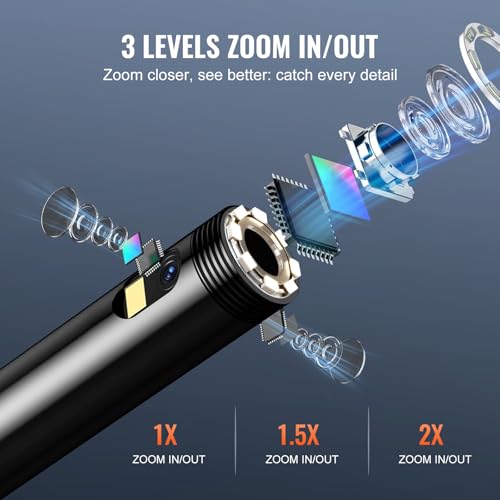

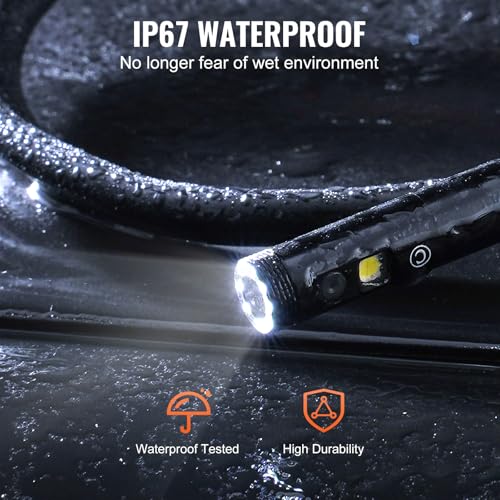


VEVOR Triple-Lens Endoscope, 49.2 ft Semi-Rigid Cable (model 5003)
Long trunk lines, basement runs and larger buildings
- Reach
- 49.2 ft, semi-rigid
- Camera
- 8 mm lens, front + 2 side
- Screen
- 5" IPS
- 49.2 ft of semi-rigid cable, the longest of the triple-lens scopes here
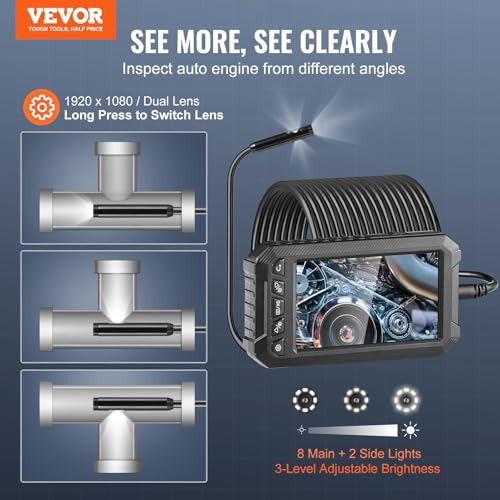
- Front and two side cameras; 8 + 2 LEDs in three levels
- 1920 × 1080 capture and 180° image rotation
- 32 GB card, hook and magnet included
- 2000 mAh battery; VEVOR's product page gives no runtime
- VEVOR lists an 8 mm lens but an 8.5 mm head
The longest of the triple-lens scopes here: 49.2 ft of semi-rigid cable with the same front-and-two-side camera layout as VEVOR's SC16, for long trunk lines, basement runs and bigger buildings.
Check the head size before you buy: VEVOR lists an 8 mm lens but gives the head as 8.5 mm across in one of its answers. The 2000 mAh battery is well under half the SC16's, and the product page publishes no runtime.
Based on the maker's specifications and manual and the published reviews linked below, not on our own test of this unit.
Setup, everyday use and what others found
Setup & use · per the maker
- A front camera and two side cameras, with 8 + 2 LEDs in three brightness levels. VEVOR's page for this model doesn't describe a split screen or how you switch lenses.
- 49.2 ft (15 m) of semi-rigid cable. VEVOR says the cable is custom-made and doesn't recommend extending it.
- VEVOR's listing gives an 8 mm lens; an answer on its product page gives the head's outside diameter as 8.5 mm. IP67 applies to the lens and cable, not the handset.
- 1920 × 1080 capture resolution and a 5-inch IPS screen, with 1×, 1.5× and 2× zoom and 180° image rotation.
- A 2000 mAh battery charged over USB-C. A 32 GB card, hook, magnet and protective cap are included, but VEVOR says there's no carrying case.
- VEVOR's site-wide policy gives a 12-month manufacturer's warranty.
What others found
We found no independent test. VEVOR's product reviews don't show dates, so we couldn't tell which version of the camera they cover.


Teslong NTS300 Dual-Lens Inspection Camera (8 mm, 16.5 ft)
Register-side checks and short runs, with nothing to learn
- Reach
- 16.5 ft
- Camera
- 8 mm, front + side
- Screen
- 5" IPS
- Opens straight to a live picture, with no app or WiFi
- One button swaps between the front and side cameras
- 5000 mAh battery, rated 4–5 hours; 32 GB card
- Bob Vila's testers found the 16-foot cable cumbersome
- Can't steer, and reaches less far than the VEVORs
The simplest scope here to hand to anyone. It opens straight to a live picture on its own 5-inch screen, and one button swaps between the front camera and a side camera that reads the duct wall as you pass.
It can't steer, and Bob Vila's testers found its 16-foot cable cumbersome. For long trunk runs, the two VEVORs reach further.
Based on the maker's specifications and manual and the published reviews linked below, not on our own test of this unit.
Setup, everyday use and what others found
Setup & use · per the maker
- Hold the power button for a few seconds and it opens to a live picture. There is no app or WiFi.
- A button just above the probe's plug cycles between the front and side cameras, one view at a time.
- Photos save at 1920 × 1080 and video at 1280 × 720 to the included 32 GB microSD card. The handle adds 1.5× digital zoom and a 180° image flip.
- Sharpest about 1.2–3.2 in from the front lens and 0.8–2 in from the side lens, so work close.
- Charges over USB-C. Teslong rates the 5000 mAh battery at 4–5 hours of use, and the listing gives about 5 hours to recharge.
- Only the probe is waterproof (IP67, to 1 m for 30 minutes). The handset is IP45: fine for splashes, but never submerge it.
What others found
Bob Vila's testers named this listing their best overall borescope. They used it down a car's spark-plug hole and a shower P-trap, switched to the side lens to check brake-pad wear, and fished a dropped screw out of a drain with the magnet tip. Their one complaint was that the 16-foot cable is cumbersome.
Older reviews on this Amazon listing may describe an earlier version with a 4.5-inch screen, so read them with that in mind.


Teslong TD450S Articulating Borescope (8.5 mm, single lens)
Looking up a riser or into a branch from a register
- Reach
- 5.08 ft
- Camera
- 8.5 mm, steers up to 210°
- Screen
- 4.5" IPS (854×480)
- Tip bends up to 210° with a lever, and locks
- 2 MP camera with 8 LEDs in three levels
- IP67 probe; 12-month warranty
- Only 5.08 ft of probe
- Bends in one plane; you rotate the probe to aim it
The camera for looking around the first bend. From a register or an access hole, its tip bends up to 210° and locks, so you can look up a riser or into a branch that a straight scope only points past.
The trade-off is reach. The probe is 5.08 ft long, so this is for the first few feet of a duct, not a whole run, and The Drive's reviewer found the lever worked "with varying degrees of success."
Based on the maker's specifications and manual and the published reviews linked below, not on our own test of this unit.
Setup, everyday use and what others found
Setup & use · per the maker
- An 8.5 mm single-lens probe on a 1.55 m (5.08 ft) cable that Teslong describes as stiff but flexible.
- Two-way articulation of up to 210°, in one plane, steered with a lever below the screen and lockable in position. Teslong's manual says to return the dial to neutral before pulling the probe out.
- A 2 MP camera with a 70° field of view, sharpest from about 0.8 to 3.9 in (20–100 mm). Photos and video at 1920 × 1080 or 1280 × 720.
- A 4.5-inch IPS screen, 854 × 480, and 8 LEDs in three brightness levels.
- A 3000 mAh battery, rated for 3–4 hours, charged over USB-C. A 32 GB card is included.
- Only the probe is waterproof, rated IP67. Teslong's manual rates the probe for −10 to 70 °C in air and the handset for 0 to 45 °C. Teslong gives a 12-month warranty.
- The Amazon part number matches Teslong's single-lens version; a dual-lens TD450S with a 1 MP camera is sold separately.
What others found
The Drive's Michael Febbo, reviewing a single-lens unit, wrote that the tip "can swing through 210° of motion by using a lever with your thumb, right below the screen; sometimes with varying degrees of success," and that "you also have to try and twist the cable to rotate the head since it only pivots in one plane."
That is the only independent review we found.


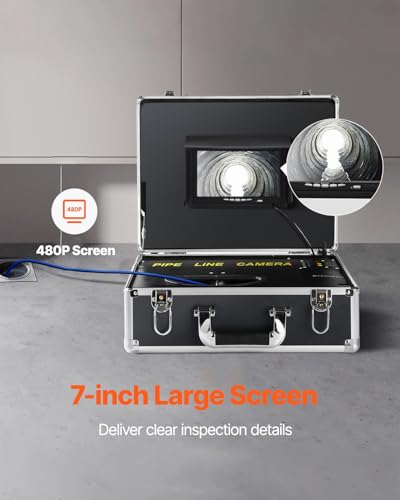


VEVOR 98 ft Sewer Camera (7" screen)
Dryer vents and flue liners within its 1.18–7.87 in pipe range
- Reach
- 98 ft push cable
- Camera
- 25 mm head, 130° view
- Screen
- 7" (480p)
- Listed for 1.18–7.87 in straight pipe, 1.97 in and up through bends
- 98 ft cable with length markings
- 12 LEDs in three levels; IP68 lens
- Records to an included 16 GB card
- Doesn't self-level, and the screen is 480p
- No substitute for a chimney sweep's video inspection
The push camera for dryer vents and chimney flues. VEVOR lists it for straight pipe from 1.18 to 7.87 in, which covers a 4-inch dryer vent and a 6-inch flue liner, and its 98 ft cable with length markings reaches a long vent run or a tall chimney.
It's a sewer camera at heart: it doesn't self-level, the 480p screen is coarse, and it's no substitute for a chimney sweep's video inspection. Never put it into a warm flue.
Based on the maker's specifications and manual and the published reviews linked below, not on our own test of this unit.
Setup, everyday use and what others found
Setup & use · per the maker
- 25 mm stainless head with a sapphire lens, a 130° view and 12 LEDs in three brightness steps; IP68 lens. It doesn't self-level.
- 7-inch 480p screen; video and photos save to the included 16 GB card.
- 98 ft (30 m) semi-rigid cable with length markings; there's no digital counter.
- Listed for pipe from 1.18 to 7.87 in straight and 1.97 in through right-angle bends; VEVOR's own Q&A says 90° turns need pipe over 60 mm.
- 4500 mAh battery, up to about 6 hours. VEVOR warns that running without the guide wheels can scratch the lens.
What others found
VEVOR's own reviews, pooled across versions, mostly praise the picture for the price. Owners of this version note it doesn't turn the picture upright, and a few reviewers report it sticking in small pipes and bends.
We found no independent hands-on test. Some specs come from VEVOR's matching 98 ft model page, which we matched to this listing by its specifications.
- Aeronautics diploma
- Engineering degree
- BAMEC (DGCA)
- QC-trained
- ~2 yrs tool management
Why you should trust us
SK Kutubuddin spent over two decades in aero-engine maintenance and inspection, and looking inside engines through borescopes and video scopes was core daily work. That job teaches you to record where a finding is as carefully as what it is, which is exactly what a duct inspection needs: the crushed run is useless to a contractor unless you can say which one, and how far in.
Every cable length, lens layout and rating below was checked against the maker's product pages and manuals where they exist, and against the current Amazon listing, per our how-we-test method. Where a maker's documents disagree, we say so. We found no independent test with measurements for any camera here. This is a buying guide built on verified specs, published guidance from the EPA, NADCA and CSIA, and inspection experience, not a lab test.
Who this is for
This page is for homeowners who want to check a duct cleaner's claims before and after the job, HVAC techs who document what they find, and anyone who wants a first look down a dryer vent or a chimney flue.
It isn't a substitute for a chimney sweep's inspection or a mold test. For walls, engine bays and general household jobs, our inspection camera picks cover shorter, more versatile scopes, and for drains and sewer lines, see our pipe inspection cameras.
- Checking what a duct-cleaning company says it found
- Finding crushed, kinked or disconnected duct
- Looking for lint, nests or crushed sections in a dryer vent
- A first look up a chimney flue before calling a sweep
How we picked
We started from what a duct, vent or flue inspection has to show, then checked each camera against its maker's own documents.
- 01
Reach that matches the run
A register-side look needs a few feet; a trunk line needs tens of feet. We covered 5 ft to 98 ft and gave weight to cables stiff enough to push without buckling.
- 02
A view of the walls
Disconnects, gaps and damage sit on the duct wall, not straight ahead. We favored side cameras and, for bends, a tip you can steer.
- 03
Light you can turn down
Metal ducts reflect a camera's LEDs back as glare. We gave weight to adjustable brightness, which all five picks document.
- 04
A record of what you saw
NADCA recommends photos as part of the job record. Every pick records photos and video to a card, so you can show a contractor exactly what you found.
What to know before you buy
What a duct camera is for
Most of a duct system is out of sight, and that's where the disputes start. The EPA's advice to homeowners is blunt: "A thorough visual inspection is the best way to verify the cleanliness of your heating and cooling system," but "many sections of your heating and cooling system may not be accessible for a visible inspection, so ask the service provider to show you any mold they say exists." A camera on a long cable is how you see those sections yourself, before you pay for cleaning and after it's done.
The EPA suggests cleaning when there is substantial visible mold growth inside hard ducts, when ducts are infested with rodents or insects, or when they're clogged with excessive dust and debris, or particles are released from the supply registers. It also notes that duct cleaning "has never been shown to actually prevent health problems." NADCA, the duct cleaners' trade body, defines the goal as visibly clean: "free from non-adhered substances and debris." Its checklist recommends photos as part of the job record, and suggests inspecting a home's air handler every year and its ducts every two.
What a camera finds in ductwork
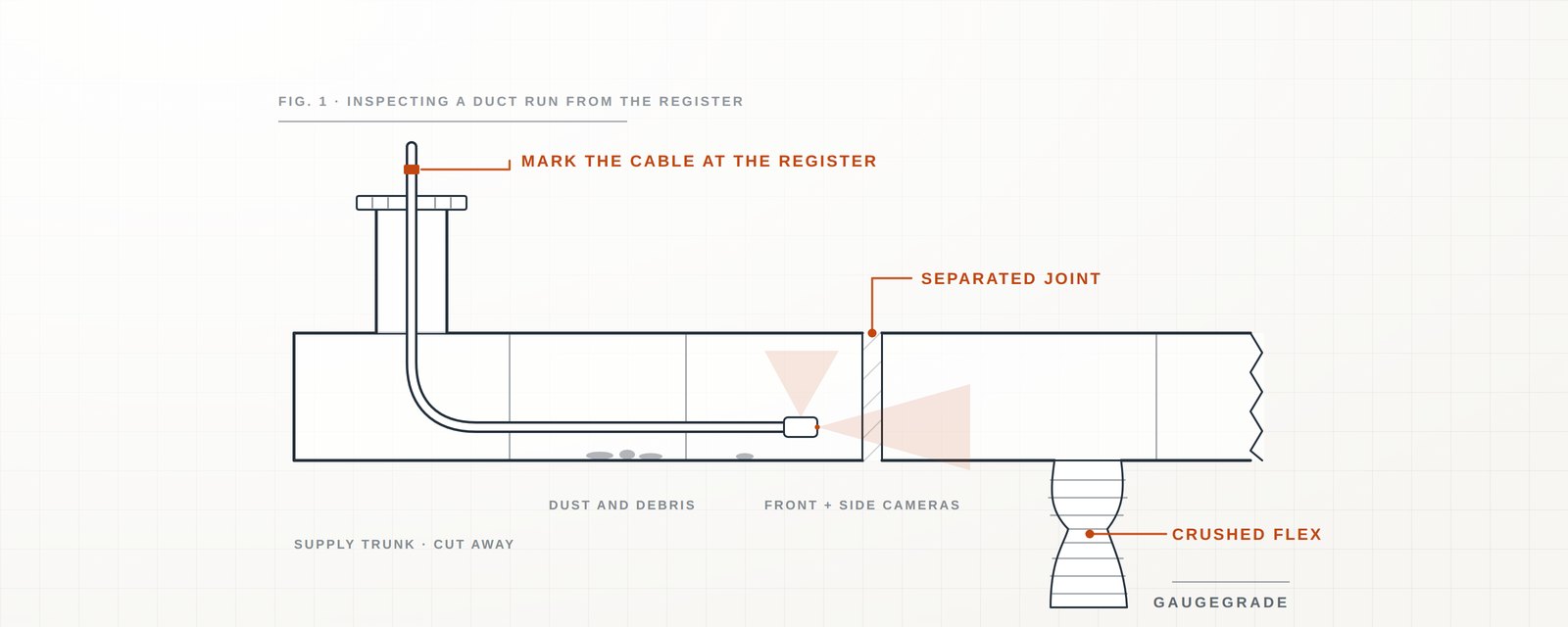
Dust is the least of it. ENERGY STAR estimates that in a typical house about 20 to 30 percent of the air moving through the ducts is lost to leaks, holes and poorly connected ducts, and it names tangled or kinked flexible duct as a sign of trouble. The Department of Energy's advice is to look for sections that should be joined but have separated, then for obvious holes. A camera finds both, along with crushed flex runs, debris and pest nests that restrict airflow.
One limit is worth knowing before you look. A camera can show a dark growth on a duct wall, but it can't tell you it's mold: the EPA says a positive determination "can be made only by an expert and may require laboratory analysis." Photograph it, note where it is, and take it to a professional.
Reach, stiffness and a view of the walls
Reach comes first. Estimate the run from your access point to the farthest spot you need to see, and buy a cable with length to spare. Stiffness matters too, and the advice pulls both ways: Teslong's HVAC guide says a longer, more flexible cable makes it easier to navigate long or twisted ductwork, while VEVOR says the cable it calls ultra-rigid on its SC16 gives stable push force through long pipes and tight spaces.
Then the walls. The problems that waste air, a separated joint, a crushed section, a loose connection at a register, sit on the sides of the duct rather than straight ahead. Side cameras, like the two on each VEVOR endoscope and the one on the Teslong NTS300, read the wall as you pass. The Teslong TD450S steers its single camera up to 210° instead, to look around the first bend.
Last, light and a record. Metal ducts reflect a camera's LEDs back as glare, so adjustable brightness matters; Rotobrush advertises its professional Roto-Vision duct camera's adjustable LEDs "to reduce reflection off the ducts." And record everything. NADCA recommends photos as part of the job record, and a video with distances noted is what a contractor can act on.
Dryer vents: the duct that starts fires
The US Fire Administration estimated about 2,900 clothes dryer fires in homes each year in its 2008–2010 data, with failure to clean the leading factor at 34%. NFPA's later study put failure to clean at a third of dryer fires. A camera shows lint build-up directly, along with crushed or disconnected sections.
The 2015 and 2021 editions of the International Residential Code set the standard a camera checks against: a smooth-walled rigid metal exhaust duct, no longer than 35 feet from the dryer's transition duct to the outlet, reduced for every elbow, with the flexible transition duct itself limited to 8 feet. CSIA, which certifies dryer exhaust technicians, recommends an annual inspection and notes that it is not uncommon to find transition ducts crushed as the dryer is pushed against the wall. Check which code edition your area has adopted.
Chimneys: where a consumer camera stops
CSIA quotes the chimney standard NFPA 211, which applies where a jurisdiction has adopted it: "chimneys, fireplaces, and vents shall be inspected at least once a year for soundness, freedom from deposits, and correct clearances." For a Level 2 inspection, which CSIA recommends when a home is sold and after a chimney fire or any event likely to have damaged the chimney, CSIA's procedure says video scanning, or a similar inspection, of the chimney interior is required.
That scan is a sweep's job, done with purpose-built systems: Wöhler's VIS 700 pans 360° and tilts 180° on a 100-foot push rod with a distance counter, and Chim-Scan's cameras mount on sweep rods so the head turns as the rods do. A consumer inspection camera can show a homeowner an obvious blockage, a nest or loose debris at the base of a flue. It isn't a Level 2 inspection. Posters in a 2024 Hearth.com thread on liner inspection mention soot and too little light, and one doubts that consumer scopes can focus close enough to work in a 6-inch liner.
Before the probe goes in
A few habits keep the inspection safe and the camera intact.
- Turn the HVAC system off first. Teslong's guide says so, and its safety manual warns against putting the probe anywhere with moving parts, which in a duct means the blower.
- If you suspect mold, don't run the system. The EPA warns that running a contaminated system can spread mold through the building.
- Switch off any UV lamps in the air handler. NADCA warns that UVC exposure can be extremely harmful and that lamps should be powered off under lockout/tagout when serviced.
- Never put a camera into a warm flue. Wöhler rates its professional chimney camera only to 104°F, and one chimney service asks owners to stop using the fireplace 24 hours before an inspection.
- Mark the cable at the register so you know how far in each finding is, and record video rather than relying on memory.
Where the guidance comes from
The inspection guidance on this page comes from these documents. Product sources are listed under each pick.
- EPA, Should You Have the Air Ducts in Your Home Cleaned?, and Mold Cleanup in Your Home.
- NADCA's commercial checklist, and its 2023 article on UV lamps in HVAC systems.
- ENERGY STAR, Duct Sealing; US Department of Energy, Minimizing Energy Losses in Ducts.
- US Fire Administration, Clothes Dryer Fires in Residential Buildings (2008–2010); NFPA research report on home fires involving clothes dryers and washing machines (Richard Campbell, 2017).
- International Residential Code, section M1502 (2015 and 2021 editions).
- CSIA homeowner resources (quoting NFPA 211), CSIA Level 2 inspection procedure, and CSIA dryer-vent safety pages.
- Wöhler USA, VIS 700 chimney camera; Chim-Scan chimney cameras; Rotobrush Roto-Vision duct camera.
- Teslong, Using an Inspection Camera for HVAC Ducts (2025), and its camera safety manual.
- Hearth.com forum thread on chimney liner inspection, 2024.
Frequently asked questions
What is the best camera for inspecting air ducts?
For most homes, a screen scope with a long, stiff cable and side cameras, such as the VEVOR SC16 with 32.8 ft of cable. For longer runs, VEVOR's 49.2 ft version; for looking around the first bend from a register, an articulating scope like the Teslong TD450S.
How much cable do I need to inspect ductwork?
Enough to reach from your access point to the farthest spot you need to see, with some to spare, because a cable that has to follow elbows covers less ground than its length. Estimate the run before you buy; the picks here range from about 5 ft to 98 ft.
Can a duct camera tell if there's mold in my ducts?
It can show you something that looks like mold, but not confirm it. The EPA says a positive determination can be made only by an expert and may require laboratory analysis. Photograph it, note where it is, and don't run the system if you suspect contamination.
How often should air ducts be inspected?
NADCA's recommended schedule is every year for a home's air handler and every two years for its supply and return ducts, and every year for all three in commercial buildings. The EPA suggests cleaning when there's substantial visible mold growth in hard ducts, vermin, or excessive dust and debris, especially if particles come out of the supply registers.
Can I use a duct camera in a dryer vent or chimney?
Yes, with the right head and cable. A push camera like the VEVOR 98 ft reaches the length of a vent or flue; check the maker's pipe range against your duct size, and never put a camera into a warm flue. At a home sale or after a chimney fire, a sweep's Level 2 inspection, which CSIA says requires video scanning, is still the one that counts.
Is duct cleaning worth it?
Only when there's a reason. The EPA says duct cleaning has never been shown to actually prevent health problems, and suggests it when there's substantial visible mold growth in hard ducts, vermin, or clogged ducts. A camera lets you see whether any of those apply before you pay for the job.
Should the HVAC system be off before I put a camera in a duct?
Yes. Teslong's guide says to turn the system off first, and its safety manual warns against putting the probe anywhere with moving parts. If you suspect mold, the EPA says not to run the system at all until it's been dealt with.
Why is the picture washed out inside a metal duct?
Glare. Sheet-metal ducts reflect the camera's LEDs back as glare; professional duct cameras such as Rotobrush's Roto-Vision advertise adjustable LEDs to reduce it. Turn the brightness down and angle the view slightly off the wall.
Related reading
- Aeronautics diploma
- Engineering degree
- BAMEC (DGCA)
- QC-trained
- ~2 yrs tool management
SK spent over two decades in aircraft maintenance, working hands-on with aero-engine systems and flight data recorder systems, borescope-inspecting turbine and compressor blades, and spending almost two years in a dedicated tool bay. He holds a diploma in mechanical engineering (aeronautics), an associate degree in science, an engineering degree and a Basic Aircraft Maintenance Engineer's Certificate (BAMEC) from DGCA, and has completed quality-control and aviation fuels & lubricants training. GaugeGrade applies the same inspection, torque and tool-management standards to the tools everyday mechanics, DIYers and trades actually buy.