TEKTON Torque Wrench Review: Which Model to Buy
TEKTON is the torque wrench brand a lot of home mechanics end up with, and its current range gives them good reason. The micrometer click wrenches TEKTON launched in 2025 are rated ±3% in both directions, tested from the bottom of the scale to the top, and shipped with a serialized certificate. Here is how the range breaks down, what changed from the older models, and which TEKTON to buy for each job.

GaugeGrade is reader-supported. When you buy through links on our site we may earn an affiliate commission at no extra cost to you. We only recommend gear we have researched against verified manufacturer specifications.
- TEKTON's current micrometer wrenches are rated ±3% clockwise and counter-clockwise, tested at the lowest marked value, 60% and 100% of the scale, and come with a certificate of the results.
- Most people should start with the 3/8-inch TRQ51402 (10–100 ft-lb); add the 1/2-inch TRQ52402 for wheels, or buy all three drives as the TRQ95901 set.
- TEKTON's older 24335 and 24340 wrenches were rated ±4% clockwise only and came without a certificate. Check the model number on any used or discounted TEKTON.
- Best overallTEKTON TRQ51402 3/8" Micrometer Torque Wrench
- Best for wheelsTEKTON TRQ52402 1/2" Micrometer Torque Wrench
- Best inch-poundTEKTON TRQ50402 1/4" Micrometer Torque Wrench
- Best digitalTEKTON TRQ81122 3/8" Electronic Torque Wrench
- Best split-beamTEKTON TRQ96901 3/8" and 1/2" Split-Beam Torque Wrench Set
- Best setTEKTON TRQ95901 1/4", 3/8" and 1/2" Torque Wrench Set
What we recommend
- Range
- 10–100ft-lb
- Type
- Click(micrometer)
- Accuracy
- ±3%CW and CCW
- Range
- 40–200ft-lb
- Type
- Click(micrometer)
- Accuracy
- ±3%CW and CCW
- Range
- 20–200in-lb
- Type
- Click(micrometer)
- Accuracy
- ±3%CW and CCW
- Range
- 10–100ft-lb
- Type
- Electronic, torque + angle
- Accuracy
- ±2% torque, ±1% angle(CW and CCW)
- Range
- 20–100 and 50–250 ft-lb
- Type
- 2 split-beam click wrenches
- Accuracy
- ±4%CW
- Range
- 20–200 in-lb; 10–100 and 40–200 ft-lb
- Type
- 3 click (micrometer) wrenches
- Accuracy
- ±3% CW and CCW, each
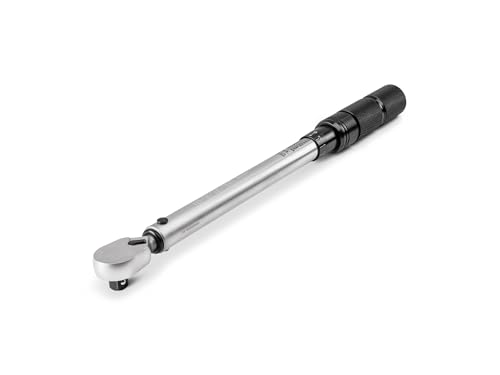
TEKTON TRQ51402 3/8" Micrometer Torque Wrench
A first torque wrench for engine-bay and general work
- Range
- 10–100 ft-lb
- Type
- Click (micrometer)
- Accuracy
- ±3% CW and CCW
- Rated ±3% in both directions, tested at 10, 60 and 100 ft-lb
- Serialized certificate with the test results
- 90-tooth ratchet with a 4° swing arc
- Case and a 3/8"-to-1/4" reducer included
- 10 ft-lb minimum: small covers need the 1/4-inch model
- Wind it down to the lowest setting after use
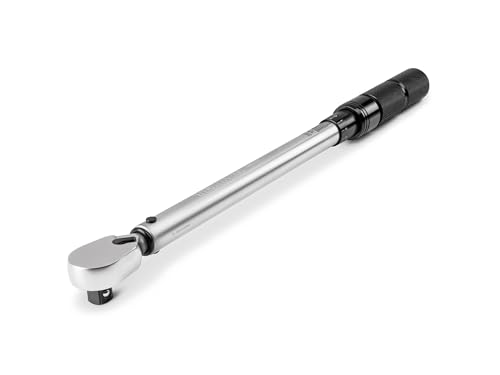
TEKTON TRQ52402 1/2" Micrometer Torque Wrench
Lug nuts, suspension and chassis bolts
- Range
- 40–200 ft-lb
- Type
- Click (micrometer)
- Accuracy
- ±3% CW and CCW
- Rated ±3% in both directions, tested at 40, 120 and 200 ft-lb
- Serialized certificate with the test results
- 90-tooth ratchet with a 4° swing arc
- Case and a 1/2"-to-3/8" reducer included
- 40 ft-lb minimum
- Big truck fasteners may need the 40–300 ft-lb TRQ52403

TEKTON TRQ50402 1/4" Micrometer Torque Wrench
Small fasteners in aluminum, trim, motorcycles and small engines
- Range
- 20–200 in-lb
- Type
- Click (micrometer)
- Accuracy
- ±3% CW and CCW
- Rated ±3% in both directions across the full scale
- Serialized certificate with the test results
- 90-tooth ratchet with a 4° swing arc
- Tops out at 200 in-lb, about 16.7 ft-lb
- Wind it down to the lowest setting after use

TEKTON TRQ81122 3/8" Electronic Torque Wrench
Torque-plus-angle procedures and jobs with many different specs
- Range
- 10–100 ft-lb
- Type
- Electronic, torque + angle
- Accuracy
- ±2% torque, ±1% angle (CW and CCW)
- Torque, angle, or torque-plus-angle modes
- Tested at 10, 60 and 100 ft-lb to ISO 6789-1:2017; serialized certificate
- Lights, beeps and handle vibration as you reach the target
- 90-tooth flex head
- Needs 3 AA batteries (not included)
- A click wrench is simpler if you never use angle specs
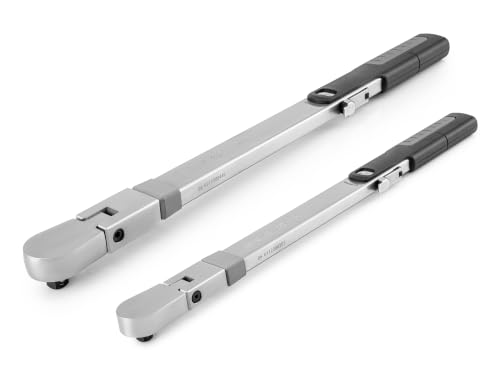
TEKTON TRQ96901 3/8" and 1/2" Split-Beam Torque Wrench Set
Changing settings often without winding the wrench down afterwards
- Range
- 20–100 and 50–250 ft-lb
- Type
- 2 split-beam click wrenches
- Accuracy
- ±4% CW
- TEKTON's new split-beam line: TRQ61122 (3/8") and TRQ62122 (1/2")
- No spring under load, so they can be stored at any setting, per TEKTON
- Serialized certificate for each; 90-tooth ratchets with 10° flex heads
- Rated clockwise only, at ±4%
- Sold as a pair: worth it if you use both sizes

TEKTON TRQ95901 1/4", 3/8" and 1/2" Torque Wrench Set
Anyone who works across small, engine-bay and wheel fasteners
- Range
- 20–200 in-lb; 10–100 and 40–200 ft-lb
- Type
- 3 click (micrometer) wrenches
- Accuracy
- ±3% CW and CCW, each
- Three dual-direction micrometer wrenches, one per drive size
- Each has its own case and serialized certificate
- Drive adapters and a magnetic bit holder included
- Worth it only if you use all three ranges
- Three coil-spring wrenches to wind down after use
Why you should trust us
SK Kutubuddin spent over two decades maintaining and inspecting aircraft, including almost two years in a dedicated tool bay, where every torque wrench carried a calibration label and was checked for serviceability when it came back. That habit of reading the paperwork before trusting a tool is how this review approaches TEKTON: by the tolerance each wrench is rated to, where on the scale the rating applies, and what its certificate records.
We compared TEKTON's current range model by model and checked every range, accuracy figure, standard and included item against TEKTON's product pages and manuals and the live Amazon listing, per our how-we-test method. TEKTON does not sponsor this page. It is a buying guide built on verified specs and long experience with the category, not a lab test.
Who this is for
This page is for anyone weighing up a TEKTON torque wrench: first-time buyers choosing a drive size, owners of an older TEKTON wondering whether the new line is worth it, and anyone deciding between TEKTON's click, split-beam and electronic models.
If you want a wrench made in the USA, CDI, a Snap-on Industrial brand, makes serialized click wrenches there; they appear on our 3/8-inch and 1/2-inch pages.
- Home mechanics buying a first torque wrench
- Owners of an older 24335 or 24340 deciding whether to upgrade
- Anyone who wants a certificate with test results in the box
- Buyers choosing between click, split-beam and electronic
How we picked
We grouped TEKTON's torque wrenches by job and chose the model in each group that does that job most directly, then verified every figure against TEKTON's own pages and manuals and the live listing.
One model per job
TEKTON sells several wrenches that differ only in range. We picked the one whose range centers on each common job and named the alternatives where they matter, such as the 40–300 ft-lb TRQ52403 for trucks.
Accuracy, direction and where it applies
We recorded each wrench's rated tolerance, whether it covers counter-clockwise use, and the test points on its certificate. TEKTON tests its current micrometer and electronic wrenches at the lowest marked value, so their rating covers the full scale.
Paperwork and service
Every pick ships with a serialized certificate, and the single wrenches here are on TEKTON's list of models eligible for its paid recertification service, which matters for a wrench you plan to keep for years.
A type for every way of working
We covered TEKTON's micrometer click wrenches in all three drives, its split-beam and electronic models, and the three-wrench set.
Is TEKTON a good torque wrench brand?
For most home and many professional users, yes. The current micrometer wrenches are rated ±3% in both directions and calibrated to ISO 6789-1:2017, which TEKTON says also meets or exceeds ASME B107.300-2021, and each one ships with a serialized certificate that records its test results. That is a tighter rating on paper than many better-known click wrenches, several of which are rated only from 20% of the scale upward.
TEKTON's torque wrenches are made in Taiwan. Its warranty has no time limit and needs no receipt, and it offers a paid recertification service for its current models, so a TEKTON wrench can be checked and adjusted rather than replaced when it drifts.
Which TEKTON torque wrench should you buy?
Match the drive and range to the fasteners you tighten most:
- Engine-bay and general work: the 3/8-inch TRQ51402, 10–100 ft-lb.
- Wheels, suspension and chassis: the 1/2-inch TRQ52402, 40–200 ft-lb, or the TRQ52403, 40–300 ft-lb, for trucks.
- Small fasteners: the 1/4-inch TRQ50402, 20–200 in-lb.
- Torque-plus-angle procedures: the electronic TRQ81122, or the 1/2-inch TRQ82123 (30–300 ft-lb).
- Frequent setting changes without winding down: TEKTON's new split-beam line, the 3/8-inch TRQ61122 and 1/2-inch TRQ62122, sold together as the TRQ96901 set.
Old TEKTON vs new TEKTON
TEKTON's earlier micrometer wrenches, such as the 24335 and 24340, were rated ±4%, calibrated to the 2010 edition of ASME B107.300 and tested at 20%, 60% and 100% of the scale. They drove in both directions but measured torque only clockwise, and TEKTON says they did not include a certificate. Both are listed as no longer available.
The current TRQ line, released in 2025, is rated ±3% in both directions, calibrated to ISO 6789-1:2017 (which TEKTON says also meets or exceeds ASME B107.300-2021), tested from the lowest marked value upward, and certified individually. If you already own an older TEKTON that checks out well, keep using it; if you are buying, get the current model. TEKTON renewed its split-beam wrenches in 2026 too: it lists the older TRQ62103 as a version without a certificate and the TRQ62203 as no longer available.
Click, split-beam or electronic?
A micrometer click wrench is the simplest choice: set the value on the handle and pull until it clicks. TEKTON's split-beam wrench also clicks, but it has no preloaded spring, so it can be stored at any setting; the trade-off is a ±4% clockwise-only rating. The electronic wrench reads the torque live, alerts you as you approach the target and adds an angle mode. Our beam vs click vs digital guide explains each type in more depth.
What ±3% means in practice
On TEKTON's current micrometer wrenches, ±3% is the worst case allowed anywhere on the scale, in either direction; the certificate shows what your own wrench measured. At a 60 ft-lb setting, ±3% allows 58.2 to 61.8 ft-lb.
Many click wrenches are rated only from 20% of their scale upward, which leaves the bottom fifth unrated. TEKTON tests at the lowest marked value, so a 10–100 ft-lb TRQ51402 is rated at 10 ft-lb as well, which helps with low engine-bay values.
Looking after a TEKTON torque wrench
Store the micrometer wrenches at their lowest marked setting, as TEKTON's manual says, and set that lowest value before you switch the ratchet direction. Never use a torque wrench to break a fastener loose.
Check it at least once a year or every 5,000 cycles, the ISO 6789 benchmark, and straight away after a drop. Our calibration guide shows how to check a wrench at home, and TEKTON's recertification service can adjust it if it is out.
Frequently asked questions
- Are TEKTON torque wrenches accurate?
- The current micrometer wrenches are rated ±3% in both directions across their full scale, and the electronic models ±2% for torque. Each comes with a serialized certificate that records the readings from its own calibration test.
- Where are TEKTON torque wrenches made?
- In Taiwan, according to TEKTON's product pages and manuals.
- Does TEKTON calibrate torque wrenches?
- Yes. TEKTON runs a paid recertification service for its current torque wrenches, which tests the wrench and adjusts it if it is out of specification.
- What is TEKTON's warranty on torque wrenches?
- TEKTON's warranty has no time limit and does not require a receipt. For calibration, use its paid recertification service.
- Which TEKTON torque wrench is best for lug nuts?
- The 1/2-inch TRQ52402 (40–200 ft-lb) suits most cars. For trucks with higher lug-nut values, the TRQ52403 goes to 300 ft-lb.
- Do I need to set a TEKTON torque wrench to zero?
- Not to zero. TEKTON's manual says to store its micrometer wrenches at the lowest marked setting. Its split-beam wrenches can be stored at any setting.
- Is TEKTON as good as CDI?
- On paper, TEKTON's current micrometer wrenches are rated tighter: ±3% in both directions, against ±4% clockwise and ±6% counter-clockwise from 20% of scale for CDI's 3/8-inch 1002MFRMH. CDI's are made in the USA and TEKTON's in Taiwan, and both ship with a serialized certificate.
- Can I use a TEKTON torque wrench counter-clockwise?
- The current micrometer and electronic models are rated in both directions. TEKTON's split-beam wrenches are rated clockwise only.
- How often should a TEKTON torque wrench be calibrated?
- The usual benchmark is every 12 months or 5,000 cycles, from ISO 6789, and straight away after a drop or an overload.
Related reading
- Aeronautics diploma
- Engineering degree
- BAMEC (DGCA)
- QC-trained
- ~2 yrs tool management
SK spent over two decades in aircraft maintenance, working hands-on with aero-engine systems and flight data recorder systems, borescope-inspecting turbine and compressor blades, and spending almost two years in a dedicated tool bay. He holds a diploma in mechanical engineering (aeronautics), an associate degree in science, an engineering degree and a Basic Aircraft Maintenance Engineer's Certificate (BAMEC) from DGCA, and has completed quality-control and aviation fuels & lubricants training. GaugeGrade applies the same inspection, torque and tool-management standards to the tools everyday mechanics, DIYers and trades actually buy.