The Best Aviation Borescopes for Aircraft Engines
A borescope is now a routine part of judging a piston aircraft's cylinders. Continental's maintenance manual calls for one at every 100-hour or annual inspection, and Savvy Aviation's Mike Busch calls it "the gold standard" for exhaust valves. The scope that job needs isn't the one most car owners buy: it's a rigid probe with a tip that bends back to look at the valve. These are the best for cylinders and for airframes, with every spec checked against the maker's own documents wherever they exist.

- 4 picks compared
- Specs checked against maker data
- No paid placements
GaugeGrade is reader-supported. When you buy through links on our site we may earn an affiliate commission at no extra cost to you. We only recommend gear we have researched against verified manufacturer specifications.
- 1For cylinders, the Vividia Ablescope VA-400 v5: a rigid 8.5 mm probe whose tip bends from 0° to 180° and locks. It fits the guidance in AVweb's report on Savvy Aviation's borescope program, and it's the current version of the scope Mike Busch named his favorite in 2017.
- 2On an iPhone or iPad, the VA-400i has the same probe and plugs straight in; its light isn't adjustable.
- 3For wings and airframes, a joystick scope on a long probe steers where a rigid one can't: the ME-610i on a phone, or the Teslong TF600 on its own screen. None of these is the tool for a PT6 hot section, which needs a professional videoscope.
- 1Best overallVividia Ablescope VA-400 v5 Rigid Articulating Borescope (8.5 mm)
- 2Best for iPhone and iPadVividia VA-400i Rigid Articulating Borescope for iPhone and iPad (8.5 mm)
- 3Best for wings and airframesVividia ME-610i Joystick Articulating Borescope (6 mm)
- 4Best with its own screenTeslong TF600 4-Way Articulating Borescope (6.5 mm, dual lens)
What we recommend
Compare the key specs side by side, then read the full notes on each pick below.
- Probe
- 8.5 mm × 42 cm, rigid
- Tip
- One-way, 0–180°, locks
- Screen
- Your PC, Mac, Android or Chromebook(iPhone via adapter)
- Probe
- 8.5 mm × 42 cm, rigid
- Tip
- One-way, over 180°, locks
- Screen
- Your iPhone, iPad, Android or Windows PC
- Probe
- 6 mm × 1 m, flexible
- Tip
- Joystick, any direction, to about 210°
- Screen
- Your iPhone, iPad or Android
- Probe
- 6.5 mm × 1.55 m
- Tip
- Four-way joystick, 210°, locks
- Screen
- Built-in 6" 1080p


Vividia Ablescope VA-400 v5 Rigid Articulating Borescope (8.5 mm)
Exhaust valves, bores and piston crowns at each annual, through the top plug hole
- Probe
- 8.5 mm × 42 cm, rigid
- Tip
- One-way, 0–180°, locks
- Screen
- Your PC, Mac, Android or Chromebook (iPhone via adapter)
- Rigid 8.5 mm probe: the type AVweb's guidance on Savvy's borescope program recommends
- Tip bends from 0° to 180° and locks, to look back at the exhaust valve
- One handle button sets the light and takes photos
- Stocked by aviation suppliers including Aircraft Spruce
- Owners report broken articulation on earlier VA-400s; treat the bending section gently
- No IP rating from Vividia, whose manual says not to immerse it, despite "IP67" on the listing
The scope to buy for cylinders. It is the current version of the VA-400 that Mike Busch named his favorite in 2017, and it matches the guidance in AVweb's 2025 report on Savvy Aviation's borescope program: a rigid 8.5 mm probe with a tip that bends from 0° to 180° and locks, so from the top plug hole you can look straight down at the piston or back up at the exhaust valve.
The history is mixed. Owners report broken articulation on earlier VA-400s, one buyer reports crashes in the Windows app, and it needs a computer, an Android phone or an adapter box for an iPhone. The v5 adds a tungsten mesh over the bending section in place of the old rubber sleeve.
Based on the maker's specifications and manual and the published reviews linked below, not on our own test of this unit.
Setup, everyday use and what others found
Setup & use · per the maker
- An 8.5 mm camera on a 42 cm (16.5 in) rigid tube. The bending section is covered in tungsten braided mesh, bends from 0° to 180° and can be locked; Vividia gives a 30 mm bend radius.
- A 1280 × 720 camera for photos and 30 fps video, with a 120° field of view. The Amazon listing calls that Full HD; it is 720p. Vividia's page gives focus as 5 mm to infinity, and its manual as 5 mm to 4,000 mm.
- Six white LEDs. One button on the handle sets the brightness and takes photos.
- Powered through its 200 cm USB 2.0 cable. It works with Windows, macOS, Chromebook, Linux and Android; an iPhone or iPad needs Vividia's U2i adapter or its W03B Wi-Fi box.
- The manual rates it for 0–60 °C and says it shuts itself down at 150 °F. Vividia gives no IP rating, and its manual says not to immerse the cable camera in oils, water, gasoline or other fluids, so disregard the "IP67" in the Amazon title.
- One-year limited warranty, per the manual. Aircraft Spruce stocks it as P/N 12-04891.
What others found
A Zenith forum member who replaced his original VA-400 with the v5 in October 2023 wrote that "the camera resolution has been doubled", that the tungsten mesh is a permanent sleeve where the old scopes used a replaceable rubber one, and "I highly recommend this scope."
Buyer reviews on Aircraft Spruce's VA-400 listing, which don't say which version they cover, are mixed. One owner says it lives up to Mike Busch's recommendation for inspecting the valves on an O-360 Lycoming; another says the Windows application keeps crashing, and a third reports the camera turning itself off.
Two Van's Air Force members report the articulation failing on earlier VA-400s, one of them on his second unit.
In 2017 Mike Busch called the earlier VA-400 "my current favorite", for its ability to adjust its view from 0°, looking down at the piston, to 180°, looking back at the valves.
Most published reports cover the earlier VA-400, which had a 640 × 480 camera and a rubber sleeve over the bending section. We found one owner report specific to the v5 and no independent test with measurements.


Vividia VA-400i Rigid Articulating Borescope for iPhone and iPad (8.5 mm)
The same cylinder inspection, on an iPhone or iPad
- Probe
- 8.5 mm × 42 cm, rigid
- Tip
- One-way, over 180°, locks
- Screen
- Your iPhone, iPad, Android or Windows PC
- Same 8.5 mm × 42 cm rigid probe and lockable one-way tip as the VA-400 v5
- Plugs straight into an iPhone or iPad; Lightning and USB-C adapters included
- Runs from the phone or tablet, with no battery to charge
- Comes in a metal case
- LED brightness is fixed, as Vividia states and an owner confirms
- Not compatible with Mac or Chromebook
A rigid 8.5 mm probe and lockable tip like the VA-400 v5's, built to plug straight into an iPhone or iPad with no adapter box. If the device you take to the hangar is an iPad, this is the simplest way to follow the same cylinder procedure.
Two things to know before you buy: the LED brightness is fixed, which matters on a shiny valve face, and it doesn't work with a Mac or a Chromebook.
Based on the maker's specifications and manual and the published reviews linked below, not on our own test of this unit.
Setup, everyday use and what others found
Setup & use · per the maker
- An 8.5 mm camera head on a 42 cm (16.5 in) rigid stainless steel tube, with tungsten braided mesh over the bending section. It bends one way to more than 180° and locks.
- A 1280 × 720 camera at 30 fps with a 120° field of view. Vividia gives focus as 5 mm to infinity, while Oasis Scientific and Aircraft Spruce list 20 mm to infinity.
- Connects by cable to iPhone, iPad, Android and Windows through the UseePlus app, with Lightning and USB-C adapters in the box. Vividia gives the cable as 150 cm; Oasis and Aircraft Spruce say 200 cm. It is not compatible with Mac or Chromebook.
- It has no battery and runs from the phone, tablet or PC. Vividia says the LED brightness can't be adjusted.
- It comes in a metal case. Vividia's VA-400i page gives no IP rating, operating temperature or warranty term. Aircraft Spruce stocks it as P/N 12-06446.
What others found
A Van's Air Force member using the VA-400i wrote that "the resolution is great and it works well with ipad and iphone", and that the only downside is that "the camera light is NOT adjustable."
That is the only owner report of the VA-400i we found, and we found no independent test.



Vividia ME-610i Joystick Articulating Borescope (6 mm)
Inside wings, tail cones and behind panels, on a phone
- Probe
- 6 mm × 1 m, flexible
- Tip
- Joystick, any direction, to about 210°
- Screen
- Your iPhone, iPad or Android
- Joystick steers the tip in any direction
- IP67 probe on a 1 m flexible tube
- Six LEDs at four brightness levels
- Stocked by Aircraft Spruce, which lists it for inspecting inside wings
- Flexible and 6 mm, so not a cylinder scope by AVweb's guidance
- Phones and tablets only; the probe is warranted for just six months
The scope for inside wings, tail cones and behind panels, where a rigid probe can't follow the path. A joystick steers the 6 mm tip in any direction, and Aircraft Spruce, which stocks it, lists it for looking inside airplane wings.
It is flexible and 6 mm, so by the guidance above it's the wrong choice for cylinders. It works only with iPhone, iPad and Android, and Vividia warrants the probe for six months.
Based on the maker's specifications and manual and the published reviews linked below, not on our own test of this unit.
Setup, everyday use and what others found
Setup & use · per the maker
- A 6 mm probe on a 1 m tube of plastic and metal braided layers, which Oasis Scientific and Aircraft Spruce describe as flexible.
- A joystick steers the tip in any direction. Vividia's page says it bends 210° or more, and its manual says up to 210° and warns against holding the tip at full bend for long. Vividia doesn't mention a lock.
- A 1280 × 720 camera with a 100° field of view and six LEDs at four brightness levels. Vividia's page gives depth of field as 20–1,000 mm, and its manual as 20 mm to infinity.
- Connects by USB cable, not wirelessly, to iPhone, iPad and Android through the USee app, and saves photos and video to the phone.
- A 2600 mAh battery. Vividia gives at least two hours and its manual about 120 minutes; the Amazon listing and Oasis say about four hours.
- The probe is IP67. The manual says not to use the main body in rain or liquids, and rates the unit for −20 to 70 °C.
- A 12-month warranty, but only six months on the insertion tube and probe. Aircraft Spruce stocks it as P/N 12-05629.
What others found
We found no independent test and no owner reports of the ME-610i. Aircraft Spruce's description of it for wing inspection is a retailer's listing, not a review.


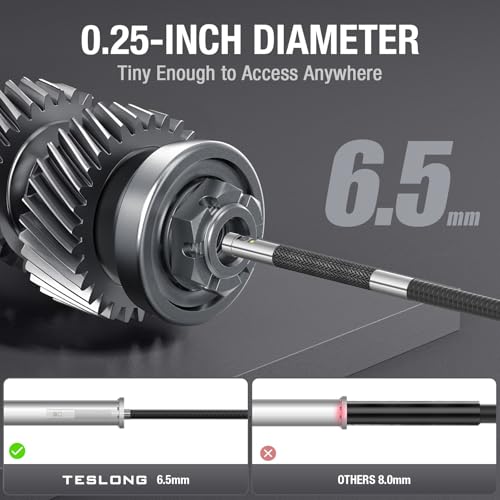


Teslong TF600 4-Way Articulating Borescope (6.5 mm, dual lens)
Airframe inspection without a phone, with the longest reach here
- Probe
- 6.5 mm × 1.55 m
- Tip
- Four-way joystick, 210°, locks
- Screen
- Built-in 6" 1080p
- Four-way joystick steering with a lock
- Front and side cameras, with split-screen viewing
- 1.55 m probe, the longest here
- 6" 1920 × 1080 screen and a 6000 mAh battery
- Not a cylinder scope by AVweb's guidance: 6.5 mm, on a cable rather than a rigid rod
- Teslong says the probe can't be replaced if it's damaged
The pick for airframe work if you'd rather not tie up a phone. Four-way joystick steering with a lock, a side camera and a 1.55 m probe, the longest here, let you work along a wing bay or a tail cone from one inspection hole, with the picture on its own 6-inch screen.
It's the wrong tool for cylinders by the guidance above: a 6.5 mm probe on a long cable rather than a rigid 8.5 mm rod. Teslong also says the probe can't be replaced if it's damaged.
Based on the maker's specifications and manual and the published reviews linked below, not on our own test of this unit.
Setup, everyday use and what others found
Setup & use · per the maker
- A joystick steers the tip four ways and can lock it in position. Center it and let the bending section straighten before you withdraw the probe.
- Front camera with 6 LEDs and a side camera with 1, each 1.0 MP, with split-screen viewing. Photos and video save at up to 1920 × 1080 to the included 32 GB card.
- 6-inch 1920 × 1080 IPS screen, plus a built-in microphone and speaker.
- Charges over USB-C. B&H lists about 4 hours to charge the 6000 mAh battery and up to 4 hours of use.
- The 1.55 m probe is IP67; B&H rates the unit for 0–45 °C (32–113 °F). Teslong says the probe can't be replaced if it's damaged.
- In the box: 32 GB card, USB-C cable, hook and magnet tips and a carrying case.
What others found
We found no independent hands-on test and no owner reviews outside Amazon. Owners on Van's Air Force and Pilots of America often name a Teslong as their step up from the VA-400, but rarely say which model, so we don't count those as reports on this one.
- Aeronautics diploma
- Engineering degree
- BAMEC (DGCA)
- QC-trained
- ~2 yrs tool management
Why you should trust us
SK Kutubuddin spent over two decades in aero-engine maintenance and inspection, and borescope inspection of turbine and compressor blades was core daily work. In that job a finding is judged against the maintenance manual and recorded before anyone draws a conclusion. This page applies the same standard: the picks follow what engine makers' procedures need a borescope to see and what experienced maintainers recommend, not what a listing claims.
Every probe size, bend angle and compatibility claim below was checked against Vividia's product pages and manuals, Teslong's pages and B&H's listing for the TF600, and aviation suppliers' listings, per our how-we-test method. Where the maker and the Amazon listing disagree, we say so and give the maker's figure. We found no independent test with measurements for any scope here. This is a buying guide built on verified specs, published maintenance guidance and inspection experience, not a lab test.
Who this is for
This page is for owners, builders and mechanics of piston aircraft who want to see inside their cylinders at each annual, as Continental's maintenance manual and Savvy Aviation advise, and for anyone inspecting inside wings, tail cones and behind panels.
It isn't for turbine hot sections: a PT6 inspection needs a professional videoscope and the engine's guide tube, as the section below explains. For the rest of the aviation toolbox, from safety-wire pliers to torque seal, see our aviation tools.
- Owners who want photos of every exhaust valve at each annual to share with their A&P
- A&Ps and IAs who want a scope that suits the Continental and Savvy procedures
- Builders checking inside wings, fuselages and tail cones for debris, chafing and corrosion
- Buyers comparing Vividia models whose Amazon listings don't match the maker's specs
How we picked
We started from what engine makers' procedures need a borescope to see and what experienced maintainers recommend, then checked every candidate against its maker's own documents wherever they exist.
- 01
Rigid first, for cylinders
AVweb's 2025 report on Savvy Aviation's borescope program advises a rigid probe with an articulating tip, at least 8.5 mm across, and warns off flexible scopes. Only scopes that meet it are picked for cylinders.
- 02
A tip that looks back
The exhaust valve face is in the cylinder head, on the same side the probe enters from, so the camera has to bend back about 180° to see it. We required articulation, and gave credit for a lock that holds the angle.
- 03
Steering for airframes
Inside a wing or tail cone, the probe has to follow a path a rigid tube can't. For that job we picked scopes with long probes and joystick steering in every direction.
- 04
The maker over the listing
Vividia's Amazon listings claim things its own documents don't: an IP67 rating the VA-400 v5 manual contradicts, and a four-hour battery on the ME-610i where Vividia's manual says about two. We used the maker's figures and flagged the conflicts that matter.
What to know before you buy
What the engine makers and the FAA ask for
Continental makes the borescope part of the routine. Its Standard Practice Maintenance Manual (M-0), which absorbed service bulletin SB03-3, calls for a cylinder borescope inspection at every 100-hour or annual inspection, when oil consumption is excessive, after an overspeed and whenever an anomaly is suspected. It says the inspection "must be used in conjunction with" the differential pressure test, with the probe through the upper spark plug hole.
Lycoming's newer engine manuals, such as those for the IO-360-P1A and YO-233-B2A, call for a cylinder borescope inspection at 400 hours, and the YO-233's also at its 25-hour check if oil consumption has increased. Lycoming's long-standing compression guidance, SI 1191A, doesn't mention a borescope, and we found no Lycoming bulletin setting borescope criteria for older engines.
The FAA's annual-inspection checklist, Part 43 Appendix D, asks only for a cylinder compression check; the word borescope doesn't appear in it. Savvy Aviation argues that isn't enough: it recommends borescoping every cylinder every 100 hours, or every 50 on turbocharged engines.
The probe: rigid, 8.5 mm, and a tip that looks back
Aviation spark plugs traditionally use an 18 mm thread, where car plugs use 14 mm, so the size limits that shape car scopes don't apply. AVweb's March 2025 report on Savvy Aviation's borescope program goes the other way: "Choose a rigid probe with an articulating tip. Next best is a semi-rigid unit," at least 8.5 mm across, and stay away from flexible scopes, "as they tend to flop around."
The tip matters as much as the probe. Savvy's inspection checklist views the exhaust valve head with the piston at bottom dead center and the tip bent about 180° back toward the cylinder head, and the valve seat with the valve open and the tip at about 90°, just inside the plug hole. A scope that only looks straight ahead can't take either view. One Van's Air Force member who owns a non-articulating scope finds looking back at exhaust valves "difficult to impossible".
In our search of current Amazon listings, only Vividia's VA-400 family combined a rigid 8.5 mm probe with a 180° tip. Several other 8–8.5 mm articulating scopes, such as SATA's 359570, use what their listings call semi-rigid gooseneck cables, the class AVweb rates next best. We haven't picked one, because we couldn't check those listings against maker specifications; SATA's US website, for one, doesn't list its scope. The other two picks are joystick scopes for airframes. Our articulating borescope guide covers the wider field.
Which one: cylinders, airframes or both
If you only inspect cylinders, buy the VA-400 v5 if you'll use a laptop, a Chromebook or an Android phone, and the VA-400i if you use an iPhone or iPad. Both carry the same rigid probe and 180° tip.
If you also inspect airframes, you need a second kind of scope, because a rigid tube can't follow a path through a wing. Choose the ME-610i if a phone suits you, or the Teslong TF600 for its own screen and longer reach. No single scope here does both jobs well, and the guidance above advises against a flexible scope in a cylinder.
Reading an exhaust valve
The exhaust valve is the part most worth seeing. Mike Busch describes a healthy valve's deposits as "almost perfectly symmetrical, similar to a bull's-eye," and a failing valve's as highly asymmetrical, with a hot spot on one side of the face.
Continental's list of abnormal conditions is short and specific. On the exhaust valve it lists "localized discoloration on the valve face circumference", "minute cracks" and "erosion (missing material)". In the bore it lists heavy scoring or piston rub, piston pin rub, corrosion, and excessive oil or heavy carbon, and on the piston crown, erosion, missing material and damage from foreign debris. It also notes that an upper bore with no visible hone pattern is normal in a cylinder that has been in service.
Savvy's analysts reviewed 1,550 sets of borescope images and found at least one distressed exhaust valve in 27% of them, and 85% of those valves were at an early stage. Read what you see alongside the differential pressure result, and take anything doubtful to your mechanic; our engine inspection guide covers the method step by step.
Turbines and the PT6: a different class of tool
A PT6 borescope inspection is not a plug-hole job. Pratt & Whitney Canada ties it to fuel-nozzle maintenance, which Covington Aircraft puts at every 200 to 400 hours, and the probe typically goes in through a fuel manifold adapter port, inside an engine-specific P&WC guide tube. On some engines it has been mandated: FAA AD 2014-17-08 called for repeat borescope inspections of the compressor-turbine blades on PT6A-114 and -114A engines.
The scope is specified too. P&WC's 2011 service information letter on PT6A borescope equipment called for a probe no thicker than 4.5 mm, at least 1,300 mm long, that steers at least 120° in all four directions. None of the scopes on this page meets that, and nor does the two-way Vividia D3245 that Vividia's US brand-holder markets for PT6 engines, which is why it isn't a pick.
The bigger gap is measurement. The engine manual sets limits, and a professional videoscope measures a nick or crack to compare against them; Duncan Aviation's Shawn Schmitz has described measuring a nick's depth to decide whether a blade is still airworthy. A consumer scope can't do that, because the scale of the image changes with the tip's distance from the part. It can show you that something is there. Deciding what it means takes the professional tool and the people trained to use it.
Looking is not signing off
Under the FAA's definitions, inspection is maintenance (14 CFR 1.1). An owner-pilot may do only preventive maintenance. Part 43 Appendix A lists examples, which the FAA says aren't all-inclusive, and a borescope inspection isn't among them. We found no FAA ruling on whether an owner's own look inside a cylinder counts as maintenance.
So treat your own pictures as information for your mechanic, not as a finding. The inspection that goes in the logbook, and any decision about a cylinder's airworthiness, belongs to an A&P, an IA or a repair station. A good set of photos, taken at the same angles every time, is still worth having: it makes that conversation shorter, and it lets you watch a valve change between annuals.
Where the guidance comes from
The maintenance guidance on this page comes from these documents. Product sources are listed under each pick.
- Continental Standard Practice Maintenance Manual M-0, section 6-4.11.3, Cylinder Borescope Inspection (formerly SB03-3).
- Lycoming engine maintenance manuals for the IO-360-P1A and YO-233-B2A, and Service Instruction 1191A, Cylinder Compression.
- 14 CFR 1.1, 43.3 and 43.7, Part 43 Appendices A and D, and the FAA's 2009 Coleal legal interpretation on preventive maintenance.
- Mike Busch, EAA Sport Aviation, August 2010, on exhaust valve failures; AOPA Pilot, May 2017, March 2024 and June 2025; Savvy Aviation's Cylinder Borescope Inspection Checklist.
- AVweb, March 2025, on Savvy's borescope initiative.
- KITPLANES, 2023, on aviation and automotive spark plugs.
- Pratt & Whitney Canada, SIL GEN-PT6-029, Borescope Equipment (2011), its Airtime blog on PT6A line maintenance (2018), and its PT6A-60 series training manual; Covington Aircraft, Understanding a Borescope Inspection (2022); FAA AD 2014-17-08.
- Aviation Maintenance magazine, July 2017, interviewing Duncan Aviation's Shawn Schmitz; Waygate Technologies patent US7170677, on stereo measurement.
- Van's Air Force forum, 2021–2022, borescope recommendation thread.
Frequently asked questions
What is the best borescope for aircraft engines?
For piston cylinders, a rigid probe of at least 8.5 mm with a tip that bends to 180°, such as the Vividia Ablescope VA-400 v5 or, for iPhone and iPad, the VA-400i. That is the type AVweb's report on Savvy Aviation's borescope program recommends. For turbine hot sections you need a professional videoscope with four-way steering and measurement, not a consumer scope.
How often should aircraft cylinders be borescoped?
Continental calls for it at every 100-hour or annual inspection, and when oil consumption is excessive, after an overspeed or whenever an anomaly is suspected. Savvy recommends every 100 hours, or every 50 on turbocharged engines. Lycoming's newer engine manuals call for it at 400 hours.
What size borescope fits an aircraft spark plug hole?
Aircraft plugs traditionally use an 18 mm thread, so an 8.5 mm probe goes in with room to spare. That's why aviation guidance can ask for a thicker, stiffer probe than car work allows.
Is a borescope better than a compression test on an aircraft engine?
They answer different questions, and Continental requires them together. The differential pressure test shows how well the cylinder seals; the borescope shows the valve, bore and piston. Mike Busch goes further, calling the compression test "a terrible way to assess cylinder airworthiness" and the borescope the gold standard.
Can I borescope my own aircraft?
You can look, but the FAA treats inspection as maintenance, and a borescope inspection isn't among the FAA's examples of preventive maintenance owners may perform. Share your images with your A&P or IA; any airworthiness decision and logbook entry is theirs.
Can I use an inexpensive borescope on a PT6?
Not for the inspection itself. A PT6 is usually inspected through a fuel-nozzle port with an engine-specific guide tube, P&WC has specified thin, long, four-way videoscopes for it, and findings have to be measured against the engine manual's limits. That is a job for a shop with the right equipment.
Should the engine be cold before a borescope inspection?
Yes. Vividia rates the VA-400 for 0–60 °C and says it shuts itself down at 150 °F, and Covington Aircraft's turbine specialist puts it bluntly: don't put your borescope in a hot engine. Let the cylinders cool before the probe goes in.
Does the VA-400 v5 work with an iPhone?
Not directly. Vividia says an iPhone or iPad needs its U2i adapter or its W03B Wi-Fi box. The VA-400i plugs straight into an iPhone or iPad, with Lightning and USB-C adapters in the box.
What does IP67 mean on a borescope listing?
Sealed against dust and against immersion in water, but check what it covers. On the ME-610i it is the probe only, and Vividia gives the VA-400 v5 no IP rating at all, despite the "IP67" in its Amazon title.
Can I use a car borescope on an aircraft engine?
It will fit, since aircraft plug holes are larger than car ones. What matters is the tip: a scope that only looks straight ahead can't see the exhaust valve face, and the guidance on this page calls for a rigid probe with a tip that bends back to it. Our engine inspection guide covers the method.
Related reading
- Aeronautics diploma
- Engineering degree
- BAMEC (DGCA)
- QC-trained
- ~2 yrs tool management
SK spent over two decades in aircraft maintenance, working hands-on with aero-engine systems and flight data recorder systems, borescope-inspecting turbine and compressor blades, and spending almost two years in a dedicated tool bay. He holds a diploma in mechanical engineering (aeronautics), an associate degree in science, an engineering degree and a Basic Aircraft Maintenance Engineer's Certificate (BAMEC) from DGCA, and has completed quality-control and aviation fuels & lubricants training. GaugeGrade applies the same inspection, torque and tool-management standards to the tools everyday mechanics, DIYers and trades actually buy.