The Best Torque Wrenches for Cars
For car work a torque wrench mainly needs to nail two things: lug nuts (commonly around 80–100 ft-lb) and the fasteners across your engine and suspension. A 1/2-inch wrench covers most of it. Here are the best, click and digital, by use.

- 5 picks compared
- Specs checked against maker data
- No paid placements
GaugeGrade is reader-supported. When you buy through links on our site we may earn an affiliate commission at no extra cost to you. We only recommend gear we have researched against verified manufacturer specifications.
- 1A 1/2" wrench in a 10–150 or 40–200 ft-lb range covers lug nuts plus most car fasteners.
- 2Click is simple and battery-free; digital adds a live readout, target alerts and, on some models, a torque-angle mode.
- 3Add a 3/8" wrench for smaller engine-bay and interior fasteners.
What we recommend
Compare the key specs side by side, then read the full notes on each pick below.
- Drive
- 1/2"
- Range
- 40–200ft-lb
- Type
- Click
- Drive
- 1/2"
- Range
- 10–150ft-lb
- Type
- Click
- Drive
- 1/2"
- Range
- 25–250ft-lb
- Type
- Digital
- Drive
- 3/8"
- Range
- 10–100ft-lb
- Type
- Digital
- Drive
- 1/2"
- Range
- 14.8–147.5ft-lb
- Type
- Digital
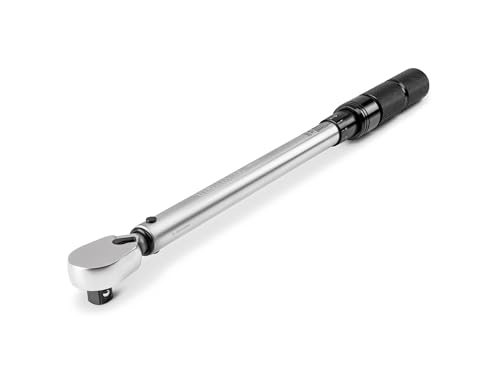


TEKTON TRQ52402 Micrometer Torque Wrench
Lug nuts and suspension, with no batteries to go flat
- Drive
- 1/2"
- Range
- 40–200 ft-lb
- Type
- Click
- Rated ±3% clockwise and counter-clockwise
- Serialized calibration certificate with test results
- 90-tooth ratchet with a 4° swing arc
- No batteries; 1/2"-to-3/8" reducer included
- 40 ft-lb minimum is high for small fasteners
- No digital readout or angle mode
The click wrench to buy for wheels and suspension. Its 40–200 ft-lb scale puts common lug-nut values in the middle of the range, and TEKTON rates it ±3% in both directions, with a serialized certificate that records what your own wrench measured.
No batteries, a 90-tooth ratchet and a 1/2-to-3/8-inch reducer in the box. It starts at 40 ft-lb, so small engine-bay bolts need a second, smaller wrench.
Based on the maker's specifications and manual and the published reviews linked below, not on our own test of this unit.
Setup, everyday use and what others found
Setup & use · per the maker
- Pull the locking collar down and hold it, turn the handle to the value on the main and micrometer scales (1 ft-lb marks), then release the collar and twist it to confirm it's locked.
- Rated ±3% clockwise and counter-clockwise. TEKTON tests it at 40, 120 and 200 ft-lb, and the serialized certificate lists your wrench's results, the test equipment and the conditions.
- Set it to its lowest value before switching the ratchet direction, and store it at the lowest marked value. Don't turn the handle below it.
- Don't use it to break fasteners loose or put an extension on the handle. Crowfoot and other offset adapters change the effective length, so the setting has to be corrected.
- In the box: a case, the manual, the certificate and a 1/2-to-3/8-inch drive reducer. It's 19.1 in long, weighs 2.77 lb and is made in Taiwan.
- The manual says to test it after any drop. TEKTON's paid recertification service covers this model.
What others found
It's a recent model: we found no independent test and no owner reviews we could read, so this verdict rests on TEKTON's published specifications and manual.


LEXIVON LX-183 Click Torque Wrench
A lower-starting click wrench that still covers lug nuts
- Drive
- 1/2"
- Range
- 10–150 ft-lb
- Type
- Click
- 10 ft-lb start reaches well below the TEKTON's 40 ft-lb
- Covers lug-nut torque
- Calibration certificate with a serial number
- Measures clockwise only; rated ±4%
- Faint click at low settings, per the manual and owners
- 150 ft-lb max, below the TEKTON's 200
A budget 1/2-inch click wrench that starts at 10 ft-lb, so one tool covers lug nuts and many of the smaller chassis bolts that the TEKTON's 40 ft-lb start can't reach.
The trade-offs are real. It measures clockwise only, it's rated ±4% against the TEKTON's ±3%, and LEXIVON's own manual warns that the click is subtle at low settings.
Based on the maker's specifications and manual and the published reviews linked below, not on our own test of this unit.
Setup, everyday use and what others found
Setup & use · per the maker
- Turn the lock knob at the end of the handle counter-clockwise to unlock, set the main scale and the micrometer, then turn the knob clockwise until snug to lock.
- Dual scale in ft-lb (1 ft-lb steps) and N·m, covering 10–150 ft-lb (13.6–203.5 N·m).
- Rated ±4%. The ratchet turns both ways, but the wrench only measures clockwise.
- Ships with a hard case and a calibration certificate with a traceable serial number.
- Store it at the 10 ft-lb minimum, never below. After long storage, work it a few times at a low setting before use. Don't add leverage or use it to free stuck fasteners.
- The warranty is 12 months, or 24 if you register within 90 days; recalibration isn't covered.
What others found
Reviewers on LEXIVON's own store are split. Two say the click is easy to feel at higher settings but faint or missing at low ones, matching the maker's warning, and two more doubt its low-end accuracy; one found a 10 ft-lb setting tightened closer to 13. Another checked it on a test bench at work and found it accurate out of the box.
The store reviews don't name a model, and Walmart's review pool for this wrench mixes several LEXIVON models, so we haven't used Walmart's. We found no independent hands-on test of the LX-183.
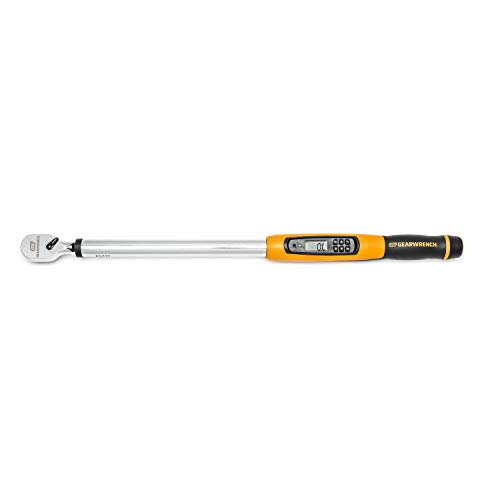


GEARWRENCH 85077 Electronic Torque Wrench
A readout and target alert on lug nuts and suspension
- Drive
- 1/2"
- Range
- 25–250 ft-lb
- Type
- Digital
- Buzzer, LED and vibrating handle at the target, with an early warning
- Wide 25–250 ft-lb range
- Rated ±2% clockwise, ±3% counter-clockwise (20–100% of range)
- Battery-powered
- More than a simple lug job needs
The digital pick for wheels and suspension: 25–250 ft-lb on a 1/2-inch drive, a target you key in, and three signals at once when you reach it: a buzzer, a red LED and a vibrating handle. An adjustable early warning tells you when to slow down.
It measures torque only, with no angle mode, and GEARWRENCH says not to use it to loosen fasteners. Accuracy is rated ±2% clockwise and ±3% counter-clockwise from 20% of the scale (50 ft-lb) up.
Based on the maker's specifications and manual and the published reviews linked below, not on our own test of this unit.
Setup, everyday use and what others found
Setup & use · per the maker
- Hold the power button for 3 seconds, pick the unit, press SET and key in the target with + and −. There are five units: ft-lb, in-lb, N·m, kg-m and kg-cm.
- Peak mode is the default and shows the highest torque reached for 15 seconds. A button combination switches to tracking mode for a live reading.
- Set an alert tolerance and it warns early: at a 90 ft-lb target with a 10% tolerance, the tone starts at 81 ft-lb. At the target a red LED lights, the buzzer sounds and the handle vibrates.
- Rated ±2% clockwise and ±3% counter-clockwise from 20% to 100% of full scale. The ratchet has 72 teeth and a 5° swing arc.
- Batteries aren't included. The manual and Amazon listing say 2 AA while GEARWRENCH's product page says 3 AAA, so check the battery compartment. It turns itself off after 90 seconds at zero.
- Never exceed its capacity or pull with the power off. The warranty is one year, with calibration accuracy warranted for 90 days, and GEARWRENCH says periodic recalibration is required.
What others found
Bob Vila's testers made it their upgrade pick. They found the buttons had a positive click even in gloves and said the vibration meant they didn't miss the target, but noted the value can be hard to set quickly. Their test didn't measure accuracy.
A Garage Journal owner who torques wheels for work (2019) said his 1/2-inch 85077 works well, but finds changing the target with the up and down buttons jumpy when he resets it often.
We couldn't read Home Depot's review text for the 85077.


TEKTON TRQ81122 3/8" Electronic Torque Wrench
Smaller engine-bay fasteners and torque-plus-angle jobs
- Drive
- 3/8"
- Range
- 10–100 ft-lb
- Type
- Digital
- Torque, angle, or torque-plus-angle modes
- Rated ±2% torque and ±1% angle in both directions, with a serialized certificate
- 10–100 ft-lb suits engine work
- 3/8" range not for big lug nuts
- Needs 3 AA batteries (not included)
The wrench for the engine bay rather than the wheels: a 3/8-inch electronic that reads torque as it builds and adds an angle mode, which many modern head and rod bolts specify. It's rated ±2% on torque and ±1% on angle, in both directions, with a serialized certificate.
Lug nuts and the bigger chassis bolts still want one of the 1/2-inch wrenches above. It runs on three AA batteries, which aren't included.
Based on the maker's specifications and manual and the published reviews linked below, not on our own test of this unit.
Setup, everyday use and what others found
Setup & use · per the maker
- 10–100 ft-lb in 1 ft-lb steps, with three modes: torque only, angle only, or torque plus angle.
- Rated ±2% on torque and ±1% on angle, clockwise and counter-clockwise, to ISO 6789-1:2017 and ASME B107.300-2021. The certificate tests torque at 10, 60 and 100 ft-lb and angle at 45°, 90°, 135° and 180°. TEKTON states the angle figure at a reference of 90° at 30° per second.
- 90-tooth head with a 4° swing arc and a 15° flex. 20.0 in long, an effective length of 15.9 in, 2.71 lb, made in Taiwan.
- Backlit screen with large buttons, and feedback from lights, beep patterns and handle vibration as you approach and reach the target. Auto shut-off is user-set to 2, 5, 10, 30, 60 or 120 minutes.
- Runs on three AA batteries, not included. In the box: a case, the manual, the serialized certificate and a 3/8-to-1/4-inch reducer.
- There's no winding down to do: the manual says to store it in its case and take the batteries out for long storage. Don't use it to break fasteners loose or add an extension to the handle, and verify its accuracy after a drop. It's covered by TEKTON's no-time-limit warranty and its paid recertification service.
What others found
It's a new model. We found no owner reviews we could read and no independent test, so everything here comes from TEKTON's published data and manual.


ACDelco ARM601-4 Digital Torque Wrench
A 1/2" digital with peak and trace modes and an early-warning beep
- Drive
- 1/2"
- Range
- 14.8–147.5 ft-lb
- Type
- Digital
- Beeps from 90% of the target, rapid beep at it
- Serialized calibration certificate, per the listing
- 14.8–147.5 ft-lb covers lug nuts
- Lower maximum than the 85077
- Rated accuracy starts at about 29.5 ft-lb
- 4 AAA batteries not included
A 1/2-inch digital with peak and trace modes, an intermittent beep from 90% of the target and a rapid one at it. Its Amazon listing promises a serialized, NIST-traceable calibration certificate.
Targets set from 14.8 to 147.5 ft-lb, but rated accuracy (±2% clockwise, ±3% counter-clockwise) starts at 20% of the scale, about 29.5 ft-lb. Batteries aren't included, and one Walmart owner found the instructions hard going.
Based on the maker's specifications and manual and the published reviews linked below, not on our own test of this unit.
Setup, everyday use and what others found
Setup & use · per the maker
- Press Power to switch on; once it's on, a press of Power zeroes the reading, so never zero it with load applied. The Up and Down buttons switch between Peak, which holds the highest reading, and Trace, which shows live torque.
- To set a target, hold SET for 2 seconds, adjust with Up and Down, then hold SET again or wait 5 seconds. Units are ft-lb, in-lb, N·m and kg-cm.
- An intermittent beep starts at 90% of the target, and a rapid beep at the target means stop pulling.
- Rated ±2% clockwise and ±3% counter-clockwise from 20% to 100% of full scale. Apply the force at the centre of the handle grip.
- It runs on 4 AAA batteries (not included) and switches off after 60 seconds unused. A counter logs how many times the target has been reached.
- Overloading can damage it and its accuracy; if you suspect an overload, have the calibration checked. Remove the batteries for long storage and keep it in its protective case. The calibration certificate is described in the Amazon listing; ACDelco's manuals don't mention one.
What others found
A Walmart reviewer (2026) found the instructions complicated and the learning curve steeper than expected.
Another Walmart owner (2025) said it arrived with a plastic case and seemed a little more accurate than the manual wrench they had been using.
We found no independent hands-on test of the ARM601-4, and many of the Walmart reviews are marked incentivized. The same model number has also been sold with a 4–99 ft-lb range, so check the range on the listing you buy.
- Aeronautics diploma
- Engineering degree
- BAMEC (DGCA)
- QC-trained
- ~2 yrs tool management
Why you should trust us
SK Kutubuddin spent over two decades maintaining and inspecting aircraft, and on the flight line a fastener was tightened to a written value with a calibrated wrench, in the specified sequence, every time. Wheels, brakes and suspension on a car deserve the same approach. His engineering degree, his BAMEC and his qualification in aviation fuels and lubricants also shape how he reads a torque spec, including whether it assumes clean, dry threads.
The wrenches on this page were chosen for the fasteners a home mechanic meets most: lug nuts first, then brakes, suspension and the engine bay. We checked each pick's drive, range and type against the manufacturer's specifications and the current retail listing, as set out in our how-we-test method, and kept both click and digital options so you can choose by how you work. Each pick is tied to the car job it suits best.
Who this is for
This page is for drivers and home mechanics who swap their own wheels, rotate tires, do brake jobs or tackle suspension and engine work in a driveway or garage. If a job comes with a torque value in the owner's or service manual, a torque wrench is the only reliable way to meet it.
If most of your work is small engine-bay or interior fasteners, look at an inch-pound wrench first. If you only ever work on small screws, a torque screwdriver is the better tool.
- Seasonal wheel and tire swaps at home
- Brake pad, rotor and caliper work
- Suspension, steering and subframe fasteners
- Engine jobs such as spark plugs, drain plugs and covers (usually with a 3/8-inch wrench)
- Anyone ready to stop tightening wheels by feel
How we picked
We started from the jobs a car torque wrench actually does and worked back to drive size, range and type. Every figure was confirmed against the manufacturer's specifications and the current listing.
- 01
Lug-nut coverage in the useful part of the range
Lug nuts are the job most buyers have in mind, so every 1/2-inch pick needed to reach typical wheel torque without working at the very top or bottom of its scale, where any torque wrench is least accurate.
- 02
A sensible low end
A wrench that starts too high cannot set smaller brake and suspension fasteners accurately. We noted where a 10 ft-lb starting point reaches further down than a 25 or 40 ft-lb one, and added a 3/8-inch option for engine-bay work.
- 03
Click and digital, each on merit
A battery-free click wrench suits most car owners, while a digital wrench earns its price on torque-angle jobs and varied specs. We included both types so the choice follows your work rather than a default recommendation.
- 04
Calibration documentation
A stated accuracy and calibration paperwork are worth more than extra features. Where a pick ships with a calibration certificate, as TEKTON's micrometer wrenches do, we say so, because it gives you a documented starting point to compare against later.
What to know before you buy
What range do you need for a car?
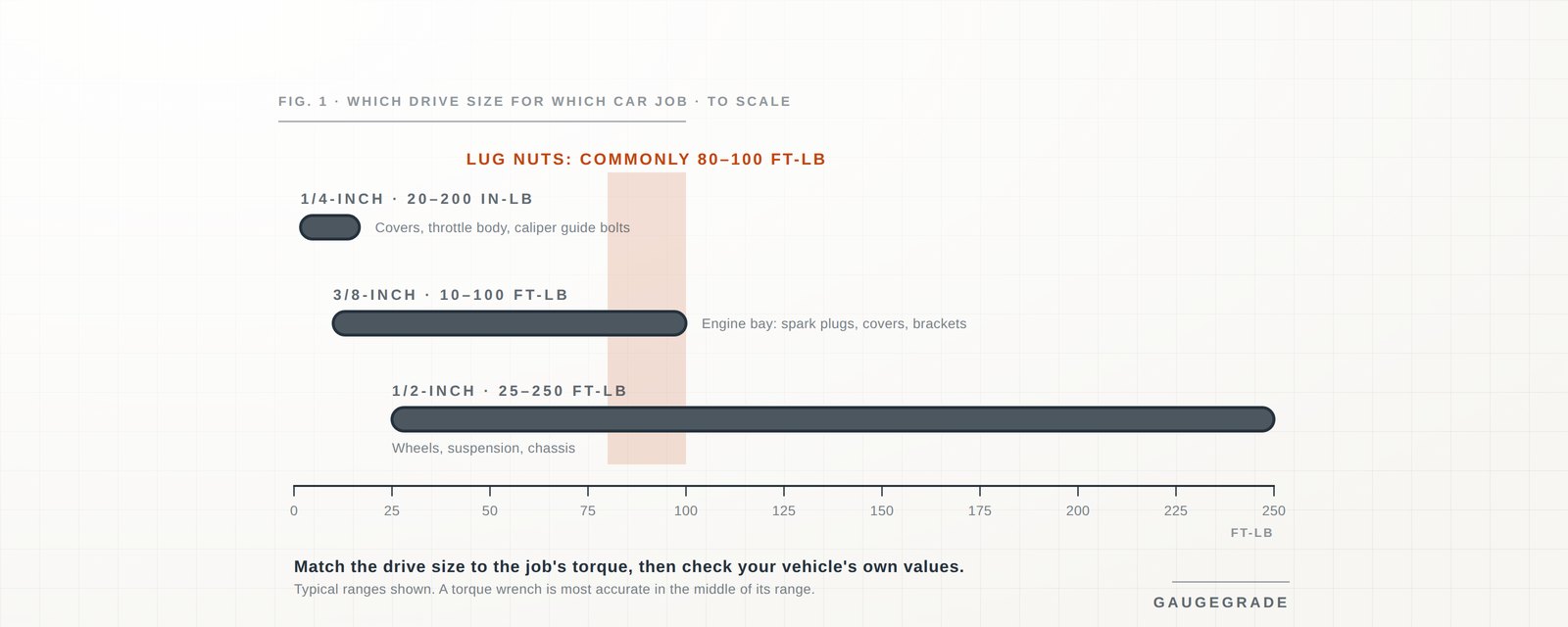
Lug nuts are commonly around 80–100 ft-lb (check your vehicle), so a 1/2" wrench in a 10–150 or 40–200 ft-lb range covers them along with most suspension and chassis fasteners.
Buy a range centered on your work — a torque wrench is most accurate in the middle of its range. For smaller engine-bay and interior fasteners, add a 3/8" wrench that reaches lower.
Click vs digital
A click wrench is simple, battery-free and clicks at the value you set — all most car jobs need. A digital wrench shows the live reading and beeps at the target, and some, like the TEKTON TRQ81122, add a torque-angle mode, which many modern engines specify for head and rod bolts.
Using it right
Whichever you buy: hand-snug the fastener first, pull smoothly to a single click, follow the wheel or head tightening sequence, and dial the wrench back down before storing it. The full method is in our torque-wrench guide.
Lug nuts: a routine that gets it right
Wheels are where most people first use a torque wrench, and the routine matters as much as the number. Start with clean threads on the studs and nuts, because rust, grit or old grease change how much of your effort becomes clamp load. Seat the wheel squarely on the hub and run each nut on by hand so it cannot cross-thread.
Snug the nuts in a star (criss-cross) pattern while the wheel is still in the air, just enough to pull it evenly against the hub. Then lower the car until the tire carries weight so the wheel cannot spin, set the wrench to the vehicle maker's value, and make the final pass in the same star pattern: one smooth pull and one click per nut. If the maker calls for tightening in stages, such as part torque and then full torque, follow that exactly.
- Use the torque value in your owner's or service manual, not a generic chart.
- Check whether the spec assumes clean, dry threads before adding any lubricant.
- Use a correctly sized socket that clears the wheel's lug holes without scraping the finish.
Beyond the wheels: car jobs that call for a torque value
Once you own a torque wrench, you will find torque values all through a service manual. Brake, suspension, steering and subframe fasteners are safety-critical and are generally specified in foot-pounds. Engine-bay fasteners such as spark plugs, oil drain plugs, valve covers and intake bolts are often far lower, and over-tightening them is how oil pans and cylinder heads end up with stripped threads.
That spread is why many home mechanics end up with two or three tools: a 1/2-inch wrench for wheels and chassis, a 3/8-inch wrench for engine work, and an inch-pound wrench for covers and small bolts, with a torque screwdriver below that for electronics and optics. Cylinder head, main and rod bolts are a special case. Modern engines often specify an initial torque followed by a set angle, and many of those bolts are single-use torque-to-yield fasteners that must be replaced rather than reused. Follow the manual's sequence, stages and bolt guidance to the letter.
Frequently asked questions
What size torque wrench do I need for a car?
A 1/2" drive covers lug nuts and most fasteners. Add a 3/8" wrench for smaller engine-bay and interior fasteners.
What torque should lug nuts be?
Commonly around 80–100 ft-lb, but check your vehicle's spec. Any of the 1/2" wrenches here covers that range.
Click or digital torque wrench for cars?
Click is simple, cheaper and battery-free. Digital adds a readout and alerts, and some models add the torque-angle mode used on many modern engines.
Do I need two torque wrenches?
A single 1/2" wrench is enough to start. A 3/8" is a useful second for small fasteners that a 1/2" range does not reach accurately.
How do I use a torque wrench correctly?
Hand-snug first, pull smoothly to one click, follow the sequence, and store it dialed down. See our full how-to guide.
Can I use an impact wrench on lug nuts?
For removal, yes. For installation, run the nuts on by hand or gently, then do the final tightening with a torque wrench. An impact wrench can easily go well past spec and tighten nuts unevenly, which risks stretched studs and an unevenly clamped wheel. Torque-limiting extensions help, but they are not a substitute for a final pass with a torque wrench.
Should I put anti-seize or oil on wheel studs?
Only if your vehicle or wheel maker says to. Lug-nut torque values usually assume clean, dry threads, and a lubricant lets the same torque produce more clamp load, which can over-stretch the studs. If the manual calls for a lubricant, or a reduced value when one is used, follow it exactly.
Do I need to re-torque lug nuts after driving?
It is good practice, especially after new wheels or a fresh install, and many tire shops and wheel makers recommend a recheck after a short distance. Set the wrench to spec and pull each nut in the star pattern. If a nut clicks without turning, it is still at least at spec.
Related reading
- Aeronautics diploma
- Engineering degree
- BAMEC (DGCA)
- QC-trained
- ~2 yrs tool management
SK spent over two decades in aircraft maintenance, working hands-on with aero-engine systems and flight data recorder systems, borescope-inspecting turbine and compressor blades, and spending almost two years in a dedicated tool bay. He holds a diploma in mechanical engineering (aeronautics), an associate degree in science, an engineering degree and a Basic Aircraft Maintenance Engineer's Certificate (BAMEC) from DGCA, and has completed quality-control and aviation fuels & lubricants training. GaugeGrade applies the same inspection, torque and tool-management standards to the tools everyday mechanics, DIYers and trades actually buy.