The Best Inspection Cameras
An inspection camera puts a small camera and lights on the end of a cable, so you can see inside walls, ducts, appliances, engine bays and machinery without taking anything apart. The best one for you comes down to three things: how thin the probe needs to be, how far it needs to reach, and how you want to see the picture. These are our picks for general use, with pointers to our specialist pages where a job needs something more specific.

GaugeGrade is reader-supported. When you buy through links on our site we may earn an affiliate commission at no extra cost to you. We only recommend gear we have researched against verified manufacturer specifications.
- For most people, a 5.5 mm dual-lens camera with its own screen covers walls, engine bays, appliances and vents; our top pick is the Teslong NTS500.
- Choose the probe by the smallest opening you need to enter and the cable by the longest reach. A side camera lets you look at a cavity wall without twisting the cable.
- For drains and sewer lines you need a pipe camera with a push cable, not a borescope: see our pipe inspection camera picks.
- Best overallTeslong NTS500 Dual-Lens Inspection Camera (5.5 mm, 9.8 ft)
- Best big screenTeslong NTS700 Triple-Lens Inspection Camera (7" screen)
- Best for trade workKlein Tools ET19 Pro Borescope (5.5 mm, 9.8 ft)
- Best for M12 ownersMilwaukee M12 M-Spector 360 4 ft Inspection Camera
- Best expandableRIDGID micro CA-350 Inspection Camera
What we recommend
- Screen
- 5"(1280×720)
- Probe dia
- 5.5mm
- Lenses
- Front + side
- Screen
- 7"(1280×720)
- Probe dia
- 7.9mm
- Lenses
- Front + 2 side
- Screen
- 4.3"
- Probe dia
- 5.5mm
- Lenses
- Front + side
- Screen
- 4.3"
- Probe dia
- 10mm
- Lenses
- Front, 360° image rotation
- Screen
- 3.5"
- Probe dia
- 17mm
- Lenses
- Front

Teslong NTS500 Dual-Lens Inspection Camera (5.5 mm, 9.8 ft)
One camera for walls, engine bays, appliances and vents
- Screen
- 5" (1280×720)
- Probe dia
- 5.5 mm
- Lenses
- Front + side
- Front and side cameras, switched with one button
- 5.5 mm probe passes most car spark-plug holes and small drilled holes
- IP67 probe; 3500 mAh battery, about 4–5 hours
- Photos at 1920×1080, video at 1280×720
- No articulation: you aim the whole probe
- 9.8 ft cable is short for drains

Teslong NTS700 Triple-Lens Inspection Camera (7" screen)
Long inspection sessions and showing the picture to someone else
- Screen
- 7" (1280×720)
- Probe dia
- 7.9 mm
- Lenses
- Front + 2 side
- Front, side and close-focus side cameras
- Wi-Fi to share the live view with a phone or tablet
- 6000 mAh battery, about 3–4 hours; 32 GB card included
- Records video at up to 1920×1080
- 7.9 mm probe is tight in 12 mm plug holes and may not pass 10 mm ones
- Sold in several cable lengths: check the one you pick

Klein Tools ET19 Pro Borescope (5.5 mm, 9.8 ft)
Electricians, HVAC techs and plumbers who want a tough cable and easy sharing
- Screen
- 4.3"
- Probe dia
- 5.5 mm
- Lenses
- Front + side
- 9.8 ft armored cable holds its shape
- Wi-Fi app to send photos and video by text or email
- IP67 camera, 6 LEDs and 3x zoom
- Hook and magnet included
- 720p camera, lower than some rivals
- About 3 hours per charge

Milwaukee M12 M-Spector 360 4 ft Inspection Camera
Jobsite users already on Milwaukee's M12 battery platform
- Screen
- 4.3"
- Probe dia
- 10 mm
- Lenses
- Front, 360° image rotation
- 360° image rotation to set the view the right way up
- 720p camera; records to an included SD card
- Hook, mirror, magnet and plumbing ball in the box, per Milwaukee
- 10 mm head is too big for small openings
- Check whether the listing includes an M12 battery and charger

RIDGID micro CA-350 Inspection Camera
A rugged handheld that can later run RIDGID SeeSnake drain cameras
- Screen
- 3.5"
- Probe dia
- 17 mm
- Lenses
- Front
- Photos and video at 640×480 to an included 8 GB SD card
- Reach extends to 30 ft with cable extensions
- Also works with SeeSnake microReel, nanoReel and microDrain reels
- 12V lithium-ion battery
- 17 mm head is too large for small holes
- 640×480 is modest resolution
Why you should trust us
For much of his over two decades in aviation, SK Kutubuddin's day-to-day work was borescope inspection of turbine and compressor blades, where a missed crack matters. That is the standard he brings to everyday inspection cameras: a clear, well-lit image of the right spot, a probe that gets there without a struggle, and a way to record what you found.
We compared general-purpose inspection cameras across probe sizes, lens layouts and displays, and checked every figure against the manufacturer's specifications and the live listing, per our how-we-test method. Where a maker does not publish a spec, we left it out. This is a buying guide built on verified specs and inspection experience, not a lab shoot-out.
Who this is for
This page is for homeowners, electricians, HVAC techs, plumbers and mechanics who want one camera for looking into walls, ducts, appliances, engine bays and machinery.
If your main job is inside an engine cylinder, around a tight corner or along a sewer line, our engine inspection, articulating borescope and pipe inspection camera pages will serve you better.
- Checking wall and ceiling cavities before you cut
- HVAC ducts, vents and appliances
- Engine bays and machinery
- Finding and retrieving dropped parts
How we picked
We picked for general-purpose work and verified each spec against the maker's data and the live listing.
A probe for the opening
We covered thin 5.5 mm probes for small holes through to the 10 and 17 mm heads on rugged handhelds, and listed each probe's diameter, since a camera that will not fit is no use.
A way to see to the side
Dual- and triple-lens probes add side views, so you can look at the wall of a cavity without twisting the cable. We gave them extra weight for general work.
A screen you can use
We covered 3.5- to 7-inch screens and noted which cameras can also share the view over Wi-Fi.
Build and system
We included trade cameras from Klein Tools, Milwaukee and RIDGID for people who want an armored cable, a battery platform they already own, or a camera that grows into a drain system.
Probe size: what fits where
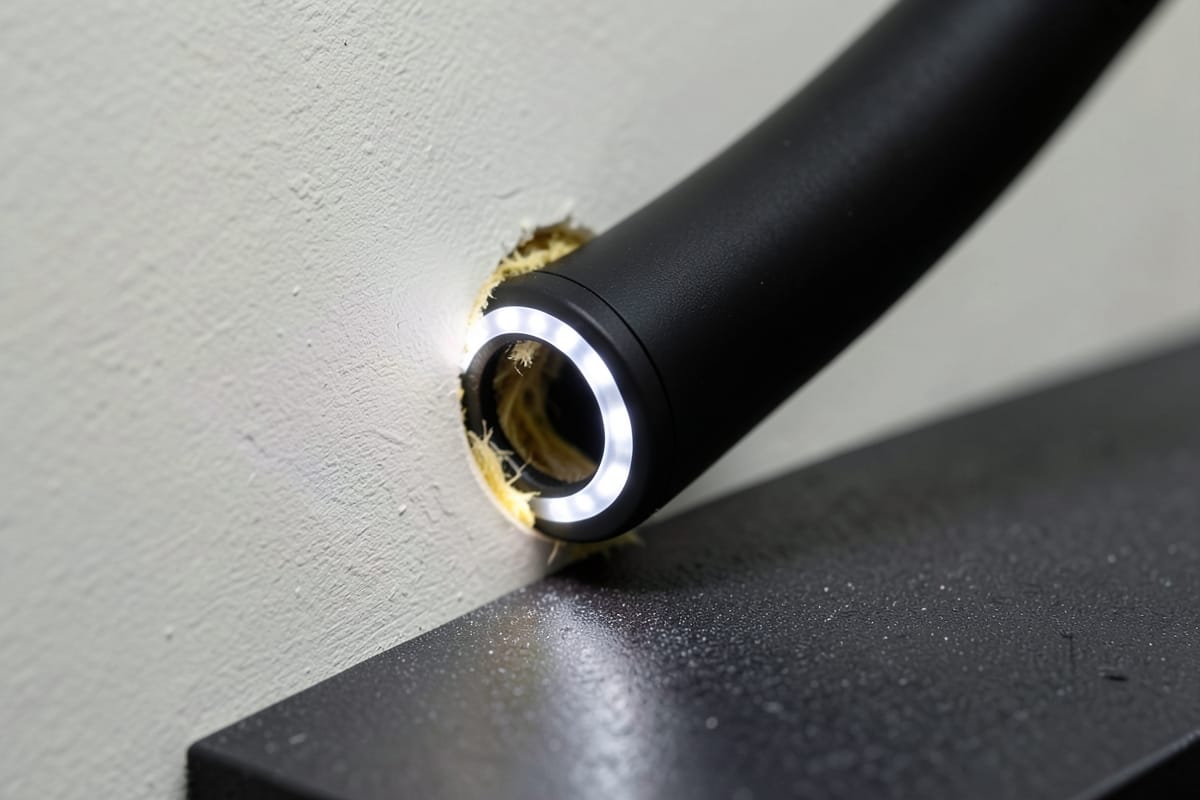
Start with the opening. A 3.9 mm probe passes almost any spark-plug hole and other very small gaps. A 5.5 mm probe passes most car plug holes and the small holes you would drill in drywall, which makes it the best all-round size. A 7.9–8 mm probe suits engine bays, vents and larger holes, and the 10 to 17 mm heads on rugged trade handhelds are for places where you can make or find a bigger opening.
Then consider reach. A few feet of cable is enough for an engine bay or a wall cavity; ducts and long runs need more, and a semi-rigid cable is easier to push and steer than a floppy one.
Single, dual or triple lens, or articulating
A single forward camera shows what is straight ahead. A dual-lens probe adds a side camera, and a triple-lens probe adds a second, often close-focus, side camera; you switch between them rather than twisting the cable. That makes them the practical choice for general work.
An articulating probe lets you steer the tip, which is worth paying for when the thing you need to see is around a corner, such as a cylinder wall. See our articulating borescope picks if that is your main job.
Screen, phone or Wi-Fi
A camera with its own screen is the quickest to use: switch on and look. A larger 7-inch screen is easier on the eyes in long sessions. Some screen cameras also connect over Wi-Fi: the Teslong NTS700 shares its live view with a phone or tablet, and the Klein ET19 sends photos and video to its app. Cameras that use your phone as the only screen cost less; our iPhone and Android pages cover them.
What IP67 means for a camera probe
IP67, under the IEC 60529 standard, means dust-tight and protected against temporary immersion, up to 1 m for 30 minutes. That covers a wet engine bay or a dip into standing water, not hours submerged in a drain. Check what the rating covers: on many cameras it applies to the probe or camera, not the handset.
Looking inside a wall safely
Turn off the power to the circuits in the wall before you drill. Make the smallest hole the probe needs, where it will be hidden or easy to patch, and keep clear of outlets and switches, where wiring runs. Feed the probe in slowly and let the side camera do the looking; forcing a cable through insulation smears the lens.
Getting a sharp picture
Most inspection cameras have a fixed focus that is sharp only over a set range, often a few centimeters to several inches from the lens. If the picture is soft, move the tip closer or further away before you blame the camera, and turn the LEDs down if a nearby surface is washed out.
Frequently asked questions
- What is the best inspection camera?
- For general use, a thin dual-lens camera with its own screen, such as the Teslong NTS500 (5.5 mm, 5-inch screen). For trade work, the Klein Tools ET19 adds an armored cable and Wi-Fi sharing.
- Is an inspection camera the same as a borescope?
- Effectively yes. Inspection camera is the retail name for what is technically a video borescope: a camera on a cable feeding a screen or a phone.
- Can I use an inspection camera to look inside walls?
- Yes. Turn off the power to the circuits in that wall, drill a small hole where it is easy to patch, and feed the probe in. A side camera lets you scan the cavity without twisting the cable.
- Can an inspection camera go down a drain?
- A few feet, yes, if the probe is waterproof. For sewer lines and long drain runs you need a pipe inspection camera with a stiff push cable, a reel and an IP68 head.
- Is the Milwaukee M12 inspection camera worth it?
- If you already use Milwaukee's M12 batteries, it is a tough, straightforward jobsite camera. Its 10 mm head is too large for small openings, where a 5.5 mm scope is the better tool.
- What resolution should an inspection camera have?
- Lighting and focus matter more than headline resolution in a dark cavity. A 720p or 1080p camera with adjustable LEDs gives a clear picture for most work.
- Can an inspection camera see through walls?
- No. It sees only what is in front of the lens, so it needs a way in: an existing gap, a vent, an outlet box with the power off, or a small drilled hole.
- How do I retrieve something with an inspection camera?
- Most cameras come with a hook and a magnet that attach to the tip. Use the camera to find the part, then snag it; a magnet only picks up steel parts.
- Are inspection cameras worth it for homeowners?
- Usually, if you do your own repairs. One look inside a wall, a vent or an appliance can save you from cutting in the wrong place.
Related reading
- Aeronautics diploma
- Engineering degree
- BAMEC (DGCA)
- QC-trained
- ~2 yrs tool management
SK spent over two decades in aircraft maintenance, working hands-on with aero-engine systems and flight data recorder systems, borescope-inspecting turbine and compressor blades, and spending almost two years in a dedicated tool bay. He holds a diploma in mechanical engineering (aeronautics), an associate degree in science, an engineering degree and a Basic Aircraft Maintenance Engineer's Certificate (BAMEC) from DGCA, and has completed quality-control and aviation fuels & lubricants training. GaugeGrade applies the same inspection, torque and tool-management standards to the tools everyday mechanics, DIYers and trades actually buy.