The Best Torque Screwdrivers for Electricians
Since the 2017 edition, the National Electrical Code has required terminals to be tightened to the manufacturer's torque value, and since 2020 with "an approved means", the first example of which is a torque tool. For breakers, receptacles and terminal blocks, that tool is a torque screwdriver. The right one has a range that brackets your terminals, insulation you can trust near live parts, and an accuracy figure its maker actually publishes. These are the best, with every spec checked against the maker's documents and the gaps noted.

- 6 picks compared
- Specs checked against maker data
- No paid placements
GaugeGrade is reader-supported. When you buy through links on our site we may earn an affiliate commission at no extra cost to you. We only recommend gear we have researched against verified manufacturer specifications.
- 1For most electricians, the Wiha 28781: an insulated, adjustable 10–50 in-lb set, individually tested at 10,000 V and rated for 1,000 V, rated ±6%, with 15 blades and a calibration certificate.
- 2Bigger breakers? Wiha's 28792 runs 18–62 in-lb. Specs in N·m? Wera's 7441 VDE set adjusts by hand from 1.2 to 3.0 N·m.
- 3Torque it right the first time. NEMA advises against re-torquing a finished termination; if a check is unavoidable, it says to de-energize the circuit and set the tool to 90% of the value.
- 1Best overallWiha 28781 Insulated TorqueVario-S Set, 10–50 in-lb (20 pieces)
- 2Best for breakersWiha 28792 Insulated TorqueVario-S Set, 18–62 in-lb (16 pieces)
- 3Best for N·m specsWera Kraftform Kompakt VDE 15 Torque Set (7441 VDE, 1.2–3.0 N·m)
- 4Fastest for panel workWera Kraftform Kompakt VDE Safe-Torque Speed Control Cabinet Set 1 (23 pieces)
- 5Best budget insulatedFIRSTINFO H5287 VDE Insulated Torque Screwdriver Set, 10–50 in-lb
- 6Best uninsulatedIDEAL 35-936 Adjustable Torque Screwdriver Kit (7 pieces)
What we recommend
Compare the key specs side by side, then read the full notes on each pick below.
- Range
- 10–50 in-lb, 2 in-lb steps
- Insulated
- Yes: 10,000 V tested, 1,000 V rated
- Accuracy
- ±6%(ISO 6789)
- Range
- 18–62 in-lb, 2 in-lb steps
- Insulated
- Yes: 10,000 V tested, 1,000 V rated
- Accuracy
- ±6%(ISO 6789)
- Range
- 1.2–3.0 N·m (10.6–26.6 lb-in), 0.1 N·m steps
- Insulated
- Yes: 10,000 V tested(IEC 60900)
- Accuracy
- ±6%(EN ISO 6789)
- 4
 Fastest for panel workWera Kraftform Kompakt VDE Safe-Torque Speed Control Cabinet Set 1 (23 pieces)
- Range
- 0.4–4.0 N·m in 10 fixed values
- Insulated
- Yes: 10,000 V tested(IEC 60900)
- Accuracy
- ±10%
- Range
- 10–50 in-lb, 0.5 in-lb steps
- Insulated
- Claimed: 1,000 V(IEC 60900)
- Accuracy
- ±6%
- Range
- 2–36 in-lb, 2 in-lb steps
- Insulated
- No: de-energized work only
- Accuracy
- ±6% both directions(from 20% of scale)
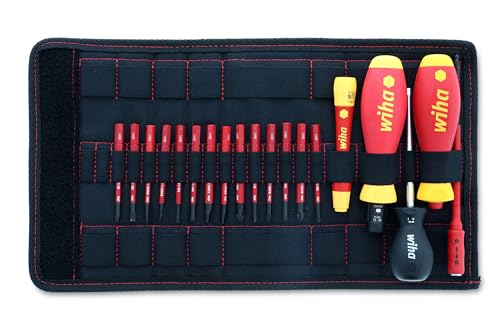


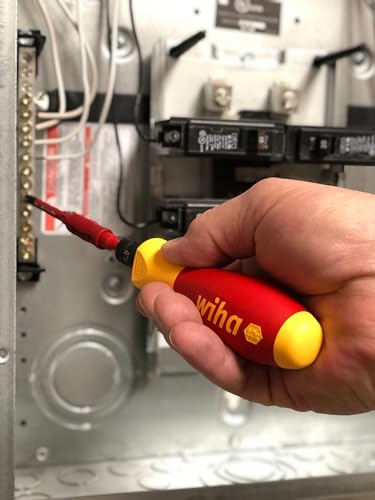
Wiha 28781 Insulated TorqueVario-S Set, 10–50 in-lb (20 pieces)
Receptacles, terminal screws and branch breakers up to 50 lb-in
- Range
- 10–50 in-lb, 2 in-lb steps
- Insulated
- Yes: 10,000 V tested, 1,000 V rated
- Accuracy
- ±6% (ISO 6789)
- Handle and 15 SlimLine blades individually tested at 10,000 V
- Set with a key, so the value can't be knocked off in a pouch
- Serialized, with a calibration certificate
- Blades include Xeno, Square and Torx
- Tops out at 50 in-lb, the value for a QO 70–125 A terminal
- One UK forum user reports Wiha's bits falling out
The set to buy if you torque terminals for a living. The 10–50 in-lb handle covers receptacle and switch screws, No. 10 terminal screws and Square D's QO branch breakers up to 50 lb-in, and the whole kit is insulated: Wiha individually tests each tool at 10,000 V AC and rates it for 1,000 V AC.
It sets in 2 in-lb steps with a separate key, so a value can't be knocked off in a pouch, and it comes serialized with a calibration certificate. Its limits: 50 in-lb tops out exactly at a QO 70–125 A terminal, and one UK forum user reports Wiha's bits falling out.
Based on the maker's specifications and manual and the published reviews linked below, not on our own test of this unit.
Setup, everyday use and what others found
Setup & use · per the maker
- One insulated TorqueVario-S handle, 10–50 in-lb. Wiha's spec table gives 2 in-lb increments for its 10–50 in-lb insulated handles.
- The value is set with Wiha's torque adjustment tool, which is included, and read in a window on the handle. The scale is in in-lb only.
- An audible and perceptible click signals the set torque, and the mechanism resets for the next screw. Wiha's pages describe extra capacity for loosening, quoted as 50% on this set's page and about 30% on the handle's page.
- Rated ±6% and meets EN ISO 6789 and ASME B107.14M, per Wiha. Each tool is serialized and comes with a certificate of calibration.
- Insulation: individually tested to 10,000 V AC and rated to 1,000 V AC; Wiha lists ASTM F1505 and EN/IEC 60900 among the standards it meets.
- Blades: 15 insulated SlimLine blades, slotted 2.5, 3.5, 4.0 and 6.5 mm, Phillips #1 and two #2, Square #1 and #2, Torx T10, T15, T20 and T25, and Xeno #1 and #2. Wiha sells it as a 20-piece set.
- Wiha guarantees its certified torque handles for one year or 5,000 cycles. After that it replaces the handle at a reduced cost rather than recalibrating it. Made in Germany.
What others found
On Mike Holt's forum in January 2025, one electrician wrote: "I have a wiha 10-50 in-lbs… it works quite well," while noting it came with "all short reach bits and can't fit inside certain breakers or lugs."
In an April 2024 thread, another member said he really likes the Wiha TorqueVario, and a third called Wiha "great but somewhat overpriced."
On a UK electricians' forum, one user said of Wiha's drivers that "the bits keep falling out," and that he'd lost about six in six months.
We found no independent test with measurements of this set, and the forum reports don't always say which Wiha TorqueVario-S model they mean.
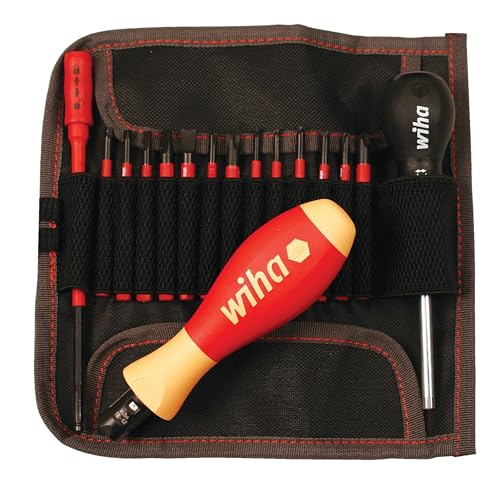


Wiha 28792 Insulated TorqueVario-S Set, 18–62 in-lb (16 pieces)
Breaker terminals from 36 to 50 lb-in, and others up to 62
- Range
- 18–62 in-lb, 2 in-lb steps
- Insulated
- Yes: 10,000 V tested, 1,000 V rated
- Accuracy
- ±6% (ISO 6789)
- Covers Square D's QO values of 36, 45 and 50 lb-in with room to spare
- 13 insulated SlimLine blades, including Torx T8 to T20
- Serialized, with a calibration certificate
- Starts at 18 in-lb, the top of the usual receptacle range
- Needs its adjustment tool to change the value
The same insulated TorqueVario-S system with an 18–62 in-lb handle, for panels where the breaker terminals sit at the top of a 10–50 in-lb tool or above it. Its range covers Square D's QO values of 36, 45 and 50 lb-in with room to spare.
The trade-off is the bottom end. At 18 in-lb it starts at the top of the 14–18 in-lb range quoted for receptacles, so it's the second tool for a service electrician, not the only one.
Based on the maker's specifications and manual and the published reviews linked below, not on our own test of this unit.
Setup, everyday use and what others found
Setup & use · per the maker
- One insulated TorqueVario-S handle, 18–62 in-lb, set with the included torque adjustment tool and read in a direct-reading window. Wiha's spec table gives 2 in-lb increments for its 18–62 in-lb handles.
- Clicks at the set torque and resets for the next screw, with extra torque available for loosening.
- Rated ±6%, serialized, with a certificate of calibration, per Wiha.
- Insulation: individually tested to 10,000 V AC and rated to 1,000 V AC, per Wiha.
- Blades: 13 insulated SlimLine blades, slotted 4.0, 5.5 and 6.5 mm, Phillips #1 and #2, Xeno #1 and #2, Torx T8, T10, T15 and T20, and Square #1 and #2.
- Same guarantee as the 10–50 in-lb set: one year or 5,000 cycles, then a replacement handle at a reduced cost. Made in Germany.
What others found
On Mike Holt's forum in 2018, a member wrote that "Wiha makes a truly superior, insulated, torque screwdriver (18-62 inch pound range). Highly recommend."
We found no independent test with measurements of this set.

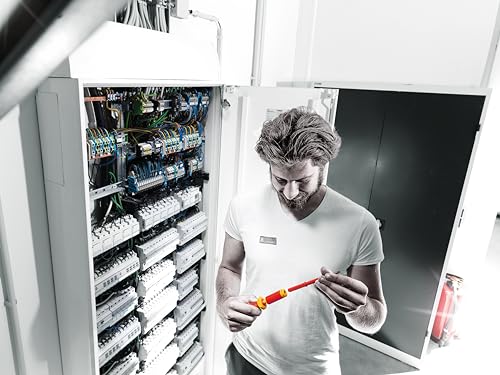

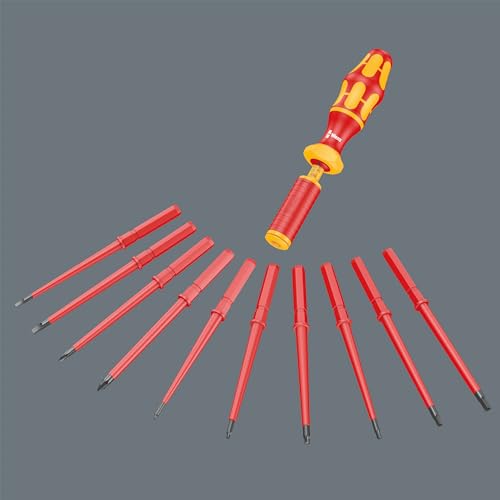


Wera Kraftform Kompakt VDE 15 Torque Set (7441 VDE, 1.2–3.0 N·m)
Control panels and terminal blocks with N·m values
- Range
- 1.2–3.0 N·m (10.6–26.6 lb-in), 0.1 N·m steps
- Insulated
- Yes: 10,000 V tested (IEC 60900)
- Accuracy
- ±6% (EN ISO 6789)
- Sets by hand, with no key, in 0.1 N·m steps
- 14 Kompakt VDE blades, including combination Pozidriv/slotted
- Unlimited torque for loosening
- Narrow range: won't reach a 36 lb-in breaker terminal
- N·m scale only, and Wera doesn't mention a calibration certificate
The insulated set to buy if your specs are in newton-meters: control panels, DIN-rail gear and imported equipment. The 7441 VDE handle sets by hand from 1.2 to 3.0 N·m in 0.1 N·m steps, with no key, and Wera rates it ±6% to EN ISO 6789.
Its range is narrow, 1.2–3.0 N·m or about 10.6–26.6 in-lb, and the scale is in N·m only. It won't reach a 36 lb-in breaker terminal.
Based on the maker's specifications and manual and the published reviews linked below, not on our own test of this unit.
Setup, everyday use and what others found
Setup & use · per the maker
- The 7441 VDE handle: 1.2–3.0 N·m with a scale graduation of 0.10 N·m, set by hand with no tool.
- A distinctly audible and noticeable signal at the set torque, and unlimited torque for loosening seized screws, per Wera.
- Measurement accuracy ±6% in accordance with EN ISO 6789.
- Individually tested at 10,000 V in accordance with IEC 60900, for work on loads up to 1,000 V.
- Fourteen Kraftform Kompakt VDE blades, 154 mm: Phillips 1 and 2, Pozidriv 1 and 2, combination Pozidriv/slotted #1 and #2, Torx TX10, TX15, TX20 and TX25, and slotted 0.4 × 2.5, 0.6 × 3.5, 0.8 × 4 and 1 × 5.5 mm, in a pouch.
- Wera says to recalibrate after 5,000 load cycles or every 12 months at the latest, and offers factory calibration. Wera's datasheet gives the country of origin as the Czech Republic; the Amazon listing says Germany.
What others found
On a UK electricians' forum, one owner wrote: "I have the Wera set based on the '7441 VDE' driver, seems quite nice but 1.2-3 Nm range only."
In an earlier thread on the same forum, another member said the Wera was "very easy to adjust."
Professional Electrician noted that no special tools or disassembly are needed to change the 7441 VDE's torque setting.
We found no independent test with measurements, and Wera doesn't say whether a calibration certificate is included.


Wera Kraftform Kompakt VDE Safe-Torque Speed Control Cabinet Set 1 (23 pieces)
Panel builders working to a handful of standard N·m values
- Range
- 0.4–4.0 N·m in 10 fixed values
- Insulated
- Yes: 10,000 V tested (IEC 60900)
- Accuracy
- ±10%
- Two drivers, each with five fixed values
- Slips at the set torque in both directions
- Torque Lock position for loosening
- 20 VDE blades plus a plain VDE handle
- Rated ±10%, looser than the ±6% ISO 6789 allows
- Only ten fixed values, nothing in between
The quickest set here for panel and control-cabinet work. Two insulated drivers cover ten fixed values from 0.4 to 4.0 N·m, and both slip at the set torque in either direction, so they can't overtighten.
The price of speed is accuracy: Wera rates these drivers ±10%, not the ±6% of its adjustable 7441 VDE, and cites no ISO standard for them. You also get only the ten values, nothing in between.
Based on the maker's specifications and manual and the published reviews linked below, not on our own test of this unit.
Setup, everyday use and what others found
Setup & use · per the maker
- Two torque drivers: the 7508 VDE with five values of 0.4, 0.8, 1.2, 1.6 and 2.0 N·m, and the 7516 VDE with 2.4, 2.8, 3.2, 3.6 and 4.0 N·m (about 3.5 to 35.4 lb-in across both).
- Wera's pages say only that the values are extremely fast to set; a German tool site describes a sliding switch on the handle.
- A slip-over function that can't be overtightened, clockwise and counter-clockwise, with an audible and noticeable signal at the set torque. A separate Torque Lock position gives unlimited torque for loosening and tightening.
- Accuracy ±10%, per Wera.
- Each tool individually tested at 10,000 V in accordance with IEC 60900, for loads up to 1,000 V, and GS-tested.
- Twenty Kraftform Kompakt VDE blades, 157 mm, including Phillips, Pozidriv, combination PH/slotted and PZ/slotted, Torx and slotted, plus an 817 VDE handle for using the blades without torque control. Wera launched the line in May 2025 and makes it in the Czech Republic.
What others found
The Safe-Torque Speed VDE line is new, and we found no independent test or owner report. Wera doesn't say whether a calibration certificate is included.


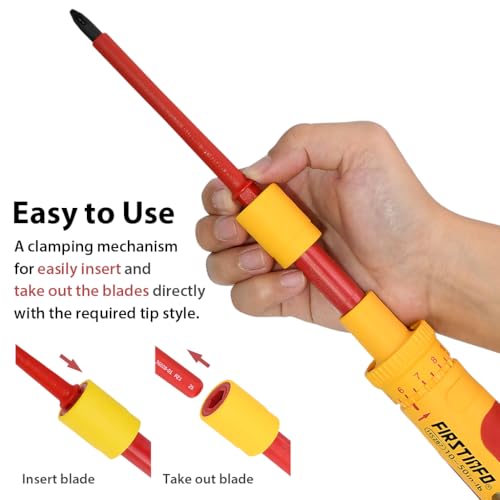


FIRSTINFO H5287 VDE Insulated Torque Screwdriver Set, 10–50 in-lb
An insulated, adjustable torque driver on a tighter budget
- Range
- 10–50 in-lb, 0.5 in-lb steps
- Insulated
- Claimed: 1,000 V (IEC 60900)
- Accuracy
- ±6%
- Finer 0.5 in-lb steps than Wiha's 2 in-lb
- Slips at the set value, so it can't overtighten
- Eight insulated blades and a calibration certificate
- No VDE certificate number or 10,000 V test statement published
- No independent review found; 12-month warranty
The low-cost way to an insulated, adjustable torque screwdriver with a certificate. It covers 10–50 in-lb in 0.5 in-lb steps, finer than Wiha's 2 in-lb, slips at the set value, and FIRSTINFO rates it ±6%.
The insulation claim is thinner than Wiha's or Wera's. FIRSTINFO calls the set VDE certified and says it meets IEC 60900, but publishes no certificate number and no 10,000 V individual-test statement. Treat it as a torque tool first, and don't let an insulated handle talk you into working live.
Based on the maker's specifications and manual and the published reviews linked below, not on our own test of this unit.
Setup, everyday use and what others found
Setup & use · per the maker
- 10–50 in-lb with 0.5 in-lb graduations, rated ±6%, per FIRSTINFO. It doesn't say whether the rating holds counter-clockwise.
- The setting locks after adjustment, and the driver slips once the set torque is reached, so it can't overtighten the screw.
- FIRSTINFO says the set meets IEC 60900, DIN ISO 6789 and ASME B107.300-2010, and calls it VDE certified for electrical equipment up to 1,000 V AC or 1,500 V DC.
- Eight interchangeable insulated blades: slotted 3, 4, 5.5 and 6.5 mm, Phillips #1 and #2, and Pozidriv PZ1 and PZ2.
- A calibration certificate is included. FIRSTINFO designs and makes it in Taiwan and gives 12 months of after-sales warranty support.
- An N·m version, the H5284, covers 1–6 N·m.
What others found
We found no independent test and no owner reports outside Amazon, and no VDE certificate we could check.

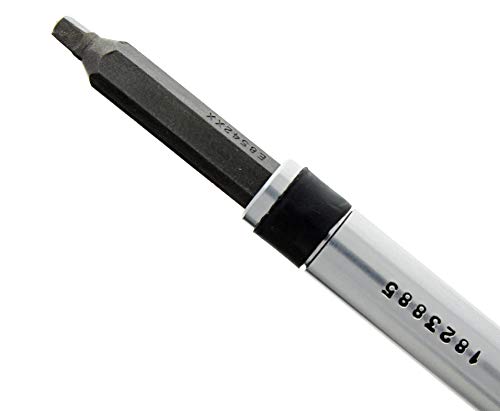

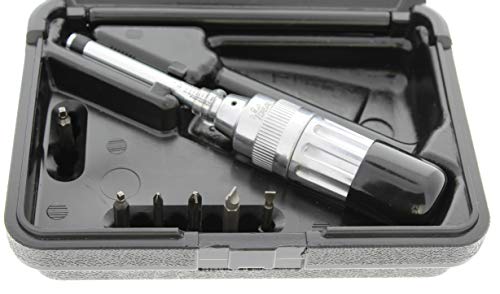

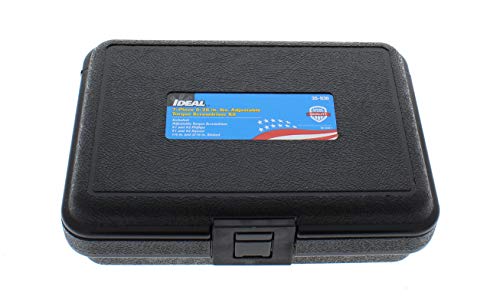


IDEAL 35-936 Adjustable Torque Screwdriver Kit (7 pieces)
De-energized terminations up to 36 lb-in
- Range
- 2–36 in-lb, 2 in-lb steps
- Insulated
- No: de-energized work only
- Accuracy
- ±6% both directions (from 20% of scale)
- Accuracy stated in both directions, to ASME B107.300 and ISO 6789
- Key-set, with a screw to fix the value in place
- Made in the USA, with a limited lifetime warranty
- Not insulated: IDEAL says not to use it on live circuits
- Stops at 36 lb-in, short of larger QO terminals
The uninsulated pick, for de-energized work, from an electrical brand. IDEAL documents its accuracy more completely than any other maker here: ±6% of the set value from 20% to 100% of capacity in both directions, and ±1.2% of capacity below that, to ASME B107.300 and ISO 6789.
It tops out at 36 in-lb, enough for receptacles, No. 10 terminal screws and 10–30 A QO breakers, but not the 45 and 50 lb-in terminals on bigger ones. IDEAL's instructions say plainly: do not use on live circuits.
Based on the maker's specifications and manual and the published reviews linked below, not on our own test of this unit.
Setup, everyday use and what others found
Setup & use · per the maker
- 2–36 in-lb in 2 in-lb graduations, per IDEAL's instruction sheet. Retail listings say 0–36.
- Set with a torque key: turn it clockwise to increase, then fold it back to lock. IDEAL includes a screw to fix the key in place if you want the value to stay put.
- A torque-limiting clutch disengages at the set value with an audible and tactile click, so it can't overtighten.
- Rated ±6% of the set value from 20% to 100% of capacity and ±1.2% of capacity below 20%, clockwise and counter-clockwise, per IDEAL.
- A 1/4-inch hex bit holder, with Phillips #1 and #2, Square #1 and #2, and 1/4-inch and 3/16-inch slotted bits, in a hard case.
- Not insulated. IDEAL gives a recalibration procedure using a torque tester but no interval, and doesn't mention a calibration certificate. Limited lifetime warranty. Made in the USA.
What others found
We found no independent test and no owner reports of the 35-936 outside Amazon.
- Aeronautics diploma
- Engineering degree
- BAMEC (DGCA)
- QC-trained
- ~2 yrs tool management
Why you should trust us
SK Kutubuddin spent almost two years in a dedicated tool bay during over two decades of aircraft maintenance, where every torque tool carried a calibration label and its paperwork was read before the tool was trusted. That is the standard behind this page: a torque screwdriver earns a place here on what its maker documents about range, accuracy and insulation, not on what its listing implies.
Every range, accuracy figure and insulation claim below was checked against the maker's product page, datasheet or instruction sheet, and against the current Amazon listing, per our how-we-test method. Where a maker claims more than it documents, we say so. We found no independent test with measurements for any tool here. This is a buying guide built on verified specs, the electrical code and inspection experience, not a lab test.
Who this is for
This page is for electricians, apprentices and maintenance techs who terminate conductors on breakers, receptacles, switches and terminal blocks, where the equipment or its instructions give a tightening torque and the NEC requires you to meet it.
If you work on electronics, optics or small hardware rather than electrical terminations, our torque screwdriver picks cover lower ranges and finer steps. For lugs above about 60 lb-in, you need an inch-pound torque wrench, not a screwdriver.
- Service and residential electricians landing branch circuits on breakers and devices
- Panel builders and controls techs working to N·m values on terminal blocks
- Anyone whose inspector asks how the listed torque was achieved
- Buyers weighing a premium insulated set against a budget one or an uninsulated driver
How we picked
We started from the torque values electricians actually meet and the rules that apply, then checked each candidate against its maker's own documents.
- 01
A range that fits the terminals
Receptacle screws, terminal screws and branch breakers mostly sit between about 14 and 50 lb-in. We picked tools whose range brackets those values, and noted where each one stops.
- 02
Insulation that's documented
We gave the most weight to tools individually tested at 10,000 V and rated for 1,000 V to IEC 60900 or ASTM F1505, and said so plainly where a maker claims insulation without that evidence.
- 03
Accuracy stated properly
The standard for torque screwdrivers, ISO 6789-1, allows ±6%. We printed each maker's figure, including where it's looser, and where it only applies from 20% of the scale.
- 04
A setting that stays set
A value that shifts in a tool pouch is worse than no value. We noted how each tool is set and locked: by key, by hand, by a fixed switch, or by a key you can screw in place.
What to know before you buy
What the NEC requires
Section 110.14(D) of the National Electrical Code covers terminal connection torque. The 2017 edition required a calibrated torque tool wherever a tightening torque was given as a numeric value on the equipment or in the manufacturer's instructions, unless the manufacturer gave an alternative method. The 2020 edition broadened it: torque values "shall be as indicated on equipment or in installation instructions provided by the manufacturer," and "an approved means shall be used to achieve the indicated torque value." The 2023 edition kept that requirement, and NFPA's second-draft report for 2026 shows only editorial changes to its notes.
The 2020 wording dropped the word calibrated. "Thankfully they took out the calibration requirement," one Mike Holt forum member wrote. It isn't much of a relaxation. The first examples of an approved means in the 2020 edition's informational note are torque tools, alongside shear bolts and breakaway-style devices with visual indicators, and the NEC defines approved as acceptable to the authority having jurisdiction, usually your inspector. A torque screwdriver that has drifted out of tolerance doesn't achieve the indicated value.
Where a manufacturer gives no value, the code's informational note points to the torque tables in UL 486A-486B's Informative Annex I, and the NEC has carried those tables in an informative annex of its own. Neither is a requirement: the label and the installation instructions come first.
The torque values electricians actually meet
Most terminations a screwdriver handles sit between about 14 and 50 lb-in. e-Hazard reports Leviton and Legrand specifying 14 to 18 in-lb for their receptacles, and UL 486A-486B gives 20 in-lb for a No. 10 slotted screw on 12 AWG wire. Square D lists 36 lb-in for its 10–30 A QO breakers, 45 lb-in for 35–70 A one- and two-pole and 40–60 A three-pole breakers, 50 lb-in for the 70–125 A range, and 25 lb-in for tandems.
Above that, a screwdriver is the wrong tool. The same Square D table gives 250 lb-in for its 150–200 A two-pole VH models, and UL 486A-486B's values for larger connectors run into the hundreds. So a torque screwdriver covers the terminals, and an inch-pound torque wrench covers the lugs. As one Mike Holt forum member put it: "Consider getting two: one for screws, and another for lugs."
Insulated or not
OSHA's rule is direct: "When working near exposed energized conductors or circuit parts, each employee shall use insulated tools or handling equipment if the tools or handling equipment might make contact with such conductors or parts." NFPA 70E has a similar requirement for work near exposed energized parts.
Insulated hand tools are made and tested to ASTM F1505 or IEC 60900, for circuits up to 1,000 V AC or 1,500 V DC. Wiha and Wera both state that every tool is individually tested at 10,000 V, and that is the claim to look for. FIRSTINFO says its set meets IEC 60900 but publishes no such test statement.
Insulation doesn't make torquing live terminals a good idea. NEMA says to de-energize the circuit before putting a torque tool on an existing connection, and IDEAL's instructions say not to use its uninsulated driver on live circuits. An insulated driver earns its price as protection when energized parts are nearby, such as the line side of a main breaker that's switched off, not as a way to skip lockout.
Don't re-torque to check
It's tempting to check an old termination by putting the torque screwdriver back on it. NEMA advises against it: "It is not recommended to 're-torque' terminations after the initial application of the proper torque during installation." Connections relax in service, so a later reading tells you little; as the 2011 NEC's torque annex, quoted in IAEI Magazine in July 2011, put it, checking torque values after installation "is not a reliable means of determining the values of torque applied at installation." And turning the screw to its full value again adds to what's there. One Mike Holt forum member: "you can't 'check' torque by torquing the same screw again, as you'll go over."
If a check is unavoidable, NEMA says to de-energize the circuit and set the tool to 90% of the recommended value. NFPA 70B-2023, as quoted by e-Hazard, likewise limits a check of existing torque with a calibrated torque wrench to 90% of the manufacturer's initial value. For finding loose connections in service, NEMA notes that NFPA 70B recommends infrared scans and visual inspection instead.
Accuracy and calibration
ISO 6789-1:2017 holds adjustable and preset torque screwdrivers to ±6%. Wiha, Wera's 7441 VDE, FIRSTINFO and IDEAL all claim that figure, and IDEAL applies it from 20% of the scale upward, with ±1.2% of capacity below that. Wera rates its Safe-Torque Speed drivers ±10% and cites no ISO standard for them.
ISO 6789-2 gives 12 months or 5,000 cycles, whichever comes first, as the default calibration interval, and calls for a check after an overload, a repair or rough handling. Wera says every 5,000 load cycles or every 12 months at the latest. Wiha guarantees its certified handles for a year or 5,000 cycles and then replaces them at a reduced cost rather than recalibrating them. Our calibration guide covers how torque tools are checked.
Where the guidance comes from
The code and industry guidance on this page comes from these documents. Product sources are listed under each pick.
- NFPA 70, National Electrical Code, section 110.14(D), 2017, 2020 and 2023 editions, and NFPA's second-draft report for the 2026 edition; Article 100's definition of approved, as quoted by Electrical Contractor (2016).
- NEMA Bulletin No. 120, Using Torque Tools for Terminating Building Wire (2021).
- NFPA 70B-2023, section 7.2.1.4.1, as quoted by e-Hazard (2024).
- IAEI Magazine, January 2015 and July 2011 (quoting the 2011 NEC's Annex I), on torque and electrical connections.
- Square D (Schneider Electric) FAQ FA128927, torque requirements for QO circuit breakers.
- UL 486A-486B values and Leviton and Legrand receptacle values, as quoted by e-Hazard (2024).
- OSHA 29 CFR 1910.335(a)(2)(i); ASTM F1505; IEC 60900.
- ISO 6789-1:2017 and ISO 6789-2:2017, hand torque tools.
- Mike Holt's Forum and ElectriciansForums.net threads on torque screwdrivers, 2018–2025.
Frequently asked questions
What is the best torque screwdriver for electricians?
For most, the Wiha 28781: an insulated, adjustable 10–50 in-lb set, individually tested at 10,000 V and rated ±6%, with a calibration certificate. For breaker terminals toward 50 lb-in and above, Wiha's 18–62 in-lb 28792; for N·m specs, Wera's 7441 VDE set.
Does the NEC require a torque screwdriver?
It requires terminals to be tightened to the manufacturer's value using an approved means (NEC 110.14(D), 2020 and 2023 editions). Torque tools are the first example the code gives, and the 2017 edition specifically required a calibrated torque tool. Your inspector decides what counts as approved.
What torque range does an electrician need?
Roughly 14–50 lb-in covers receptacles, terminal screws and most branch breakers: 14–18 in-lb is typical for receptacles, and Square D gives 36–50 lb-in for QO breakers up to 125 A. Larger breakers and lugs run to hundreds of lb-in and need a torque wrench.
Do electricians need an insulated torque screwdriver?
OSHA requires insulated tools when working near exposed energized parts the tool might contact, and in a panel that can include the line side of a main breaker that's switched off. Where the circuit is de-energized and no live parts are within reach, an uninsulated torque screwdriver is acceptable.
Should I re-torque breaker terminals during maintenance?
Not as routine. NEMA advises against re-torquing finished terminations. If a check is necessary, NEMA says to de-energize the circuit and set the tool to 90% of the recommended value, and NFPA 70B-2023 sets the same 90% limit.
How often should a torque screwdriver be calibrated?
ISO 6789-2's default is every 12 months or 5,000 cycles, whichever comes first, and after any overload or rough handling. Wera says 5,000 load cycles or 12 months at the latest; Wiha replaces its certified handles rather than recalibrating them.
Is the Klein torque screwdriver any good?
Klein's 57032 kit covers 5–40 in-lb, comes with a NIST-traceable calibration certificate and is assembled in the USA. But Klein publishes no accuracy figure for it on its page, datasheet or manual, and it isn't insulated. We picked the IDEAL 35-936 as the uninsulated option instead, because IDEAL states its accuracy in both directions.
Is Wiha's insulated torque screwdriver adjustable or preset?
Adjustable. Some retailers still sell the insulated sets under Wiha's older TorqueControl name, which sounds preset, but Wiha's own pages call them TorqueVario-S and describe a torque scale you set with an adjustment tool.
Should I buy a torque screwdriver in in-lb or N·m?
Buy the unit your labels use; Square D's QO values, for example, are given in both. Wera's VDE torque handles read in N·m only, and Wiha makes insulated handles in either unit but not both on one scale. One N·m is about 8.85 lb-in.
Can I use an insulated torque screwdriver on live circuits?
An insulated tool is protection for work near exposed energized parts, where OSHA requires it, not permission to work live. Torque terminations with the circuit de-energized, locked out and verified, and use insulated tools as the extra layer where live parts remain within reach.
Related reading
- Aeronautics diploma
- Engineering degree
- BAMEC (DGCA)
- QC-trained
- ~2 yrs tool management
SK spent over two decades in aircraft maintenance, working hands-on with aero-engine systems and flight data recorder systems, borescope-inspecting turbine and compressor blades, and spending almost two years in a dedicated tool bay. He holds a diploma in mechanical engineering (aeronautics), an associate degree in science, an engineering degree and a Basic Aircraft Maintenance Engineer's Certificate (BAMEC) from DGCA, and has completed quality-control and aviation fuels & lubricants training. GaugeGrade applies the same inspection, torque and tool-management standards to the tools everyday mechanics, DIYers and trades actually buy.