Inch-Pounds to Foot-Pounds Converter and Chart
To convert inch-pounds to foot-pounds, divide by 12: 89 in-lb is 7.42 ft-lb, and 200 in-lb is 16.67 ft-lb. To convert foot-pounds to inch-pounds, multiply by 12, so 18 ft-lb is 216 in-lb. The converter below also handles newton-meters and kilogram-force units, and the charts list common values in both directions.

- 3 reference charts
- 5 steps
- No paid placements
Torque unit converter
Divide inch-pounds by 12.
- Newton-meters (N·m)10.06 N·m
- Kilogram-force centimeters (kgf·cm)102.5 kgf·cm
- Kilogram-force meters (kgf·m)1.03 kgf·m
- Ounce-inches (oz-in)1,424 oz-in
1 ft-lb = 12 in-lb exactly; 1 ft-lb = 1.355818 N·m and 1 in-lb = 0.1129848 N·m (NIST SP 811). Results are rounded; set your wrench to the nearest mark it can show.
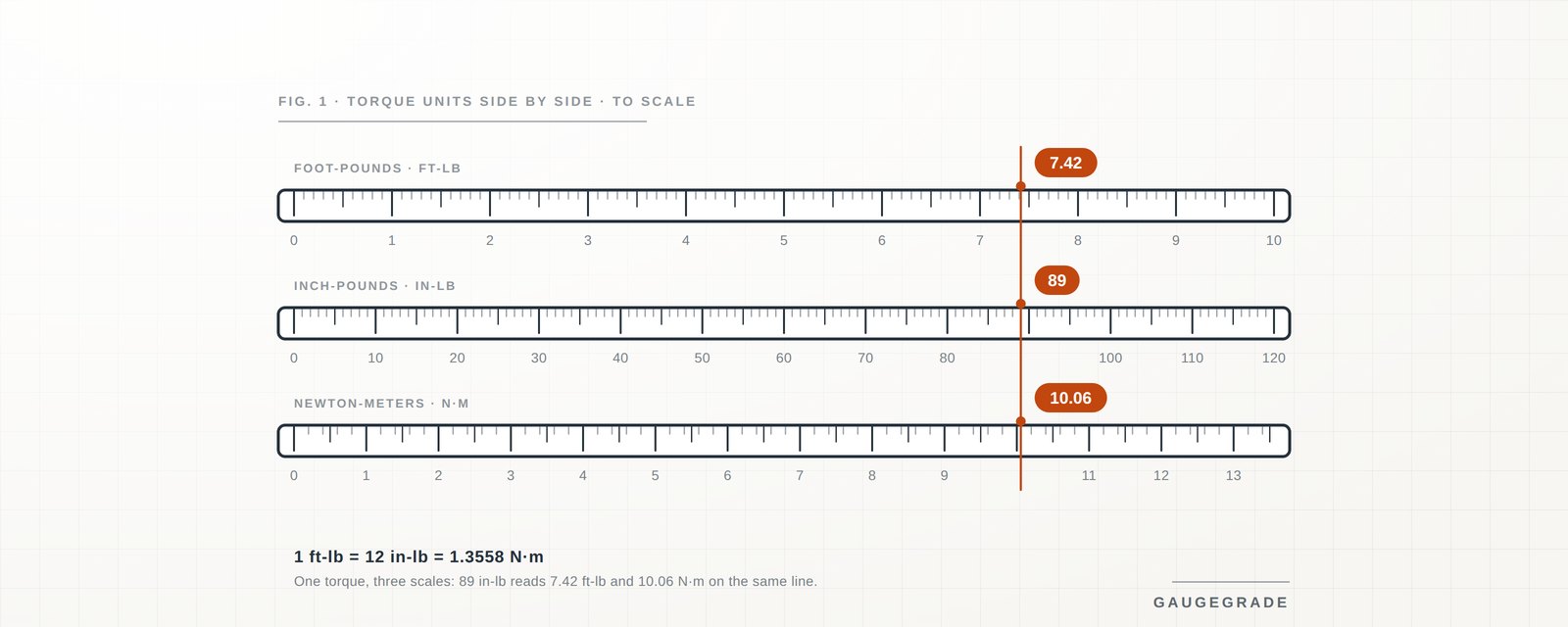
Torque is a force times the length of the lever it acts on. One pound of force on a lever one foot long gives one foot-pound; the same pound on a lever one inch long gives one inch-pound. A foot is 12 inches, so 1 foot-pound is exactly 12 inch-pounds, whatever the wrench or the job.
Newton-meters (N·m) are the metric unit, and much service data now lists both. One foot-pound is 1.3558 N·m and one inch-pound is 0.11298 N·m. Those factors follow from the definitions of the pound, the foot and standard gravity, and NIST publishes them in SP 811, its guide to using SI units.
Inch-pounds to foot-pounds chart
Divide inch-pounds by 12 for foot-pounds. The newton-meter column uses 1 in-lb = 0.1129848 N·m. Both are rounded to two decimal places.
| Inch-pounds | Foot-pounds | Newton-meters |
|---|---|---|
| 12 | 1.00 | 1.36 |
| 15 | 1.25 | 1.69 |
| 18 | 1.50 | 2.03 |
| 20 | 1.67 | 2.26 |
| 25 | 2.08 | 2.82 |
| 30 | 2.50 | 3.39 |
| 35 | 2.92 | 3.95 |
| 40 | 3.33 | 4.52 |
| 44 | 3.67 | 4.97 |
| 45 | 3.75 | 5.08 |
| 50 | 4.17 | 5.65 |
| 60 | 5.00 | 6.78 |
| 65 | 5.42 | 7.34 |
| 70 | 5.83 | 7.91 |
| 71 | 5.92 | 8.02 |
| 72 | 6.00 | 8.13 |
| 75 | 6.25 | 8.47 |
| 80 | 6.67 | 9.04 |
| 85 | 7.08 | 9.60 |
| 89 | 7.42 | 10.06 |
| 90 | 7.50 | 10.17 |
| 100 | 8.33 | 11.30 |
| 105 | 8.75 | 11.86 |
| 106 | 8.83 | 11.98 |
| 110 | 9.17 | 12.43 |
| 120 | 10.00 | 13.56 |
| 125 | 10.42 | 14.12 |
| 130 | 10.83 | 14.69 |
| 133 | 11.08 | 15.03 |
| 140 | 11.67 | 15.82 |
| 150 | 12.50 | 16.95 |
| 160 | 13.33 | 18.08 |
| 177 | 14.75 | 20.00 |
| 180 | 15.00 | 20.34 |
| 200 | 16.67 | 22.60 |
| 212 | 17.67 | 23.95 |
| 220 | 18.33 | 24.86 |
| 250 | 20.83 | 28.25 |
| 275 | 22.92 | 31.07 |
| 300 | 25.00 | 33.90 |
| 350 | 29.17 | 39.54 |
| 400 | 33.33 | 45.19 |
| 450 | 37.50 | 50.84 |
| 500 | 41.67 | 56.49 |
| 600 | 50.00 | 67.79 |
| 1,000 | 83.33 | 112.98 |
| 1,200 | 100.00 | 135.58 |
| 1,500 | 125.00 | 169.48 |
| 1,700 | 141.67 | 192.07 |
| 1,800 | 150.00 | 203.37 |
| 2,000 | 166.67 | 225.97 |
Foot-pounds to inch-pounds chart
Multiply foot-pounds by 12 for inch-pounds. That step is exact, so only the newton-meter column is rounded.
| Foot-pounds | Inch-pounds | Newton-meters |
|---|---|---|
| 1 | 12 | 1.36 |
| 2 | 24 | 2.71 |
| 3 | 36 | 4.07 |
| 4 | 48 | 5.42 |
| 5 | 60 | 6.78 |
| 6 | 72 | 8.13 |
| 7 | 84 | 9.49 |
| 8 | 96 | 10.85 |
| 9 | 108 | 12.20 |
| 10 | 120 | 13.56 |
| 11 | 132 | 14.91 |
| 12 | 144 | 16.27 |
| 13 | 156 | 17.63 |
| 14 | 168 | 18.98 |
| 15 | 180 | 20.34 |
| 16 | 192 | 21.69 |
| 17 | 204 | 23.05 |
| 18 | 216 | 24.40 |
| 20 | 240 | 27.12 |
| 22 | 264 | 29.83 |
| 24 | 288 | 32.54 |
| 25 | 300 | 33.90 |
| 30 | 360 | 40.67 |
| 35 | 420 | 47.45 |
| 40 | 480 | 54.23 |
| 45 | 540 | 61.01 |
| 50 | 600 | 67.79 |
| 60 | 720 | 81.35 |
| 75 | 900 | 101.69 |
| 80 | 960 | 108.47 |
| 100 | 1,200 | 135.58 |
Newton-meters to foot-pounds and inch-pounds
For a metric spec and a wrench marked in foot-pounds or inch-pounds: 1 N·m is 0.7376 ft-lb, or 8.851 in-lb.
| Newton-meters | Foot-pounds | Inch-pounds |
|---|---|---|
| 1 | 0.74 | 8.9 |
| 2 | 1.48 | 17.7 |
| 3 | 2.21 | 26.6 |
| 4 | 2.95 | 35.4 |
| 5 | 3.69 | 44.3 |
| 6 | 4.43 | 53.1 |
| 8 | 5.90 | 70.8 |
| 10 | 7.38 | 88.5 |
| 12 | 8.85 | 106.2 |
| 15 | 11.06 | 132.8 |
| 18 | 13.28 | 159.3 |
| 20 | 14.75 | 177.0 |
| 25 | 18.44 | 221.3 |
| 30 | 22.13 | 265.5 |
| 35 | 25.81 | 309.8 |
| 40 | 29.50 | 354.0 |
| 45 | 33.19 | 398.3 |
| 50 | 36.88 | 442.5 |
| 60 | 44.25 | 531.0 |
| 70 | 51.63 | 619.6 |
| 80 | 59.00 | 708.1 |
| 100 | 73.76 | 885.1 |
| 120 | 88.51 | 1062.1 |
| 150 | 110.63 | 1327.6 |
| 200 | 147.51 | 1770.1 |
| 250 | 184.39 | 2212.7 |
| 300 | 221.27 | 2655.2 |
All three charts are calculated from the exact definitions: 1 ft-lb = 12 in-lb = 1.3558179 N·m (NIST SP 811 lists 1.355 818).
How to convert torque units by hand
Check the unit on the spec
Inch-pounds may be written in-lb, lb-in, in·lbf or lbf·in, and foot-pounds ft-lb, lb-ft, ft·lbf or lbf·ft. The order of the words doesn't change a torque value. What matters is whether it says inch or foot, or is metric instead.
Inch-pounds to foot-pounds: divide by 12
89 ÷ 12 = 7.42 ft-lb. 106 ÷ 12 = 8.83 ft-lb. 250 ÷ 12 = 20.83 ft-lb.
Foot-pounds to inch-pounds: multiply by 12
18 × 12 = 216 in-lb. 10 × 12 = 120 in-lb. 25 × 12 = 300 in-lb.
To or from newton-meters
Multiply foot-pounds by 1.3558 for N·m, or inch-pounds by 0.11298. Going the other way, multiply N·m by 0.7376 for foot-pounds, or by 8.851 for inch-pounds. So 25 N·m is 18.44 ft-lb, or 221.3 in-lb.
Set the nearest mark your wrench can show
Round to your wrench's graduations, and use a wrench whose range puts the value well inside its scale: many makers rate accuracy only from 20% of full scale upward. A 7.42 ft-lb spec sits below 20% of most 3/8-inch click wrenches, so set 89 in-lb on an inch-pound torque wrench instead.
The 12× mistake to avoid
The conversion error that does real damage isn't a rounding slip. It's setting an inch-pound value on a foot-pound scale. Set 89 on a foot-pound wrench when the spec says 89 in-lb and the fastener gets twelve times the intended torque, 1,068 in-lb, far more than a small fastener is meant to take. Make the opposite mistake, a foot-pound value set in inch-pounds, and the fastener gets a twelfth of its torque and may work loose.
Before you pull, read the unit on the spec and the unit on the wrench, and convert if they differ. Many wrenches carry two scales, so check you're reading the right one. For small values, a torque screwdriver or an inch-pound wrench is easier to set accurately than a foot-pound wrench near the bottom of its range.
Foot-pounds or pound-feet?
Some manuals write lb-ft (pound-feet) for torque and keep ft-lb (foot-pounds) for work and energy. NIST's SP 811 follows that convention: it lists torque as the pound-force foot (lbf·ft) and the foot pound-force (ft·lbf) as a unit of energy. Both convert with the same factor, 1.355818, so for a torque spec 1 lb-ft is 1 ft-lb, or 12 in-lb.
Kilogram-force and ounce-inch units
Some service data, including Mitsubishi Electric and LG air-conditioner installation manuals, gives torque in kilogram-force centimeters (kgf·cm, often written kg-cm) or kilogram-force meters (kgf·m). One kgf·m is 9.80665 N·m exactly, and one kgf·cm is a hundredth of that.
Mitsubishi's manual for its MSZ-FS wall units, for example, gives the 1/4-inch flare nut as 140–180 kgf·cm, alongside 13.7–17.7 N·m and 10–13 ft-lb. 140 kgf·cm works out to 13.73 N·m, 10.13 ft-lb or 121.5 in-lb. For those flare nuts, see our open-end torque wrench guide.
Very small screws are sometimes specified in ounce-inches (oz-in, or ozf·in). A pound is 16 ounces, so 16 oz-in is 1 in-lb, and 1 oz-in is 0.00706 N·m. The converter above handles kilogram-force and ounce-inch units too.
Where the numbers come from
The conversion factors and examples on this page come from these documents.
- NIST Special Publication 811, Guide for the Use of the International System of Units (SI), Appendix B: factors for the pound-force foot, pound-force inch, kilogram-force meter and ounce-force inch.
- Mitsubishi Electric installation manual for MSZ-FS wall units (JG79J820H01): flare-nut torques in ft-lb, kgf·cm and N·m.
- LG wall-mounted air conditioner installation manual (MFL67647124): flare-nut torques in kgf·cm and N·m.
- Tool makers' accuracy ratings from 20% to 100% of scale, as set out in our beam, click and digital guide.
- Aeronautics diploma
- Engineering degree
- BAMEC (DGCA)
- QC-trained
- ~2 yrs tool management
Why you should trust us
Aviation torque data mixes units: inch-pounds for small fasteners, foot-pounds for larger ones and newton-meters on metric equipment. Over two decades of aero-engine maintenance, including almost two years in a dedicated tool bay, SK Kutubuddin worked across all three, where a value set in the wrong unit is exactly the kind of error an independent inspection is there to catch.
The factors on this page follow from the exact definitions of the pound, the foot and standard gravity, and match those NIST lists in SP 811. Every chart value was calculated from them rather than copied from another chart. The converter uses the same factors, and the service-manual example was checked against the manufacturer's own installation manual.
Frequently asked questions
How many foot-pounds is 89 inch-pounds?
89 in-lb is 7.42 ft-lb (89 ÷ 12), or 10.06 N·m.
What is 200 inch-pounds in foot-pounds?
200 in-lb is 16.67 ft-lb (200 ÷ 12), or 22.60 N·m.
How many inch-pounds is 18 foot-pounds?
18 ft-lb is 216 in-lb (18 × 12), or 24.40 N·m.
How many inch-pounds are in a foot-pound?
Exactly 12, because a foot is 12 inches. Divide inch-pounds by 12 to get foot-pounds, and multiply foot-pounds by 12 to get inch-pounds.
How do I convert newton-meters to foot-pounds?
Multiply by 0.7376, or divide by 1.3558. For example, 10 N·m is 7.38 ft-lb, or 88.5 in-lb.
Is lb-ft the same as ft-lb?
For torque, yes: it's the same value with the words in a different order. Some engineers write lb-ft for torque and ft-lb for energy, but the conversion factor is identical.
How many inch-pounds is 10 foot-pounds?
10 ft-lb is 120 in-lb (10 × 12), or 13.56 N·m.
How many foot-pounds is 106 inch-pounds?
106 in-lb is 8.83 ft-lb (106 ÷ 12), or 11.98 N·m.
Related reading
- Aeronautics diploma
- Engineering degree
- BAMEC (DGCA)
- QC-trained
- ~2 yrs tool management
SK spent over two decades in aircraft maintenance, working hands-on with aero-engine systems and flight data recorder systems, borescope-inspecting turbine and compressor blades, and spending almost two years in a dedicated tool bay. He holds a diploma in mechanical engineering (aeronautics), an associate degree in science, an engineering degree and a Basic Aircraft Maintenance Engineer's Certificate (BAMEC) from DGCA, and has completed quality-control and aviation fuels & lubricants training. GaugeGrade applies the same inspection, torque and tool-management standards to the tools everyday mechanics, DIYers and trades actually buy.