The Best Borescopes
A borescope puts a camera and lights on the end of a thin probe so you can see inside engines, machinery and anything else you cannot take apart just to look. The right one comes down to the probe's diameter, whether you can steer it or switch its view, and how it shows you the picture. These are the best borescopes across those choices, from a do-it-all dual-lens scope to a 3.9 mm articulating probe for cylinder work.

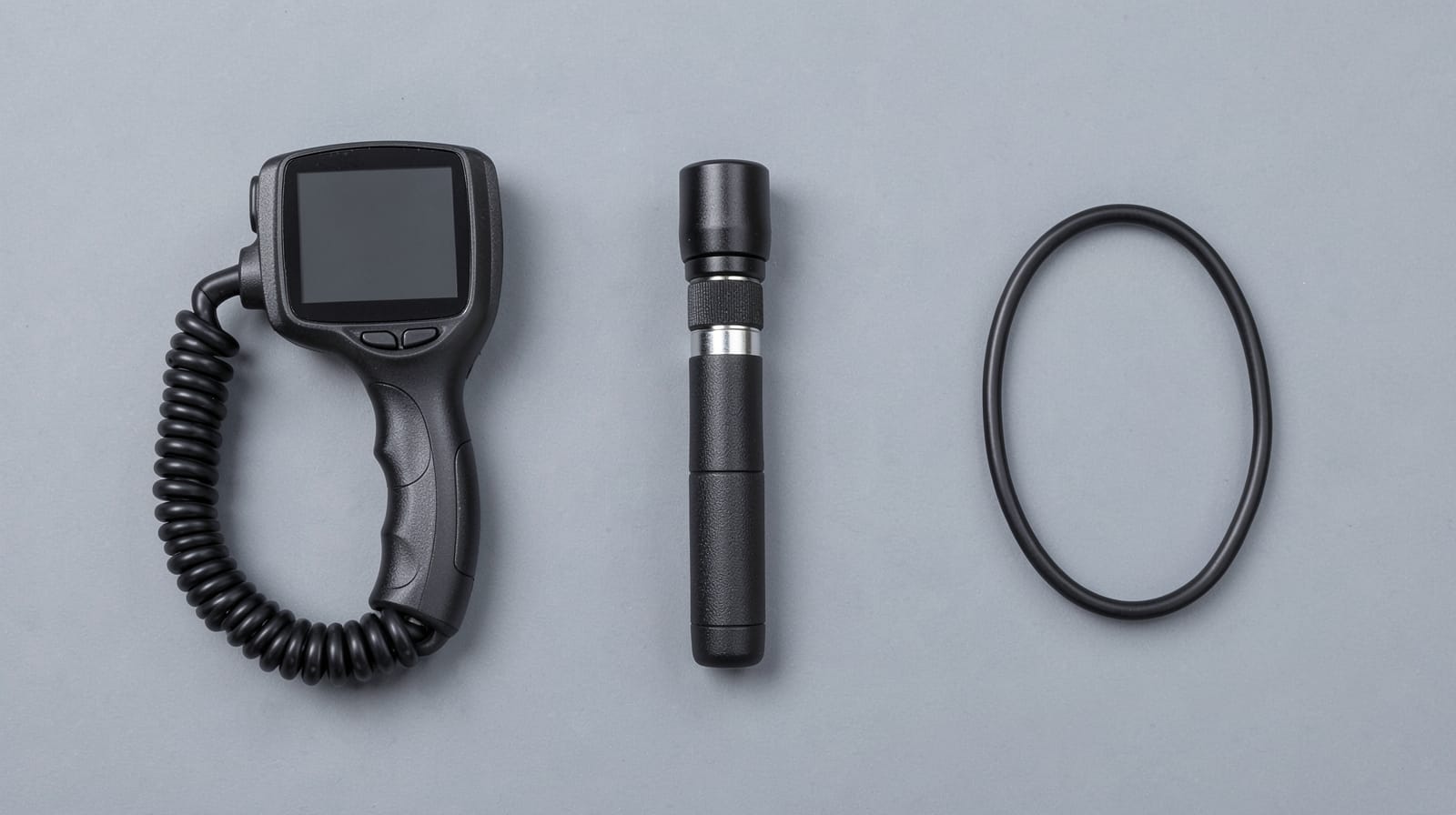
GaugeGrade is reader-supported. When you buy through links on our site we may earn an affiliate commission at no extra cost to you. We only recommend gear we have researched against verified manufacturer specifications.
- For most people, the Teslong NTS500 is the one to buy: a 5.5 mm dual-lens probe with its own 5-inch screen.
- If you need to see around corners, such as cylinder walls or the back of a component, an articulating probe is worth the extra cost; the Teslong TF600 steers four ways.
- Match the probe to the smallest opening: 3.9 mm clears almost any spark-plug hole, 5.5 mm passes most car plug holes, and 8 mm-class probes suit engine bays and larger openings.
- Best overallTeslong NTS500 Dual-Lens Borescope (5.5 mm, 9.8 ft)
- Best articulatingTeslong TF600 4-Way Articulating Borescope (6.5 mm, dual lens)
- Best two-way articulatingVividia VA-650 Two-Way Articulating Borescope (6.2 mm)
- Best for engine cylindersTeslong TF600 3.9mm 4-Way Articulating Borescope
- Best valueDEPSTECH DS300 5.5mm Inspection Camera
- Best for phonesDEPSTECH NTC55 2K Dual-Lens Borescope
What we recommend
- Probe dia
- 5.5mm
- View
- Front + side
- Display
- 5" screen(1280×720)
- Probe dia
- 6.5mm
- View
- 4-way steering, front + side
- Display
- 6" screen(1080p)
- Probe dia
- 6.2mm
- View
- 2-way steering, up to 180° each way
- Display
- 5"IPS screen
- Probe dia
- 3.9mm
- View
- 4-way steering(360°)
- Display
- 6"IPS screen
- Probe dia
- 5.5mm
- View
- Front
- Display
- 4.3"screen
- Probe dia
- 7.9mm
- View
- Front + side(2K)
- Display
- Phone, wired(USB-C or Lightning)

Teslong NTS500 Dual-Lens Borescope (5.5 mm, 9.8 ft)
Engine bays, machinery and most cylinder checks with one scope
- Probe dia
- 5.5 mm
- View
- Front + side
- Display
- 5" screen (1280×720)
- Front and side cameras, switched with one button
- 5.5 mm probe passes most car spark-plug holes
- IP67 probe; 3500 mAh battery, about 4–5 hours
- 9.8 ft cable
- No articulation: you aim the whole probe
- Video records at 1280×720

Teslong TF600 4-Way Articulating Borescope (6.5 mm, dual lens)
Steering into blind pockets and around corners
- Probe dia
- 6.5 mm
- View
- 4-way steering, front + side
- Display
- 6" screen (1080p)
- Joystick steering: 360° rotation and 210° bend
- Front and side cameras with 6+1 LEDs
- 6" 1920×1080 IPS screen, 6000 mAh battery
- 32 GB card; mic and speaker for voice notes
- Thicker 6.5 mm probe; the 3.9 mm TF600 slips into small openings more easily
- Costs more than a fixed-probe scope

Vividia VA-650 Two-Way Articulating Borescope (6.2 mm)
A compact steerable scope for machinery and engine work
- Probe dia
- 6.2 mm
- View
- 2-way steering, up to 180° each way
- Display
- 5" IPS screen
- Tip steers up to 180° in each direction
- Photos and video at 1280×720
- IP67 probe on a 1 m flexible metal tube
- 3000 mAh battery; 70° field of view
- Short 1 m (3.3 ft) probe
- Fixed focus, about 15–100 mm from the lens

Teslong TF600 3.9mm 4-Way Articulating Borescope
Cylinder walls, valves and other tight spaces through small openings
- Probe dia
- 3.9 mm
- View
- 4-way steering (360°)
- Display
- 6" IPS screen
- 3.9 mm probe clears almost any spark-plug hole
- 4-way articulation steers onto the bore walls and valves
- 6-inch IPS screen, LED-lit probe
- 5 ft flexible probe
- Near the top of Teslong's price range
- A fine articulating probe needs a careful hand

DEPSTECH DS300 5.5mm Inspection Camera
A thin-probe scope with its own screen at a fair price
- Probe dia
- 5.5 mm
- View
- Front
- Display
- 4.3" screen
- 4.3" screen, 1080p photos and video; 32 GB card included
- About 4 hours per charge; IP67 probe on a 16.5 ft semi-rigid cable
- Hook, magnet and side mirror in the box
- No side camera or articulation: the mirror attachment gives a side view
- Diesels and some small engines may need a thinner probe

DEPSTECH NTC55 2K Dual-Lens Borescope
The sharpest picture on a phone, with no Wi-Fi lag
- Probe dia
- 7.9 mm
- View
- Front + side (2K)
- Display
- Phone, wired (USB-C or Lightning)
- 2K image from front and side cameras, switched in the app
- Plugs in (USB-C, with a Lightning adapter): no Wi-Fi pairing
- 8+1 adjustable LEDs, IP67 probe; 16.5 ft cable
- 7.9 mm probe is tight in 12 mm plug holes and may not pass 10 mm ones
- Runs from the phone and ties up its port
Why you should trust us
For much of his over two decades in aviation, SK Kutubuddin's day-to-day work was borescope inspection of turbine and compressor blades, where the probe, the lighting and the method decide whether a defect is found. That is the lens for this page: which scope gets a clear, well-lit view of the right spot, and which features actually help you do that.
We compared borescopes across probe sizes, fixed, dual-lens and articulating designs, and screen and phone displays, and checked every figure against the manufacturer's specifications and the live listing, per our how-we-test method. Where a maker's published spec differs from the listing, we used the maker's. This is a buying guide built on verified specs and inspection experience, not a lab test.
Who this is for
This page is for anyone choosing a borescope for mechanical work: home mechanics, motorcyclists, technicians, machinists and anyone who needs to see inside something without taking it apart.
If your work is mostly in walls, ducts and around the house, our inspection camera picks lean toward trade cameras; for drains and sewer lines, see our pipe inspection cameras.
- Checking cylinders, valves and pistons through a spark-plug hole
- Looking inside engine bays, intakes and machinery
- Finding dropped parts in tight spaces
- Anyone choosing between a fixed and an articulating probe
How we picked
We picked one scope for each common need and verified each spec against the maker's data and the live listing.
A probe for the opening
We covered 3.9 mm probes for the tightest spark-plug holes through to 7.9 mm probes for engine bays, and listed each diameter.
A way to see to the side
We favored dual-lens and articulating probes, since a forward-only view down a hole misses the walls, where the evidence usually is.
A display that suits the job
We included screen scopes and a wired phone scope, and said plainly which is which.
Specs the maker stands behind
We used maker-published figures and corrected listing claims where they disagreed, such as the Vividia's articulation angle and focus range.
Probe diameter comes first
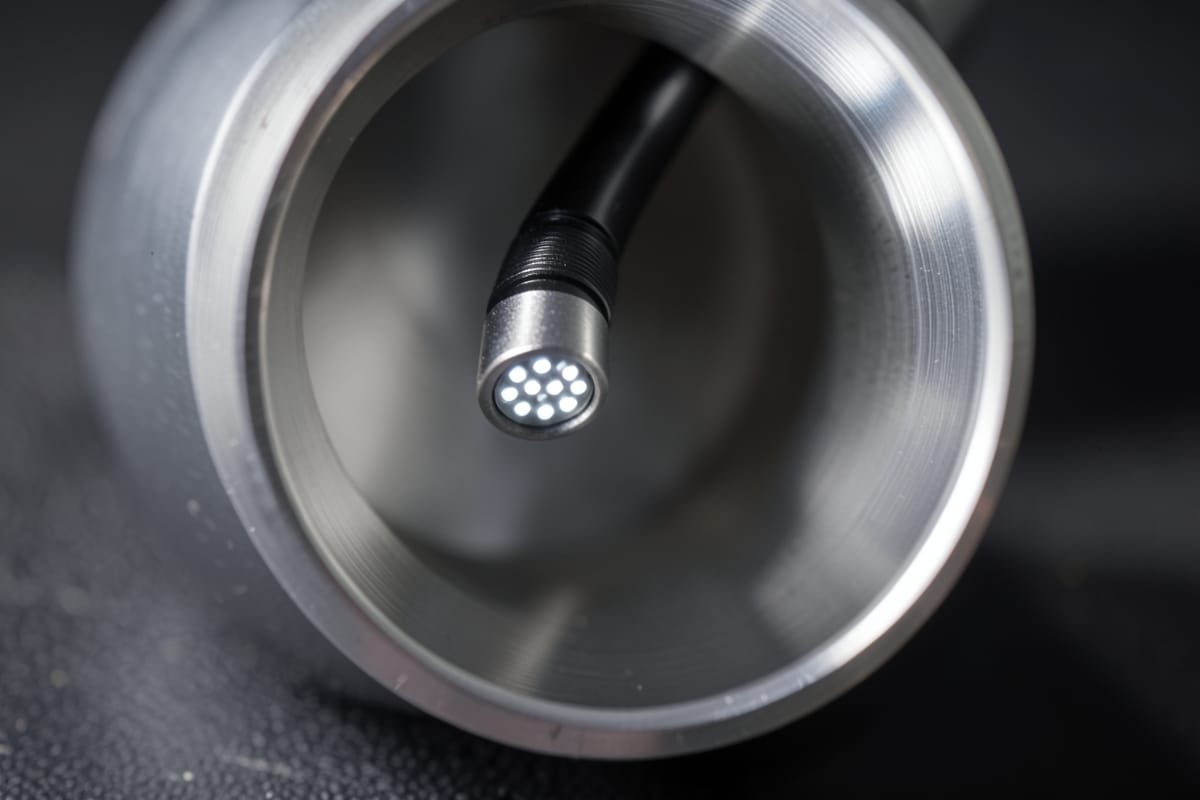
A borescope is only useful if its probe reaches the problem. Measure the smallest opening you need to pass. On a car engine that is usually the spark-plug hole, whose threaded bore is roughly 12.6 mm across for a 14 mm plug, 10.6 mm for a 12 mm plug and 8.9 mm for a 10 mm plug. A 3.9 mm probe clears all of them with room to angle it; 5.5 mm passes most car plug holes; an 8 mm-class probe fits 14 mm holes but is tight in smaller ones.
Away from cylinders, a bigger probe is often better: it carries brighter lights and a larger sensor, and engine bays, intakes and machinery housings have room for it.
Fixed, dual-lens or articulating
A single forward camera shows only what is straight ahead. A dual-lens probe adds a side camera you switch to, which covers most sideways looking without twisting the cable. An articulating probe lets you steer the tip: two-way probes bend in one plane, four-way probes in any direction.
Articulation is worth paying for when the thing you need to see is around a corner, such as a cylinder wall, a valve seat or the back of a casting. For general work, a dual-lens probe is simpler, tougher and cheaper.
Screen, phone or Wi-Fi
A scope with its own screen is quickest to use: switch it on and look. A phone scope costs less and uses the screen you already carry; a wired one, like the DEPSTECH NTC55, avoids the lag and pairing of Wi-Fi models. Our iPhone and Android pages cover phone scopes in more depth.
What the spec sheet does not tell you
Lighting and focus matter more than headline resolution in a dark cavity. Look for adjustable LEDs, and check the focus range: many borescope cameras are sharpest only a few centimeters from the lens. Cable stiffness matters too. A semi-rigid cable holds a bend so you can steer it by shaping it, while a floppy one is hard to aim.
How to use a borescope well
Wipe the lens before you start and keep the tip off surfaces, which smears the lens. Before you go in, note a landmark near the entry point, because the picture rotates as the cable twists. Move slowly, use the side view or steer the tip rather than forcing the cable, and photograph anything suspect so you can compare it later or show it to someone else.
Frequently asked questions
- What is the best borescope?
- For most people, a thin dual-lens scope with its own screen, such as the Teslong NTS500 (5.5 mm, 5-inch screen). If you need to see around corners, an articulating model such as the Teslong TF600 is the step up.
- What size borescope do I need?
- Measure the smallest opening. A 3.9 mm probe clears almost any spark-plug hole, 5.5 mm passes most car plug holes, and 8 mm-class probes suit engine bays, intakes and larger openings.
- Is an articulating borescope worth it?
- Yes, if you need to look around corners, such as at cylinder walls or valve seats. For engine bays, walls and general checks, a dual-lens probe usually does the job for less.
- Are borescopes waterproof?
- Many probes are rated IP67, which means dust-tight and protected against temporary immersion, up to 1 m for 30 minutes. The rating usually covers the probe, not the screen unit.
- What is the difference between a borescope and an inspection camera?
- Very little in practice. Inspection camera is the retail name for what is technically a video borescope: a camera on a probe feeding a screen or phone.
- Can a borescope see inside an engine without taking it apart?
- Yes. Through a spark-plug hole it shows the piston crown, the cylinder walls and, with a side view or articulating tip, the valves. Our engine inspection guide explains how.
- How long should a borescope cable be?
- Long enough for the longest job you actually do. A few feet is plenty for cylinders and engine bays; longer semi-rigid cables help in machinery, walls and ducts but are harder to aim and to coil away.
- Do I need a borescope with a screen?
- Not if you are happy using your phone, but a screen scope is quicker and works anywhere. A wired phone scope avoids Wi-Fi lag.
Related reading
- Aeronautics diploma
- Engineering degree
- BAMEC (DGCA)
- QC-trained
- ~2 yrs tool management
SK spent over two decades in aircraft maintenance, working hands-on with aero-engine systems and flight data recorder systems, borescope-inspecting turbine and compressor blades, and spending almost two years in a dedicated tool bay. He holds a diploma in mechanical engineering (aeronautics), an associate degree in science, an engineering degree and a Basic Aircraft Maintenance Engineer's Certificate (BAMEC) from DGCA, and has completed quality-control and aviation fuels & lubricants training. GaugeGrade applies the same inspection, torque and tool-management standards to the tools everyday mechanics, DIYers and trades actually buy.