The Best 3/8-Inch Torque Wrenches
A 3/8-inch drive torque wrench is the size most engine-bay work calls for: spark plugs, valve and timing covers, water pumps, brackets, and the many brake and suspension bolts that sit below 100 ft-lb, where a 1/2-inch wrench is too coarse to set accurately. Most people want one that covers about 10–100 ft-lb. These are the best, from a two-direction calibrated click wrench to a split-beam and a digital with an angle mode.

GaugeGrade is reader-supported. When you buy through links on our site we may earn an affiliate commission at no extra cost to you. We only recommend gear we have researched against verified manufacturer specifications.
- Get a 3/8" wrench that covers roughly 10–100 ft-lb, and use it in the middle of its scale where you can.
- Many makers rate accuracy only from about 20% of the scale up; our top pick is calibrated across its full range, down to 10 ft-lb.
- Click is simple and needs no batteries; split-beam sets with fingertip force and can be stored at any setting; digital adds a live readout and an angle mode.
- Best overallTEKTON TRQ51402 3/8" Micrometer Torque Wrench
- Best made in USACDI 1002MFRMH 3/8" Click Torque Wrench
- Best split-beamPrecision Instruments C2FR100F 3/8" Split-Beam Torque Wrench
- Best budgetEPAuto 3/8" Click Torque Wrench
- Best digital (with angle)GEARWRENCH 85078 Flex-Head Electronic Torque Wrench
What we recommend
- Range
- 10–100ft-lb
- Type
- Click(micrometer)
- Accuracy
- ±3%CW and CCW
- Range
- 10–100ft-lb
- Type
- Click(micrometer)
- Accuracy
- ±4% CW, ±6% CCW(20–100%)
- Range
- 20–100ft-lb
- Type
- Split-beam click
- Accuracy
- ±4% of reading, CW(20–100%)
- Range
- 10–80ft-lb
- Type
- Click(micrometer)
- Accuracy
- ±4%
- Range
- 10–100ft-lb
- Type
- Digital, torque + angle
- Accuracy
- ±2% CW, ±3% CCW(20–100%)
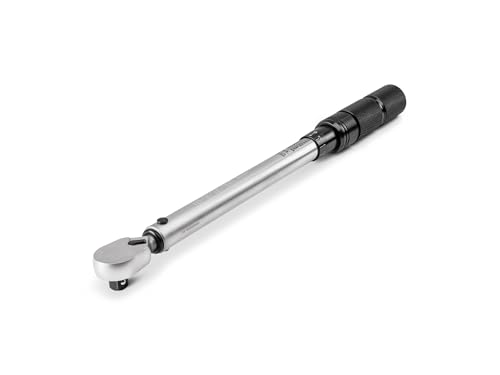
TEKTON TRQ51402 3/8" Micrometer Torque Wrench
Engine-bay and general work with a documented, two-direction wrench
- Range
- 10–100 ft-lb
- Type
- Click (micrometer)
- Accuracy
- ±3% CW and CCW
- Rated ±3% clockwise and counter-clockwise
- Calibrated across the full range; certificate tests at 10, 60 and 100 ft-lb
- 90-tooth ratchet with a 4° swing arc
- Case and a 3/8"-to-1/4" reducer included
- No readout or angle mode
- 10 ft-lb minimum: use an inch-pound wrench for small covers

CDI 1002MFRMH 3/8" Click Torque Wrench
A US-made, serialized wrench for regular shop use
- Range
- 10–100 ft-lb
- Type
- Click (micrometer)
- Accuracy
- ±4% CW, ±6% CCW (20–100%)
- Made in the USA by CDI, a Snap-on Industrial brand
- Individually serialized with a NIST-traceable calibration certificate
- Dual scale (ft-lb and N·m) in 0.5 ft-lb steps
- Calibrated for clockwise and counter-clockwise use
- Looser rated tolerance on paper than the TEKTON
- Fixed head: no flex for awkward angles

Precision Instruments C2FR100F 3/8" Split-Beam Torque Wrench
People who change settings often and do not want to wind a wrench down after every job
- Range
- 20–100 ft-lb
- Type
- Split-beam click
- Accuracy
- ±4% of reading, CW (20–100%)
- Made in the USA by Precision Instruments, whose C line launched the split-beam click wrench market in 1974
- Sets with fingertip force; no need to wind down after use
- Flex ratchet head, set in 2 ft-lb steps
- Clockwise only
- The maker sells a calibration certificate as an option

EPAuto 3/8" Click Torque Wrench
Occasional engine-bay jobs on a tight budget
- Range
- 10–80 ft-lb
- Type
- Click (micrometer)
- Accuracy
- ±4%
- Pre-calibrated to ±4%, with a dual-range scale
- Comes with 3/8"-to-1/4" and 3/8"-to-1/2" adapters and an extension bar
- Chrome-vanadium ratchet head; storage case
- 80 ft-lb top end
- No calibration certificate listed

GEARWRENCH 85078 Flex-Head Electronic Torque Wrench
Torque-plus-angle engine work and many different specs in one job
- Range
- 10–100 ft-lb
- Type
- Digital, torque + angle
- Accuracy
- ±2% CW, ±3% CCW (20–100%)
- Angle mode (5–999°) for torque-plus-angle procedures
- Vibrates, beeps and flashes at the target; 10 presets
- 72-tooth flex head with a 5° swing arc
- Runs on 2 AA batteries (not included)
- Calibration guaranteed for 90 days (1-year tool warranty)
Why you should trust us
SK Kutubuddin spent over two decades maintaining and inspecting aircraft, where engine and accessory fasteners are tightened to written values with calibrated wrenches, including almost two years in a dedicated tool bay, where every torque wrench carries a calibration label and is not issued past its due date. That is the lens for this page: a 3/8-inch wrench is the one you reach for most under a hood, so its accuracy at the low and middle of its scale matters more than its maximum.
We shortlisted 3/8-inch wrenches in the common 10–100 ft-lb class, then checked each pick's range, rated accuracy, calibration paperwork and features against the manufacturer's specifications and the current retail listing, per our how-we-test method. Where published accuracy figures differ between sources, we quote the more conservative one. This is a buying guide built on verified specs and long experience with the category, not a lab shoot-out.
Who this is for
This page is for home mechanics, motorcyclists and technicians who want one torque wrench for the engine bay: spark plugs, covers, water pumps, brackets and the brake and suspension hardware below about 100 ft-lb. It also suits anyone who already owns a 1/2-inch wrench and has found it too coarse for smaller fasteners.
If most of your fasteners are under about 20 ft-lb, start with an inch-pound wrench instead. If you mainly swap wheels, a 1/2-inch wrench is the better first buy.
- Engine-bay jobs such as plugs, covers and water pumps
- Motorcycle and small-engine work
- Brake and suspension bolts under about 100 ft-lb
- Owners of a 1/2-inch wrench who need a finer second tool
How we picked
We compared 3/8-inch wrenches on the things that decide whether the number you set is the number you get, and verified every figure against the maker's specifications and the live listing.
A range centered on engine-bay work
We looked for wrenches whose useful middle covers roughly 20–80 ft-lb, where most 3/8-inch jobs sit, and noted where a range stops short at the top.
Stated accuracy, and where it applies
A tolerance means little without the part of the scale it covers. We recorded each maker's rated accuracy and direction, and gave credit to a wrench calibrated across its full range rather than only from 20% of scale.
Calibration paperwork
A serialized certificate with test results gives you a baseline to compare against at the next check. We noted which picks include one and which listings do not mention it.
A type for every way of working
We covered a micrometer click wrench, a split-beam wrench that can be stored at any setting, a budget click wrench and a digital with an angle mode, so the choice follows how you work.
What a 3/8-inch torque wrench is for
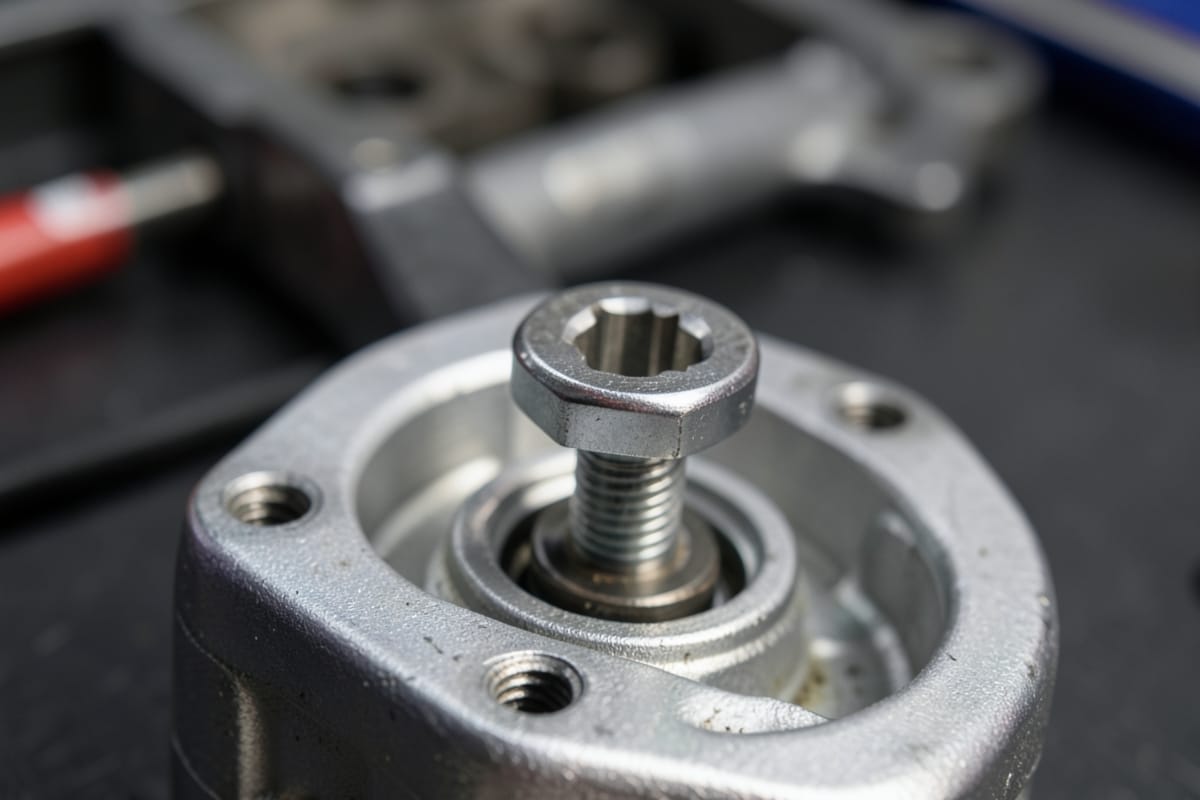
Think of 3/8-inch as the engine-bay size. It fits the sockets you already use under the hood, it is short enough to work between components, and a 10–100 ft-lb range covers most of the fasteners you meet there: spark plugs, valve and timing covers, intake and exhaust studs, water pumps, alternator brackets, and many brake-caliper and suspension bolts.
Lug nuts and larger chassis bolts usually sit at the top of that range or above it, which is 1/2-inch territory. Small covers and bolts in aluminum often sit at or below the bottom of it, where an inch-pound wrench is the better tool. Most home mechanics end up with a 3/8-inch wrench as their most-used torque tool and one of the others alongside it.
Range, and the 20% rule
A click wrench is least accurate at the bottom of its scale, and most makers only rate their accuracy from about 20% of full scale upward. On a 10–100 ft-lb wrench that means the stated tolerance applies from about 20 ft-lb. If you regularly work at 10–20 ft-lb, choose a wrench calibrated across its full range, as the TEKTON TRQ51402 is, or add a smaller wrench for that work.
At the top end, leave headroom. A 3/8-inch wrench asked to hit 100 ft-lb every day is working at its limit; if your common jobs sit near there, a 1/2-inch wrench with a wider range will serve you better.
Click, split-beam or digital
A micrometer click wrench is the default: you dial the value on the handle, pull, and it breaks with a click you can hear and feel. It needs no batteries, and it should be wound down to its lowest marked setting for storage so the spring is not left compressed.
A split-beam wrench also clicks, but it measures with a beam rather than a preloaded coil spring. The Precision Instruments wrench on this page sets with fingertip force, and its maker says there is no need to wind it down after use. A digital wrench shows the torque as it builds, alerts at the target and, on the GEARWRENCH, measures the angle for torque-plus-angle procedures.
Adapters and extensions
A 3/8-to-1/4-inch reducer or a straight extension sits in line with the drive, so it does not change the torque at the fastener. A crowfoot wrench or offset adapter can, because it can lengthen the lever arm. Our torque wrench extension calculator works out the corrected setting.
Small numbers in soft metal
Much of the engine bay is aluminum: heads, covers, housings and intake manifolds. Threads in aluminum strip far more easily than in steel, and the torque values are correspondingly low, often in the lower third of a 3/8-inch wrench's scale. That is exactly where a wrench is least forgiving, so confirm the spec, check the unit, and use a wrench whose rated accuracy actually covers that value.
Clean threads and a hand-started fastener matter as much as the wrench. A thread that binds before the fastener seats uses up torque in friction, and the wrench clicks with the joint still loose. Run each bolt in by hand first; if it will not turn freely, find out why before you torque it.
Keeping a 3/8-inch wrench accurate
Store a coil-spring click wrench wound down to its lowest marked setting, keep it in its case, and treat any drop as a reason to check it. Check it against a reference at least once a year or every 5,000 cycles, the benchmark in the ISO 6789 standard, and straight away if it ever feels different at the click.
Our guide to checking and calibrating a torque wrench walks through a home check with a known weight or a digital torque adapter, and explains when to send a wrench to a lab.
Frequently asked questions
- What is a 3/8 torque wrench used for?
- Engine-bay and general work: spark plugs, valve and timing covers, water pumps, brackets and many brake and suspension bolts under about 100 ft-lb. Lug nuts usually call for a 1/2" wrench, and small covers for an inch-pound wrench.
- What range should a 3/8 torque wrench have?
- About 10–100 ft-lb covers most engine-bay work. Use the middle of the scale where you can; many makers rate accuracy only from about 20% of full scale up.
- Can I use a 3/8 torque wrench on lug nuts?
- Only if your lug-nut spec sits comfortably inside its range. Many cars call for around 80–100 ft-lb, which is at or near the top of a 10–100 ft-lb wrench, so a 1/2" wrench is the better tool.
- Do I need a 3/8 or a 1/2 torque wrench?
- Choose by the fasteners you tighten most: a 3/8" for engine-bay work, a 1/2" for wheels, suspension and larger chassis bolts. Many home mechanics end up with both.
- Does a 3/8-to-1/4 adapter change the torque?
- No. A drive adapter or a straight extension sits in line with the wrench, so the torque at the fastener matches the setting. A crowfoot or offset adapter can change it, because it can lengthen the lever arm.
- Is a 3/8 torque wrench good for spark plugs?
- Yes, it is the usual size for spark plugs on cars. Check the plug maker's or vehicle maker's value first: plugs in aluminum heads often sit low on a 10–100 ft-lb scale, where a wrench calibrated across its full range, or an inch-pound wrench, is the better choice.
- How accurate is a cheap 3/8 torque wrench?
- Budget click wrenches are usually rated around ±4%, a little looser than the ±3% of better models. That is fine for most home work, but check a budget wrench against a reference before relying on it for critical fasteners.
- What is the difference between a micrometer and a split-beam torque wrench?
- A micrometer click wrench sets torque by compressing a coil spring with the handle, so it should be wound down for storage. A split-beam wrench measures with a beam and sets with a thumbscrew or dial, and makers such as TEKTON state it can be stored at any setting.
Related reading
- Aeronautics diploma
- Engineering degree
- BAMEC (DGCA)
- QC-trained
- ~2 yrs tool management
SK spent over two decades in aircraft maintenance, working hands-on with aero-engine systems and flight data recorder systems, borescope-inspecting turbine and compressor blades, and spending almost two years in a dedicated tool bay. He holds a diploma in mechanical engineering (aeronautics), an associate degree in science, an engineering degree and a Basic Aircraft Maintenance Engineer's Certificate (BAMEC) from DGCA, and has completed quality-control and aviation fuels & lubricants training. GaugeGrade applies the same inspection, torque and tool-management standards to the tools everyday mechanics, DIYers and trades actually buy.