Torque Seal: What It Is and How to Apply It
Torque seal is the brightly colored stripe you see running across a fastener and the part next to it — a visual “this has not moved” indicator. DYKEM, whose Cross Check is the product most people mean, calls it a tamper-proof indicator paste. Here is what it is, when to use it, and how to apply it, from the flight line to your garage.

- 6 steps
- What you'll need, listed
- No paid placements
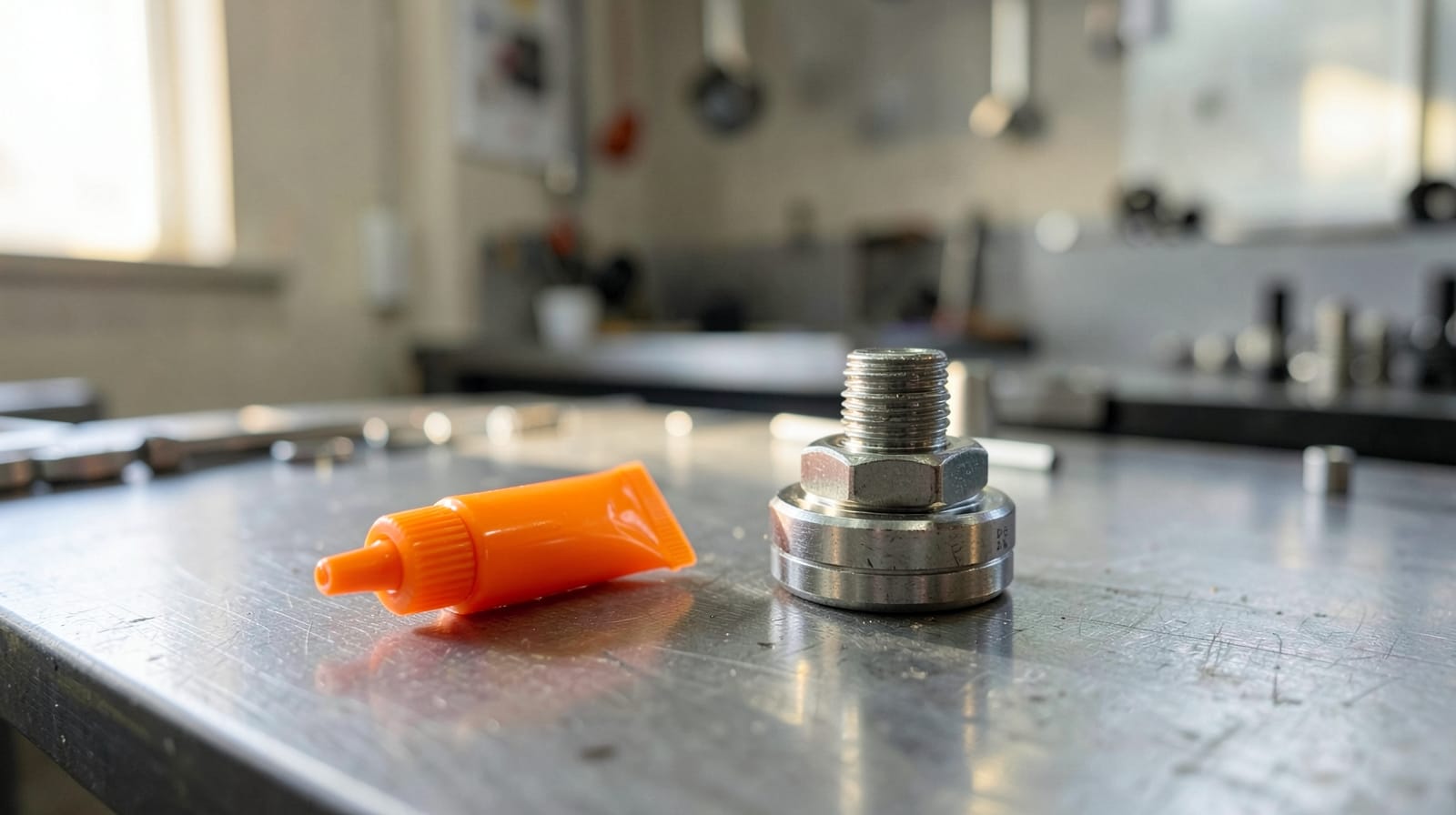
Torque seal is a lacquer or paste, not an adhesive. It does not lock a fastener — it shows at a glance whether the fastener has since rotated or been tampered with.
It goes on after a fastener is torqued to specification, bridging the fastener and the fixed surface beside it.
- See our picksTorque seal (indicator paste)
A tube in a color that contrasts with the part and fits your shop's convention, used within its shelf life.
- See our picksCalibrated torque wrench
The fastener must reach its specified torque before it is striped; the lacquer records that state but cannot create it.
- Degreaser and lint-free wipes
A cleaner compatible with the part's finish, to remove oil and grease so the stripe bonds and stays put.
- Nitrile gloves
Keep lacquer off your skin and skin oils off the surface; check the product's safety data sheet for other precautions.
- Non-marring scraper
A plastic scraper for lifting old or broken stripes without scratching the finish before you re-mark a fastener.
- Inspection light
A flashlight held at a low angle makes a hairline crack or offset in a cured stripe much easier to see.
How to apply torque seal
Torque the fastener first
Torque seal marks a finished fastener; it does not set or hold torque. Tighten the fastener to specification before you apply any.
Clean and dry the surface
Wipe oil, grease and dirt off both the fastener and the part next to it so the lacquer bonds and stays put.
Apply a single stripe
Shake or stir the torque seal, then lay one continuous stripe from the fastener — the bolt head or nut — across onto the fixed part beside it.
Bridge the fastener and the part
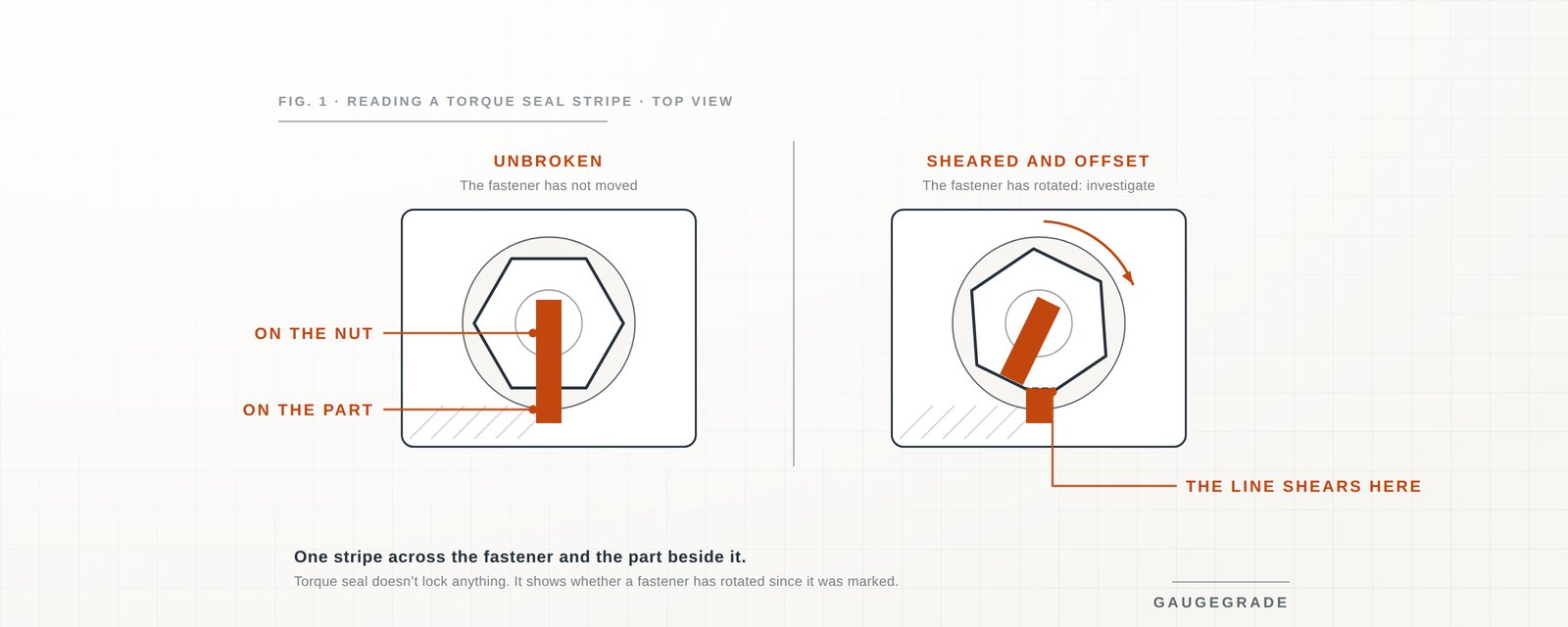
The stripe has to span both the fastener and the structure. If the fastener later rotates, the line shears and offsets, which is exactly the signal you want.
Let it cure
Cure times differ by product, so read the tube. DYKEM's standard Cross Check is dry to touch in 30–40 minutes but takes 7–10 days to cure completely; its Fast and Plus versions are dry to the touch in under a minute and fully cured in 24 hours. Do not disturb the stripe while it is wet, and do not expect a part-cured mark to break cleanly.
Read it at the next check
An unbroken stripe means the fastener has not moved. A cracked or offset stripe means it has rotated or been disturbed, and needs attention.
What torque seal is — and is not
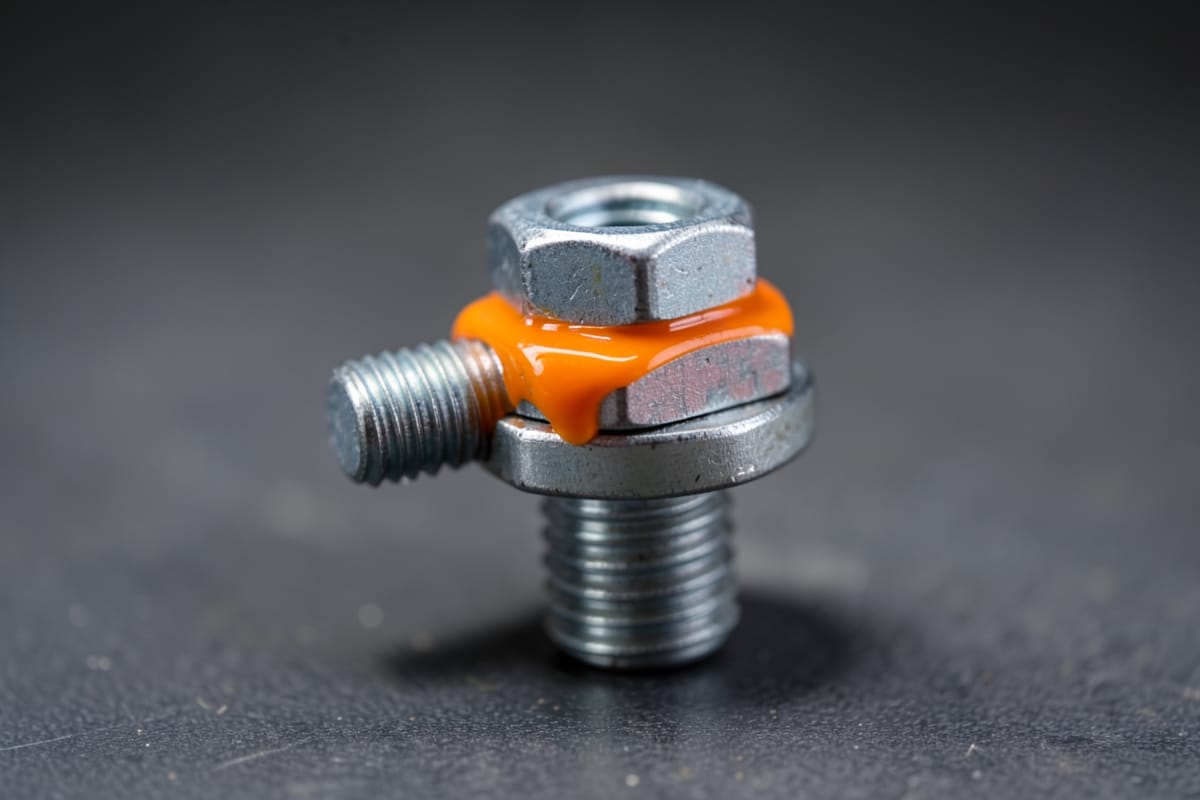
Torque seal is a tamper-evident, movement-indicating lacquer. It is not a thread locker and it is not safety wire: it will not stop a fastener backing out, it only shows you that one has.
The colors (orange, red, blue and others) carry no universal meaning — shops use them to standardize, for example by inspection stage or by who signed off a fastener.
DYKEM Cross Check, the product most people mean
Search for torque seal and you will mostly find DYKEM Cross Check, whose full name is Cross Check Torque Seal Tamper-Proof Indicator Paste. Worth knowing: Torque Seal is a live registered trademark — US Reg. 1,542,153 — and DYKEM's owner Illinois Tool Works holds it, the assignment from Organic Products Company having been recorded in June 2016. Organic Products made F-900, the inspection lacquer shops used for decades; it went out of business around the same time, per the distributor announcements of the period, and DYKEM now lists Cross Check as its approved replacement. So the two names people treat as rivals are two marks on one product line.
There are three versions, and what separates them is cure speed, fluid resistance and colour range — not how the mark works. Standard Cross Check is dry to touch in 30–40 minutes, 80% cured at 48–72 hours and fully cured at 7–10 days, and comes in eight colours. Cross Check Fast is orange only, and the aviation-grade Cross Check Plus comes in yellow, blue and pink; both are dry to the touch in under a minute and fully cured in 24 hours, and Plus is the Skydrol-resistant one.
All three ship as a 1 oz tube, and DYKEM's directions begin "Knead tube before use." The standard colours are orange, green, red, yellow, blue, white, pink and gray, and the data sheet lists blue, yellow, red, green and orange as fluorescent under blacklight — white, pink and gray are not on that list, so if you want a mark you can pick up with a UV torch, choose from the five that are.
The approvals are worth reading closely, because several are colour-restricted. DYKEM says standard Cross Check meets Boeing BMS8-45 Rev H Type II, and Northrop Grumman GC115UG rev K in six of its eight colours (not green or gray). Cross Check Plus meets Boeing BMS8-45 Rev H Type I/III and Embraer MEP 09-096 Rev. L in pink and yellow only — the blue is not covered by either — and Gulfstream GAP110S with no colour restriction stated.
One thing DYKEM does not claim for any version: a military specification. There is no MIL-spec, ASTM or AMS number on Cross Check, only those OEM approvals. Torque seal's military reputation traces to F-900, which was carried in defense supply under NSN 8030-00-408-1137 — a stock number rather than a named specification.
When to use it
Use torque seal on critical fasteners you want to verify later at a glance — on aircraft, machinery, motorsport and anything inspected periodically — and anywhere you want a simple tamper indicator. It complements the tools that actually secure a fastener, such as safety wire or thread locker, rather than replacing them.
The flight-line view
On aircraft, marking a torqued fastener this way is standard practice: apply it after torque, bridge the fastener to the structure, and at the next inspection a broken stripe instantly flags a fastener that has moved — no wrench required. The same trick works on any critical fastener you own: it turns “did that bolt move?” into something you can see across the shop.
Re-marking after rework
A torque stripe describes one moment: the fastener as it stood when it was torqued. Once that fastener is loosened, removed or re-torqued, the old stripe no longer means anything, and leaving it in place invites a misread at the next inspection.
Remove the old lacquer completely before you re-mark. Lift it with a non-marring scraper, then clean off the residue with a solvent that both the torque seal maker and the part's finish allow, so no fragment of an old line can be mistaken for part of the new one. Re-torque to specification, clean and dry the surface again, and lay a fresh stripe.
Never touch up or paint over a cracked or offset stripe. A broken stripe is a finding. Establish why the fastener moved, whether it was worked on and not re-marked or has genuinely loosened, and correct it to the maintenance data before marking it again. On aircraft, that correction and its sign-off belong to an appropriately certificated mechanic, such as an A&P; this guide is general practice, not a substitute for the aircraft's approved maintenance data.
Storing torque seal and keeping it usable
Most torque seals are solvent-based lacquers with a limited life, and a tube that has thickened or skinned over will not lay the clean, continuous stripe you need.
Check the shelf-life or expiry date on the tube or its packaging when you buy it and again before use, and mark the date you opened it if your shop tracks that. Store it tightly capped in a cool, dry place away from heat and ignition sources, following any storage position the maker gives.
Keep the nozzle clean. Wipe it after each use so dried lacquer does not block the tip or drop flakes into your next stripe. Do not thin a thickened tube unless the manufacturer permits it and names the thinner; an improvised solvent can change how the lacquer cures and breaks, which is the one property you are relying on.
Read the safety data sheet before first use. Work with ventilation, keep the product away from open flames, and wear gloves. When a tube has expired or hardened, dispose of it according to local rules for solvent and flammable waste rather than trying to revive it.
- Aeronautics diploma
- Engineering degree
- BAMEC (DGCA)
- QC-trained
- ~2 yrs tool management
Why you should trust us
SK Kutubuddin spent over two decades maintaining and inspecting aircraft, where inspection lacquer is a routine part of confirming that a critical fastener has not moved since it was torqued. A former aviation professional with an engineering degree and a BAMEC, he also holds a qualification in aviation fuels and lubricants, which gives him a working understanding of the oils, greases and solvents that decide whether a stripe bonds to a clean surface or lifts off a contaminated one.
This guide sticks to practice that holds across products: torque first, clean surfaces, one stripe bridging fastener and part, and a fresh stripe after any rework. Cure time, shelf life and approved solvents vary by product, so we tell you where to find them rather than quoting numbers. Linked tool advice comes from our buying guides, which follow the How We Test process.
Frequently asked questions
What is torque seal?
A brightly colored indicator paste applied across a fastener and the part beside it. If the fastener rotates, the stripe breaks — so it shows movement or tampering at a glance. It is not a thread locker, and it does not hold anything in place.
Does torque seal lock bolts in place?
No. It only indicates movement. To actually secure a fastener, use safety wire or a thread locker; torque seal is a visual check on top of that.
How do you apply torque seal?
Torque the fastener to spec, clean and dry the surface, then lay a single stripe from the fastener across onto the fixed part next to it and let it cure.
How long does torque seal take to dry?
Depends which one. DYKEM's standard Cross Check is dry to touch in 30–40 minutes and fully cured in 7–10 days; the Fast and Plus versions are dry to the touch in under a minute and fully cured in 24 hours.
Is there a torque seal pen or marker?
Not from DYKEM — every Cross Check version is a 1 oz tube, and the retailer listings that call it a "marker" are describing that tube. The closest thing is a different maker's product: Markal's Security Check Paint Marker, from LACO Industries, which is a 50 ml tube supplied with an extended plastic tip rather than a valve-action pen. Its cure profile is different too — Markal quotes 15 minutes to touch and four days to full cure.
Is torque seal mil-spec?
DYKEM Cross Check is not. It carries OEM approvals only — Boeing BMS8-45 and Northrop Grumman GC115UG on the standard paste, and Boeing, Embraer and Gulfstream on the Plus version, several of them restricted to particular colours — but no MIL-spec, ASTM or AMS number. The military association belongs to Organic Products' F-900, which was carried in defense supply under NSN 8030-00-408-1137 and is no longer made.
What do the torque seal colors mean?
There is no universal color code. Shops choose colors to standardize by inspection stage, torque status or sign-off — pick a convention and stick to it.
How thick should a torque seal stripe be?
A narrow, continuous bead that is plainly visible from a working distance, laid in one pass. A skimpy line can break up or wear away without the fastener moving, while a heavy blob takes longer to cure and may smear rather than break cleanly. The product's instructions have the final word.
Can I apply torque seal in cold or damp conditions?
Cure is slower in the cold, and moisture or condensation on the part can stop the lacquer bonding. Apply it within the temperature range on the product's instructions, make sure the surface is dry, and give the stripe longer to set before the part is handled or inspected.
Can I use paint or nail polish instead of torque seal?
It is a poor substitute. Purpose-made torque seal is formulated to bond to metal and break visibly when the fastener turns. Paints and cosmetics may flex, peel or flake instead, which can hide real movement or suggest movement that never happened. On aircraft, use the product your maintenance data or shop specifies.
Related reading
- Aeronautics diploma
- Engineering degree
- BAMEC (DGCA)
- QC-trained
- ~2 yrs tool management
SK spent over two decades in aircraft maintenance, working hands-on with aero-engine systems and flight data recorder systems, borescope-inspecting turbine and compressor blades, and spending almost two years in a dedicated tool bay. He holds a diploma in mechanical engineering (aeronautics), an associate degree in science, an engineering degree and a Basic Aircraft Maintenance Engineer's Certificate (BAMEC) from DGCA, and has completed quality-control and aviation fuels & lubricants training. GaugeGrade applies the same inspection, torque and tool-management standards to the tools everyday mechanics, DIYers and trades actually buy.