The Best Tire Pressure Gauges for Motorcycles
A motorcycle runs a narrow pressure window on two contact patches the size of a credit card, and the valve stem is usually tucked between a brake disc and the spokes. So a gauge for a bike has two jobs: reach the valve without a fight, and be right at around 30–42 psi. Those are different problems, and most gauges solve only one. Every accuracy figure below is the maker's own, and where the maker does not publish one we say so.

- 5 picks compared
- Specs checked against maker data
- No paid placements
GaugeGrade is reader-supported. When you buy through links on our site we may earn an affiliate commission at no extra cost to you. We only recommend gear we have researched against verified manufacturer specifications.
- 1A stated accuracy is only usable if the maker says what the percentage is a percentage of. Of these five, three do: the rest publish a number with no declared basis, so it cannot be turned into psi.
- 2Range matters as much as grade. A gauge rated to a share of full scale is allowed the same error in psi all the way down the dial, so a 0–60 gauge beats a 0–100 one at motorcycle pressures — unless the 0–100 carries a much tighter grade, which is exactly what happens here.
- 3Chuck geometry decides whether you actually use the gauge. A straight chuck will not reach a valve set between brake discs; a right-angle or swivel chuck on a flexible hose will.
- 1Best stated accuracyJACO ElitePro Digital Tire Pressure Gauge, 100 PSI
- 2Best mechanical for valve accessAccu-Gage RRA60X Dial Tire Pressure Gauge, 60 PSI
- 3Best for repeatable readingsLongacre 52-52002 Liquid-Filled Tire Gauge, 0–60 psi
- 4Battery-free compactJACO Elite Analog Tire Pressure Gauge, 100 PSI
- 5Straight-chuck alternativeAccu-Gage RH60X Dial Tire Pressure Gauge, 60 PSI
What we recommend
Compare the key specs side by side, then read the full notes on each pick below.
- Range
- 5–100psi
- Stated accuracy
- ±0.50%full scale
- Error at 32 psi
- ±0.50psi
- Chuck
- Angled, on a swivel hose
- Range
- 0–60psi
- Stated accuracy
- ANSI B40.1 Grade B
- Error at 32 psi
- ±1.20psi
- Chuck
- Right-angle
- Range
- 0–60psi
- Stated accuracy
- 2%(basis not stated)
- Error at 32 psi
- Not calculable
- Chuck
- Angle ball, on a 17 in. hose
- Range
- 5–100psi
- Stated accuracy
- ±1.5%(basis not stated)
- Error at 32 psi
- Not calculable
- Chuck
- 360° swivel, with bleeder
- Range
- 5–60psi
- Stated accuracy
- ANSI B40.1 Grade B
- Error at 32 psi
- ±1.20psi
- Chuck
- Straight

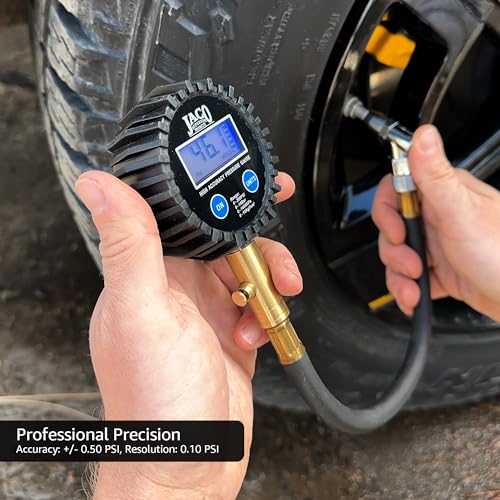


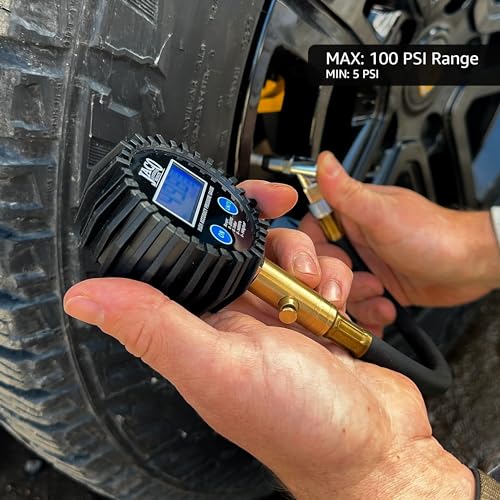
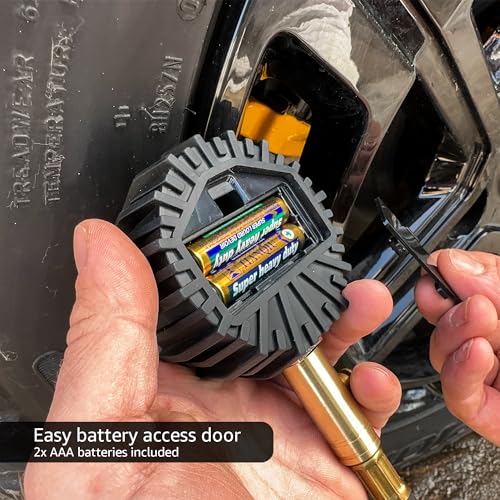
JACO ElitePro Digital Tire Pressure Gauge, 100 PSI
Anyone who wants the tightest published figure in the group and is content to read in psi.
- Range
- 5–100 psi
- Stated accuracy
- ±0.50% full scale
- Error at 32 psi
- ±0.50 psi
- Chuck
- Angled, on a swivel hose
- Resolution
- 0.1 psi
- Standard cited
- ASME B40.7 Grade 2A
- Units
- psi only
- Power
- 2 × AAA, replaceable
- The only gauge here whose maker declares the basis of its accuracy claim — ±0.50% of full scale — which is what makes the number convertible into psi at all.
- That works out at ±0.50 psi anywhere on the dial, less than half the error the 0–60 psi mechanical gauges are permitted at motorcycle pressures.
- Angled chuck on a swivel hose, which is the geometry that reaches a valve stem between brake discs.
- Backlit display, bleed valve and a reading that holds after you pull the chuck off.
- Reads in psi only. No bar, kPa or kg/cm², which is a real limitation if your service data is metric.
- A 100 psi span is wider than a motorcycle needs; the tight grade is what rescues it, not the range.
- JACO states the gauges are calibrated at its own facility but supplies no per-unit certificate and names no accreditation body, so the claim is the maker vouching for itself.
The pick if you want a number you can actually reason about. JACO publishes ±0.50% of full scale and says "full scale" in those words, which is what lets you work out that the tolerance is ±0.50 psi at any reading on the dial. Every other gauge here either publishes a bare percentage or nothing.
Skip it if your service data is in bar or kPa. It reads in psi only, and no amount of accuracy makes up for converting in your head at the roadside.
Based on the maker's specifications and manual and the published reviews linked below, not on our own test of this unit.
Setup, everyday use and what others found
Setup & use · per the maker
- Working range 5–100 psi, displayed to 0.1 psi.
- JACO's accuracy statement: "±0.50% Full Scale (±0.50 PSI)", with the certification given as ASME B40.7 Grade 2A.
- Steel angled tire chuck on a 10-inch rubberised hose, ending in a 360-degree swivel 1/4-inch NPT connector.
- Fast-action bleeder valve on the brass stem, so pressure can be let down with the chuck still seated.
- Backlit LCD. The backlight drops out after about 30 seconds idle and the gauge powers off after about 120.
- The reading holds after the chuck comes off the valve; pressing the power button zeroes it for the next tire.
- Two AAA cells behind an access door, with a battery-life indicator.
- Units: psi only.
What others found
We found no independent instrumented test of this gauge, and no dated owner report we could attribute to this model with confidence.


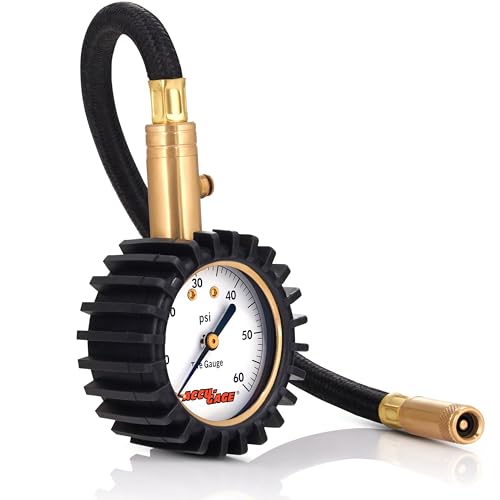
Accu-Gage RRA60X Dial Tire Pressure Gauge, 60 PSI
A bike with awkward valve stems, and anyone who wants a gauge that cannot have a flat battery.
- Range
- 0–60 psi
- Stated accuracy
- ANSI B40.1 Grade B
- Error at 32 psi
- ±1.20 psi
- Chuck
- Right-angle
- Hose
- 11 in. braided
- Dial
- Analog, rubber-guarded
- Power
- None
- Right-angle chuck on an 11-inch hose: the combination that gets to a valve between a disc and the spokes without bending your wrist around the rotor.
- Grade B on a 0–60 psi scale puts 32 psi in the middle half of the dial, the tighter of the standard's two zones, which works out at ±1.20 psi.
- No battery to die in the cold — bench testing has found budget digital gauges stop reading entirely near freezing while their backlights still work.
- Ribbed rubber guard over the dial, which is what the extra R in the model number denotes.
- Milton names the grade on the product page but publishes the actual percentage only in a blog post, so the number takes two sources to establish.
- ±1.20 psi is more than twice the JACO digital's figure, despite the narrower range.
- The listing does not state the chuck type; we take it from the RA60X base part this model is built on.
- Milton never states country of manufacture, so the "US-made Accu-Gage" line you will see repeated on blogs is not supported by anything the maker says.
The mechanical choice when the valve is the problem. A right-angle chuck on an 11-inch hose goes where a straight head cannot, and nothing about it can run out of battery in a cold garage.
Its claim needs assembling from two places, which is the irritation. The product page names ANSI B40.1 Grade B; the percentages behind that grade appear only in a Milton blog post. Put them together and Grade B on a 0–60 psi dial is ±2% of span across the middle half, which is ±1.20 psi at 32 psi.
Based on the maker's specifications and manual and the published reviews linked below, not on our own test of this unit.
Setup, everyday use and what others found
Setup & use · per the maker
- Dial 0–60 psi, analog, under a ribbed rubber guard — the leading R in the model number denotes that guard, and the part is listed as RA60X/RGG-RIB.
- Milton's RA60X base part is specified with a right-angle air chuck and an 11-inch braided hose.
- Accuracy is given on the product page only as conformance to ANSI B40.1 Grade B, with no number.
- Milton's own blog states the mechanical accuracy rating as ±2% from 30% to 60% of scale and ±3% below and above that.
- Pushbutton deflation valve for letting pressure down without unseating the chuck.
- No battery, no display, no auto-off.
What others found
Milton describes where the tighter tolerance applies as "30% to 60% of scale". The standard it cites divides the dial into a lower quarter, a middle half and an upper quarter — so the ±2% zone is 25–75% of scale, not 30–60%. The percentages are right for Grade B; the boundaries as Milton states them are not.
ASME accuracy grades for mechanical pressure gauges (Ashcroft)
We found no independent instrumented test of this model.


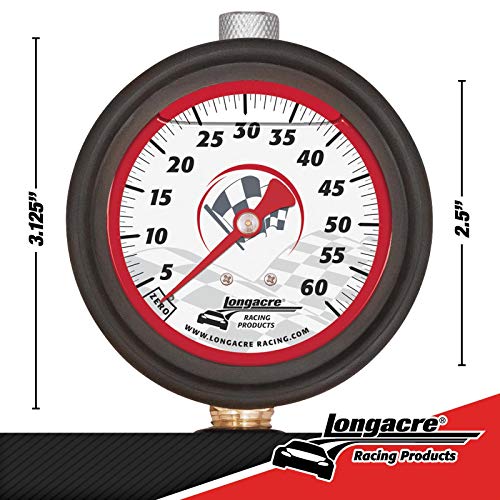


Longacre 52-52002 Liquid-Filled Tire Gauge, 0–60 psi
Track days and anyone adjusting pressure in half-pound steps rather than checking it once a month.
- Range
- 0–60 psi
- Stated accuracy
- 2% (basis not stated)
- Error at 32 psi
- Not calculable
- Chuck
- Angle ball, on a 17 in. hose
- Dial
- 2½ in., liquid filled, glow face
- Increments
- ½ lb
- Power
- None
- Half-pound graduations on a 2½-inch face, which is a finer read than any other mechanical gauge here offers.
- Liquid filling damps the pointer, so the needle settles instead of flickering — the reason racing gauges are built this way.
- A 17-inch hose with an angle ball chuck reaches almost any valve position, and the gauge holds its reading until you release it.
- Longacre fills the body to about 80% deliberately, leaving an air pocket so the fluid can expand with temperature without stressing the case.
- Longacre publishes "2% accuracy" without saying whether that is of span or of reading, so unlike the Grade B gauges it cannot honestly be converted into a figure in psi.
- No calibration certificate and no recalibration service is published, despite the racing positioning.
- Physically the largest gauge here, which is the trade-off for the dial size.
Built for adjusting rather than checking. Half-pound graduations on a 2½-inch liquid-filled face, a 17-inch hose and an angle chuck: this is the gauge for setting pressures in small steps before a track session.
What it will not give you is a figure in psi. Longacre publishes "2% accuracy" and never says whether that is of span or of reading, so unlike the Grade B gauges here its claim cannot honestly be converted.
Based on the maker's specifications and manual and the published reviews linked below, not on our own test of this unit.
Setup, everyday use and what others found
Setup & use · per the maker
- 2½-inch glow-in-the-dark dial, liquid filled, 0–60 psi in half-pound increments. Longacre also builds the line in 0–15, 0–30 and 0–45 psi.
- Longacre's stated accuracy for the line: "1/2 lb increments with 2% accuracy" (quarter-pound increments on the 0–15 psi version).
- 17-inch hose. A swivel angle chuck is fitted and a swivel ball chuck is supplied as the alternative.
- Air-pressure release button, and a separate vent valve Longacre describes as equalising pressure to maintain gauge accuracy.
- The body is filled to roughly 80%, deliberately leaving an air pocket so the fluid can expand with temperature.
- The reading holds until you release it. No battery.
What others found
We found no independent instrumented test of this gauge. Longacre publishes no calibration certificate and no recalibration service, which is worth knowing given the racing positioning.
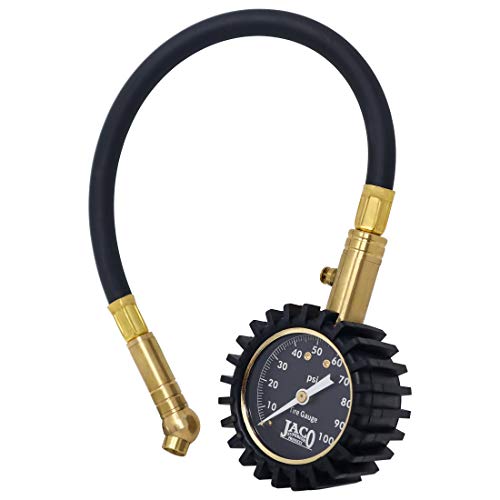
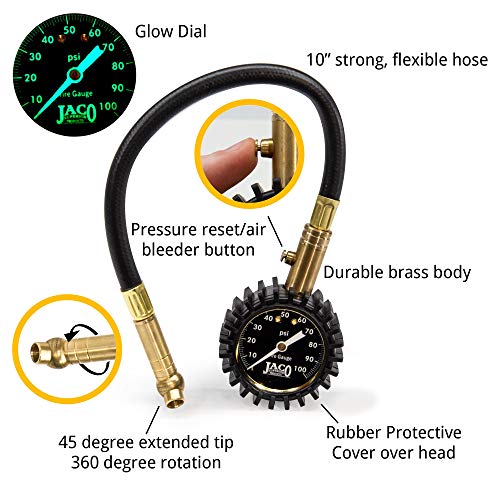


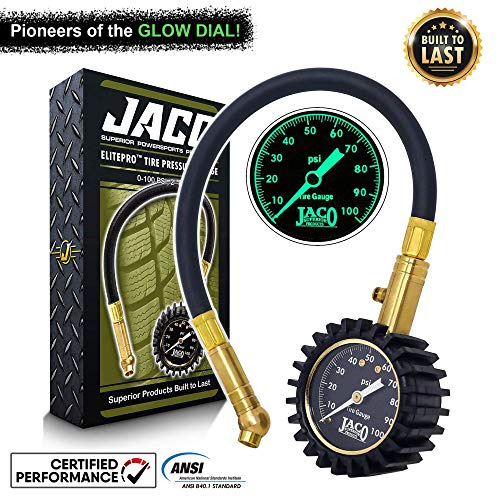
JACO Elite Analog Tire Pressure Gauge, 100 PSI
A glovebox or tail-pack gauge, where compactness and no battery matter more than the last half a psi.
- Range
- 5–100 psi
- Stated accuracy
- ±1.5% (basis not stated)
- Error at 32 psi
- Not calculable
- Chuck
- 360° swivel, with bleeder
- Dial
- 2 in., glow face
- Increments
- 1 psi
- Power
- None
- Small enough to live under the seat, with a 360-degree swivel chuck and a built-in bleeder so you can let pressure down without removing it.
- Glow-in-the-dark face and a reading that locks until you release it.
- No battery, and JACO does publish a figure — ±1.5%, citing ANSI B40.1 — which puts it ahead of the several makers in this category that publish nothing at all.
- The ±1.5% has no declared basis. ANSI B40.1 works in percentage of span, so the figure is probably ±1.5 psi on this 100 psi dial, but JACO does not say so and we will not state an inference as a specification.
- A 2-inch dial reading to 1 psi across a 100 psi span is a coarse instrument for a 34 psi target; the pressure you care about sits in the first third of the face.
- Confusingly, JACO has renamed this product "Elite" on its own site while the Amazon listing still says "ElitePro", which is now the digital line. Check you are buying the one you mean.
The one to keep under the seat. Small, battery-free, with a swivel chuck and a bleeder, and JACO does publish a figure — which in this category already puts it ahead of several better-known brands that publish nothing at all.
It is the coarsest instrument here for the job, though. A 2-inch dial reading in 1 psi steps across a 100 psi span puts a 34 psi target in the lower third of the face, which is both the hardest part to read and, under the standard JACO cites, the looser of the two tolerance zones.
Based on the maker's specifications and manual and the published reviews linked below, not on our own test of this unit.
Setup, everyday use and what others found
Setup & use · per the maker
- Dial 0–100 psi; JACO states a working range of 5–100 psi, in 1 psi increments.
- JACO's accuracy statement: ±1.5%, citing ANSI B40.1. The basis is not stated.
- 2-inch glow-in-the-dark dial. The reading locks until released.
- 360-degree swivel chuck with a built-in air bleeder valve.
- No battery and no display.
- Naming caution: JACO now calls this product "Elite" on its own site, while the retail listing still says "ElitePro" — which is the digital line.
What others found
We found no independent instrumented test of this gauge.

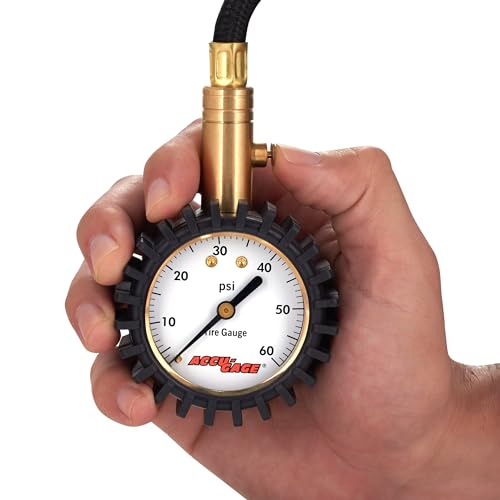

Accu-Gage RH60X Dial Tire Pressure Gauge, 60 PSI
Riders whose valve stems are easy to reach, or a garage gauge shared with the car.
- Range
- 5–60 psi
- Stated accuracy
- ANSI B40.1 Grade B
- Error at 32 psi
- ±1.20 psi
- Chuck
- Straight
- Hose
- 11 in. braided
- Dial
- Analog, rubber-guarded
- Power
- None
- Identical instrument to the RRA60X on the dial side: the same Grade B claim and the same ±1.20 psi at 32 psi, on the same 11-inch braided hose.
- A straight chuck pushes on squarely, which on an accessible valve is quicker and loses less air than wrestling an angled head into place.
- Milton states an operating range of 5–60 psi for this model, which covers both motorcycle tires comfortably.
- The straight chuck is the wrong geometry for the problem this page is about. On a spoked wheel with a disc in the way it is the harder of the two to seat.
- Same sourcing caveat as the RRA60X: the grade is on the product page, the percentage behind it is not.
- Worth knowing when you compare listings: a leading R in these model numbers means the ribbed rubber guard. RH60X is the guarded version of H60X, and the two appear under similar titles.
The same instrument as the RRA60X with a straight chuck instead of a right-angle one, and the same Grade B claim: ±1.20 psi at a 32 psi reading on its 0–60 dial.
Buy it only if you have looked at your own valve stems and know a straight head will seat. On an accessible valve it is quicker and loses less air than fighting an angled chuck into place; on a spoked wheel with a disc in the way it is the harder of the two.
Based on the maker's specifications and manual and the published reviews linked below, not on our own test of this unit.
Setup, everyday use and what others found
Setup & use · per the maker
- Milton states an operating range of 5–60 psi on a 0–60 psi dial.
- Straight air chuck on an 11-inch braided hose, with a ribbed rubber guard over the dial.
- Accuracy given as conformance to ANSI B40.1 Grade B; see the RRA60X notes for where the percentages behind that grade are published.
- Deflation button for letting pressure down with the chuck seated.
- No battery.
What others found
We found no independent instrumented test of this model.
- Aeronautics diploma
- Engineering degree
- BAMEC (DGCA)
- QC-trained
- ~2 yrs tool management
Why you should trust us
SK Kutubuddin spent almost two years in a dedicated tool bay during over two decades of aero-engine maintenance, where a measuring instrument carried a calibration label with a due date and was withdrawn the moment its history became unclear. That is the standard applied here: a gauge is judged by what its maker is willing to put in writing, not by how it feels in the hand.
Every figure on this page is the manufacturer's own, taken from its published documentation and the retail listing. Where a maker publishes a percentage without saying whether it is of span or of reading, the page says so and does not convert it into psi, because that conversion would be our inference presented as the maker's specification. The error figures at 32 psi are our arithmetic from published grades, and the method is shown in the accuracy guide. GaugeGrade does not test products.
Who this is for
This page is for riders setting their own pressures: before a ride, before a track day, or as part of ordinary maintenance on a bike whose valve stems are awkward to reach.
- You want a gauge whose accuracy claim can actually be checked against a standard.
- Your valve stems sit close to a brake disc or between spokes, and a straight chuck does not work.
- You adjust pressure rather than simply reading it, so a bleeder and a held reading matter.
- You are comparing a cheap gauge against a better one and want to know what the money buys.
How we picked
The filter was narrow and it removed most of the category. A gauge had to have a published accuracy figure traceable to its manufacturer, a range that covers motorcycle pressures, and an Amazon listing we could tie to a specific model number.
- 01
A published accuracy figure
From the maker's own documentation, not a retailer's bullet point. This alone disqualified Michelin, Slime, Topeak, AstroAI and Intercomp's analog line, all of which are widely recommended elsewhere.
- 02
A declared basis, where it exists
Percentage of span and percentage of reading are different claims. We convert a figure into psi only where the maker says which it is, or where it cites a standard grade that defines it.
- 03
A range that suits a bike
Motorcycle pressures sit roughly between 28 and 42 psi. A gauge running to 150 psi puts that in the worst part of its scale.
- 04
Chuck geometry that reaches the valve
Right-angle or swivel heads on a flexible hose, with straight-chuck options included only where the rest of the instrument justifies it.
- 05
A verifiable listing
Each ASIN was checked against the manufacturer model it claims to be. Four of the listings we examined turned out to be a different model from the one their titles implied, and those were corrected or dropped rather than published.
What to know before you buy
Why a 100 psi gauge can still beat a 60 psi one
The usual advice is to buy the narrowest range that covers your pressures, and it is good advice, because most pressure gauge tolerances are a share of full scale. A gauge rated to a percentage of span is permitted the same error in psi everywhere on the dial, so widening the range widens the error.
But grade beats range when the gap is big enough, and here it is. The JACO digital claims ±0.50% of full scale on a 100 psi span, which is ±0.50 psi. The Accu-Gage dials claim Grade B on a 60 psi span, which in the middle half of the dial is ±2% of 60, or ±1.20 psi. The wider gauge is allowed less than half the error of the narrower one, because its grade is four times tighter.
The lesson is not that range does not matter. It is that range and grade have to be read together, and that a gauge advertising only one of the two has told you nothing. Our guide to tire gauge accuracy works the arithmetic through for every grade in the standard.
Reaching the valve on a bike
On most cars you can push a gauge straight onto the valve. On a motorcycle the stem is commonly set close to a brake disc, angled toward the rim on a spoked wheel, or shrouded by a cast wheel's spokes, and a straight chuck has nowhere to go. That is why the gauges that work on bikes tend to have either a right-angle head or a swivel on a short flexible hose.
It matters for accuracy as well as convenience. Every failed attempt to seat the chuck bleeds a little air, so a gauge you have to fight with gives you a reading that is lower than the pressure you started with. On a tire holding 34 psi in a small volume, several fumbled attempts are a measurable loss, not a rounding error.
If your bike has straight valve stems and good clearance, the straight-chuck option is genuinely quicker. If it does not, no accuracy figure will rescue a gauge you cannot get onto the valve.
What we could not establish
This category is unusually poor for published specifications, and several gauges that are widely recommended elsewhere are absent here for that reason rather than on merit.
Michelin-branded gauges are made under licence and Michelin publishes no specification for any of them. Slime substitutes a trademarked phrase for a number. Topeak's SmartGauge pages say only "super-accurate". AstroAI's consumer gauge publishes nothing, and its Pro model gives three different accuracy figures across its own pages. Intercomp, despite a racing-metrology positioning, publishes no figure for any of its analog gauges. TireTek cites ANSI B40.1 Grade A on one product page and Grade B on another for the same 2% number, which means neither is a controlled specification.
We also looked at Motion Pro's analog 08-0258, a 0–30 psi liquid-filled gauge that would suit a motorcycle well, and the Accu-Gage RA30X, a 5–30 psi right-angle gauge that is arguably the ideal shape for this job. Neither is currently listed on Amazon in the form we could verify, so neither is a pick here. Note also that two Amazon listings commonly taken for the 08-0258 are in fact Motion Pro's digital 0–60 psi gauge, a different instrument.
Check it cold, and check it often
Pressure changes by roughly 1.9% of the absolute pressure in the tire for every 10 °F of ambient change, which at motorcycle pressures is a little under a psi. A bike left out overnight and checked in the morning sun will read differently an hour later, and neither reading is the gauge's fault.
Check cold, meaning not ridden for at least three hours, and check before the ride rather than after. A tire warmed by twenty minutes of riding can read several psi above its cold pressure, and setting it down to the placard figure while hot leaves it under-inflated once it cools.
A motorcycle tire also holds a small volume of air, so it loses a given number of psi faster than a car tire through ordinary permeation. Weekly is a reasonable interval; monthly is not.
What a bleeder valve is actually for
Setting a pressure is a two-way job. Inflating overshoots easily, especially from a garage compressor, and the correction is to let a little out — which on a gauge without a bleeder means pulling the chuck off, pressing the valve core with something, and guessing when to stop.
A bleed button lets you hold the chuck on the valve and watch the needle or display fall to the figure you want. Four of the five gauges here have one. It is a convenience feature rather than an accuracy feature, but it removes the repeated seat-and-unseat cycle that loses air and wastes time.
One caution from the standards: a bleeder is not the same as a zero adjustment. EN 12645 does not permit manual zero-setting on a tire gauge except by switching the instrument off and on, on the reasoning that a gauge you can quietly re-zero by hand has lost its traceability. A gauge that drifts off zero is telling you something; adjusting it away hides it.
Why the valve stem angle is a buying decision
Cast wheels on sport bikes usually carry a short straight stem close to the rotor. Spoked wheels, and many cruisers and adventure bikes, often carry a stem angled toward the rim. Some bikes have 90-degree stems fitted from the factory for exactly this reason.
Before choosing between a right-angle and a straight chuck, look at your own wheels. A right-angle head on a flexible hose handles nearly every arrangement; a straight chuck is faster on the ones it fits and useless on the ones it does not. It is the one specification on this page you can check in your own garage in about ten seconds, and it decides more about whether you will use the gauge than the accuracy figure does.
Aftermarket 90-degree valve stems are a fix, but they are a wheel-off job on a tubeless rim and they add a joint that can weep. Choosing the right chuck is cheaper.
Frequently asked questions
What tire pressure should a motorcycle run?
Whatever the motorcycle maker specifies, which is on a sticker on the swingarm, chain guard or frame, and in the handbook — not what is moulded into the tire sidewall. The sidewall figure is the tire's maximum, not a recommendation. Most road bikes sit somewhere between 28 and 42 psi, often with different front and rear figures, and some makers also give a higher pillion or loaded setting.
Is a digital or a dial gauge better for a motorcycle?
Neither category wins by itself; the individual gauge's published specification does. In this group the digital pick has the tightest claim by a factor of two, but that is because JACO declares a basis for its number and most makers do not. Against that, a mechanical gauge has no battery to fail, and bench testing has found cheap digital gauges stop reading entirely near freezing.
Why does my gauge read differently from the gas station one?
Probably because the station gauge is wrong. The one large study of them, published by NHTSA in 2002, measured station air pump gauges against a reference and found about one in five over-reported by 4 psi or more, with the rate worst at low-traffic stations. Inflate there if you have to, then set the final pressure with your own gauge.
Do I need a low-range gauge for a motorcycle?
It helps, but only if the grade comes with it. A 0–30 or 0–45 psi gauge puts your working pressure in the middle of the dial, where the standard's tighter tolerance applies and where you can actually resolve the graduations. A low-range gauge with no published accuracy figure, though, is not better than a wide-range one with a tight published grade — it just looks like it should be.
Can I use a car tire gauge on a motorcycle?
Yes, if it reaches the valve and its range suits the pressure. The common problem is that car gauges often run to 100 or 150 psi, which puts a 34 psi reading low on the scale where a percentage-of-full-scale tolerance is at its worst in proportional terms, and that many have straight chucks that will not seat between a brake disc and the spokes.
How often should I check motorcycle tire pressure?
Weekly, and always before a long ride, checked cold. A motorcycle tire contains much less air than a car tire, so the same rate of permeation costs it a larger share of its pressure, and there are only two tires carrying the whole machine.
Does a liquid-filled gauge stay accurate longer?
The liquid damps the pointer against vibration and shock, which is why racing and industrial gauges use it, and makers argue that protecting the movement from shock preserves accuracy over time. That is a plausible claim about durability rather than a measured one, and none of the makers here publishes data behind it. What the fill definitely does is settle the needle so you can read it.
Is the gauge on my compressor or inflator good enough?
Treat it as a filling aid, not a measurement. Inflator gauges read while air is moving, which is not the same as the static pressure in the tire, and they are rarely specified to any standard. Inflate with it, disconnect, let the tire settle, then measure with a proper gauge.
My two gauges disagree. Which one is right?
Two gauges can only tell you that at least one is wrong. Add a third, or compare both against one whose maker publishes a tolerance you can check, and the odd one out usually becomes clear. Our accuracy guide sets out how to run that comparison so the small pressure loss from each reading does not swamp the difference you are looking for.
Related reading
- Aeronautics diploma
- Engineering degree
- BAMEC (DGCA)
- QC-trained
- ~2 yrs tool management
SK spent over two decades in aircraft maintenance, working hands-on with aero-engine systems and flight data recorder systems, borescope-inspecting turbine and compressor blades, and spending almost two years in a dedicated tool bay. He holds a diploma in mechanical engineering (aeronautics), an associate degree in science, an engineering degree and a Basic Aircraft Maintenance Engineer's Certificate (BAMEC) from DGCA, and has completed quality-control and aviation fuels & lubricants training. GaugeGrade applies the same inspection, torque and tool-management standards to the tools everyday mechanics, DIYers and trades actually buy.