The Best 1/4-Inch and Inch-Pound Torque Wrenches
An inch-pound torque wrench handles the small fasteners a foot-pound wrench is too coarse for — brake calipers, valve and timing covers, intake bolts, plus bicycle and optics work. Here are the best 1/4-inch and 3/8-inch inch-pound wrenches.

- 3 picks compared
- Specs checked against maker data
- No paid placements
GaugeGrade is reader-supported. When you buy through links on our site we may earn an affiliate commission at no extra cost to you. We only recommend gear we have researched against verified manufacturer specifications.
- 1Inch-pounds are for small fasteners; 12 in-lb equals 1 ft-lb, so these reach the low range a ft-lb wrench cannot set accurately.
- 2A 1/4" 20–200 in-lb wrench covers most small-fastener work; a 3/8" extends the range and takes bigger sockets.
- 3For very low torque (below about 20 in-lb), use a torque screwdriver instead.
What we recommend
Compare the key specs side by side, then read the full notes on each pick below.
- Drive
- 1/4"
- Range
- 20–200in-lb
- Drive
- 1/4"
- Range
- 20–200in-lb
- Drive
- 3/8"
- Range
- 30–250in-lb


TEKTON TRQ50402 Inch-Pound Torque Wrench
Most small-fastener work: calipers, covers, brackets
- Drive
- 1/4"
- Range
- 20–200 in-lb
- Rated ±3% clockwise and counter-clockwise
- Serialized certificate with your wrench's own results at 20, 120 and 200 in-lb
- 90-tooth ratchet with a 4° swing arc
- Calibrated to ISO 6789, which requires the lowest marked value to be tested
- Case, hex bit holder and a 1/4"-to-3/8" drive adapter included
- 20 in-lb minimum: use a torque screwdriver below that
- 1/4" drive only
The inch-pound wrench to buy if you care about the bottom of the scale. TEKTON calibrates to ISO 6789, which requires the lowest marked value to be tested, so the ±3% rating covers 20 in-lb as well as 200. Most rivals are rated only from 20% of scale up.
It's a single-unit in-lb scale in 1 in-lb steps, with a fixed 90-tooth head, and it's new enough that nobody has published an owner or independent verdict on it yet.
Based on the maker's specifications and manual and the published reviews linked below, not on our own test of this unit.
Setup, everyday use and what others found
Setup & use · per the maker
- 20–200 in-lb in 1 in-lb steps, on a single-unit scale: there's no N·m marking, and TEKTON sells the metric range as a separate wrench.
- Rated ±3% clockwise and counter-clockwise, to ISO 6789-1:2017 and ASME B107.300-2021. The serialized certificate lists your wrench's own results at 20, 120 and 200 in-lb, the test equipment and the conditions.
- Pull the locking collar down and hold it, turn the handle to the value on the main and micrometer scales, then release the collar and twist it to confirm it's locked.
- Set it to its lowest value before switching the ratchet direction, and store it at the lowest value printed on the handle body. Don't turn the handle below it.
- Don't use it to break fasteners loose or put an extension on the handle. Crowfoot and other offset adapters change the effective length, so the setting has to be corrected.
- The manual says to test it after any drop. TEKTON's warranty has "no time limits, no receipts", and its paid recertification service covers this model: $50 to recertify, $75 to recalibrate and recertify, within the United States.
- 90-tooth fixed head with a 4° swing arc. 10.1 in long, 0.73 lb, made in Taiwan.
- In the box: a case, the manual, the certificate, a 1/4-inch hex bit holder and a 1/4-to-3/8-inch drive adapter, which steps up to larger sockets rather than down.
What others found
It's a new model. Home Depot shows a handful of ratings but no readable review text, and we found no independent test, so this rests on TEKTON's published data and manual. Reviews you may find for the older 24320 are a different generation of wrench.




EPAuto 1/4" Inch-Pound Torque Wrench
The same 1/4" range for less money
- Drive
- 1/4"
- Range
- 20–200 in-lb
- Low cost
- 20–200 in-lb range
- Chrome-vanadium ratchet head and a storage case
- ±4% is claimed on the listing only: no standard cited and no calibration certificate
- No manual, published warranty or calibration service
- 20 in-lb minimum
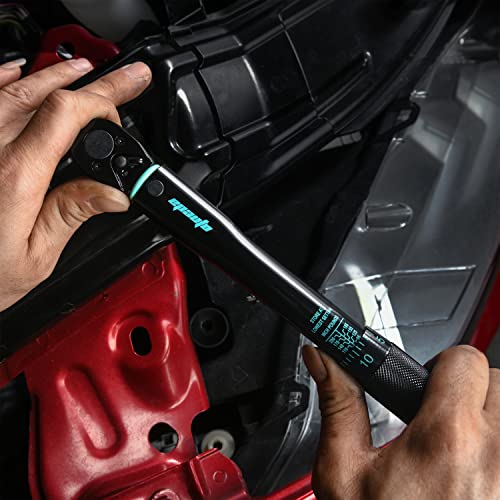
The low-cost way to get a 20–200 in-lb click wrench, with a Cr-V ratchet head and a case. EPAuto is an Amazon-first brand from EP Family Corp of Walnut, California.
Take the ±4% on trust or not at all: it appears only in the Amazon listing, with no standard named, no calibration certificate, no manual and no published warranty or calibration service. That's the real difference between this and the TEKTON, not the feel of the tool.
Based on the maker's specifications and manual and the published reviews linked below, not on our own test of this unit.
Setup, everyday use and what others found
Setup & use · per the maker
- 20–200 in-lb with a high-contrast dual-range scale and a knurled handle, per the listing. The scale steps aren't published.
- Hardened chrome-vanadium ratchet head, supplied in a plastic storage case, per the listing.
- "Pre-calibrated to ±4%", per the listing. No standard (ISO 6789 or ASME) is cited, no part of the range is specified, and no direction is given.
- EPAuto publishes no manual for this wrench, so there's no maker guidance on setting, locking, storage or which direction it measures. Treat it like any coil-spring click wrench: wind it down to the bottom of the scale before you put it away.
- EPAuto's own site lists only air filters. We found no warranty statement, calibration certificate or repair service for its torque wrenches.
- EPAuto doesn't state where it's made, and retailer listings disagree.
What others found
We found no owner reports tied to this exact model and no independent test of it. Forum opinion of the brand is split and never names a model number, so we haven't used it.

CDI 2502MRMH Inch-Pound Torque Wrench
Pro-grade accuracy with a wider 3/8" range
- Drive
- 3/8"
- Range
- 30–250 in-lb
- Rated ±3% clockwise and ±4% counter-clockwise, from 20% of scale
- Serialized with a NIST-traceable certificate and a moulded case
- Calibrated in both directions; quick-release 3/8" drive takes larger sockets
- Costs more than the 1/4" wrenches
- Rated from 50 in-lb up, so the marked 30 in-lb minimum is outside the guaranteed band
The professional inch-pound pick: a 3/8-inch CDI that CDI rates ±3% clockwise and ±4% counter-clockwise from 20% of scale, individually serialized and supplied with a NIST-traceable certificate in a moulded case.
Its 30–250 in-lb range and 3/8-inch drive reach higher than a 1/4-inch wrench and take ordinary sockets, and at 11.25 in it's short enough to work in tight spaces. CDI is a Snap-on company.
Based on the maker's specifications and manual and the published reviews linked below, not on our own test of this unit.
Setup, everyday use and what others found
Setup & use · per the maker
- 30–250 in-lb (4.0–27.7 N·m) on a dual scale in 1 in-lb steps. Fixed ratcheting head with a quick-release button.
- CDI rates it ±3% clockwise and ±4% counter-clockwise of the indicated value, from 20% to 100% of full scale, so the rating covers 50 in-lb and up, and calibrates it in both directions. Some distributors still list the older ±4%/±6% figures, which belong to CDI's flex-head line.
- Set it by pulling down the spring-loaded lock ring, turning the handle to the value, then releasing the ring to lock it.
- Individually serialized, with a matching NIST-traceable certificate of calibration and a custom-moulded storage case.
- CDI says to store it at its lowest torque setting, and to have it recalibrated once a year or every 5,000 cycles, whichever comes first.
- CDI says never to use a torque wrench to break fasteners loose, and that a cheater bar gives an inaccurate reading and can damage the wrench. CDI's warranty doesn't cover calibration beyond the certificate the wrench ships with.
What others found
Two posters in one 2020 thread on BobIsTheOilGuy praise how small it is: one says the head gets into all sorts of tight places, and the other has used one for years because of how many low-torque fasteners newer cars have.
Owner data on this model is thin: the retailers we could read show no reviews, and we found no independent test of it. Unlike CDI's bigger wrenches, this one's listing makes no US-origin claim and distributor listings disagree, so we don't state where it's made.
- Aeronautics diploma
- Engineering degree
- BAMEC (DGCA)
- QC-trained
- ~2 yrs tool management
Why you should trust us
SK Kutubuddin spent over two decades maintaining and inspecting aircraft, where torque values are commonly written in inch-pounds and small fasteners going into light-alloy parts are handled with real care. He holds a diploma in mechanical engineering (aeronautics), an engineering degree, a BAMEC and a qualification in aviation fuels and lubricants, and long experience on the flight line taught him that the smallest bolts are often the easiest to strip and the hardest to repair.
For this page we focused on the low range where a foot-pound wrench runs out of accuracy, and on the two drive sizes that suit small sockets. Each pick's drive and range was checked against the manufacturer's specifications and the current retail listing, per our how-we-test method. We chose from verified specs and category experience rather than a lab test, and every trade-off, from minimum setting to build quality, is stated on the page.
Who this is for
An inch-pound wrench is for anyone whose fasteners are too small for a foot-pound wrench but too large or too tight for a screwdriver handle. That covers much of the engine bay, a lot of motorcycle and small-engine work, and plenty of bench machinery, where the spec is written in inch-pounds and a stripped thread is an expensive mistake.
If your values mostly fall below the bottom of these ranges, a torque screwdriver is the finer tool. If they mostly sit above, a 3/8-inch or 1/2-inch foot-pound wrench is the better fit.
- Valve covers, timing covers, oil pans and intake manifolds
- Motorcycle and small-engine fasteners
- Bicycle components with inch-pound specs
- Brackets, fittings and small machinery on the bench
- Anyone who has stripped a thread tightening a small bolt by feel
How we picked
We focused on the stretch of the torque scale where a foot-pound wrench stops being accurate and a screwdriver runs out of reach. Each wrench's drive and range was confirmed against the manufacturer's specifications and the current listing.
- 01
A range that bridges the gap
The right inch-pound wrench picks up roughly where a torque screwdriver runs out and hands over cleanly to a foot-pound wrench. We looked for ranges that put common small-fastener values in their middle, not at their extremes.
- 02
A drive size that suits small sockets
A 1/4-inch drive keeps the head compact and suits the small sockets these fasteners take, while a 3/8-inch drive extends the range and fits larger sockets. We included both, so you can choose by the sockets you already own.
- 03
A click you can actually feel
At low settings, the click of a torque wrench is lighter and easier to miss. We weighed mechanisms with a reputation for a distinct, dependable release, because a click you overlook means a fastener pulled past its spec.
- 04
Proven build or an honest budget pick
We paired a professional-grade tool with a trusted mid-price wrench and a lower-cost alternative, and we stated plainly where the budget option gives up build quality, so you know exactly what the saving costs you.
What to know before you buy
What inch-pounds are for
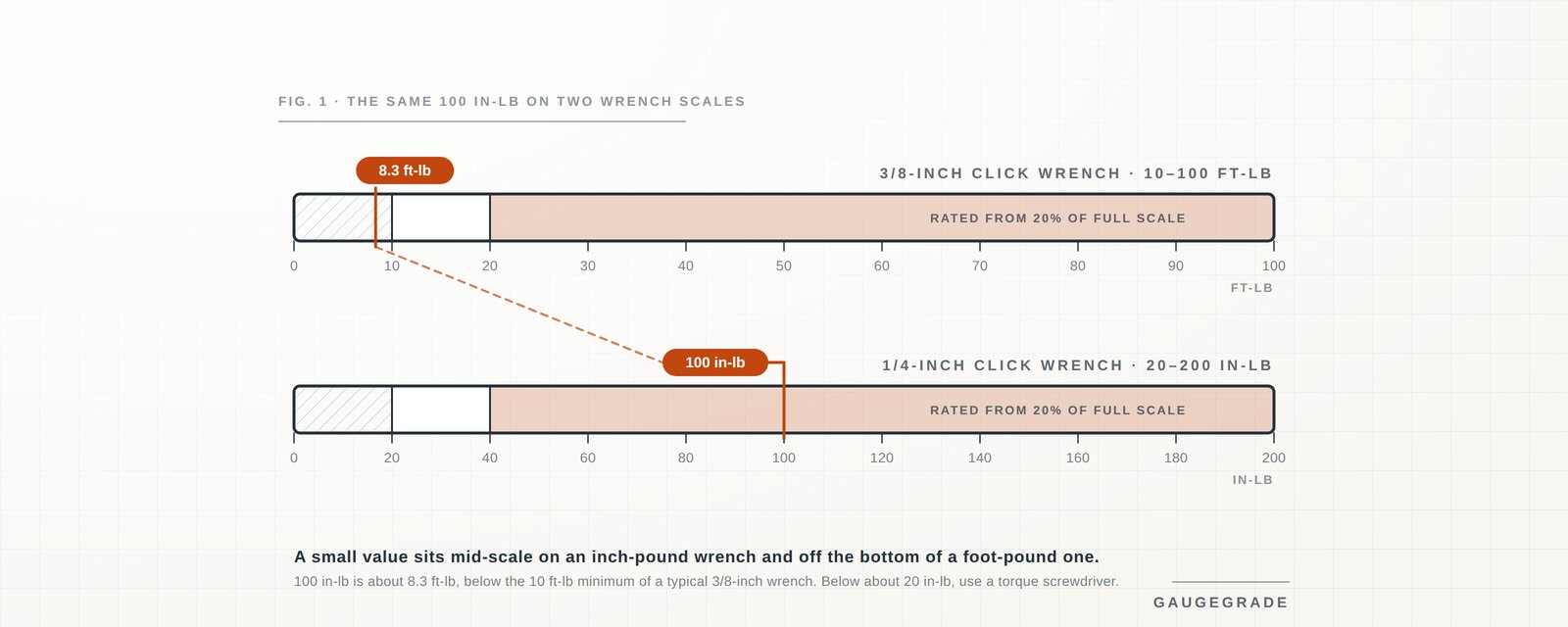
Inch-pounds cover the small fasteners where a foot-pound wrench is simply too coarse to set accurately. Since 12 in-lb equals 1 ft-lb, a job specified at, say, 100 in-lb is only about 8 ft-lb — right at or below the bottom of many ft-lb wrenches.
Typical inch-pound work: brake caliper guide bolts, valve and timing covers, intake and throttle-body bolts, plus bicycle components and optics.
Which range and drive?
A 1/4" wrench at 20–200 in-lb covers the majority of small-fastener work. A 3/8" inch-pound wrench extends the top of the range and takes larger sockets. Below about 20 in-lb — delicate electronics and optics — a torque screwdriver is finer than any wrench.
Using it right
Same rules as any torque wrench: hand-snug the fastener first, pull smoothly to a single click, and dial the wrench back down before storing it to protect the calibration. The full method is in our torque-wrench guide.
Small bolts in soft metal: covers, sequence and stripped threads
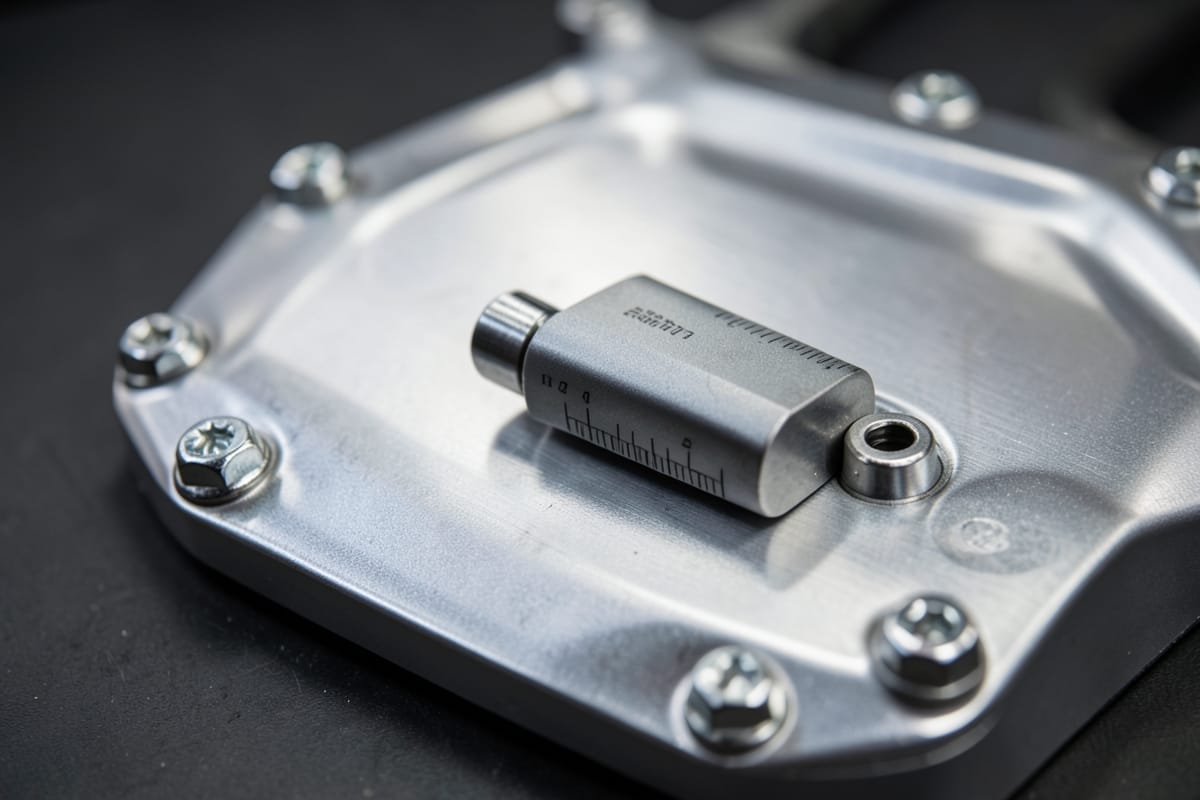
Much inch-pound work is a steel bolt going into an aluminum casting: a cylinder head, timing cover, oil pan or transmission case. Aluminum threads are far less forgiving than steel, and a small bolt can strip them with surprisingly little extra effort. The repair usually means a thread insert, which is a lot of work for a bolt that was simply pulled too far.
Gasketed covers add a second risk. A thin cover can distort if one bolt is pulled down hard before the others, leaving gaps the gasket cannot seal. Follow the manual's tightening sequence. Where none is given, a common approach is to work from the center outward in a criss-cross pattern, in two or more stages, finishing at the full value.
- Clean the threads in the casting; debris adds friction, so the wrench clicks before the bolt reaches its intended clamp load.
- Start every bolt by hand so it cannot cross-thread in soft metal.
- Add sealant or lubricant to threads only where the manual calls for it.
- If a bolt keeps turning without getting tighter, stop: the thread is likely stripping.
Converting to and from inch-pounds without mistakes
Service data for small fasteners appears in inch-pounds, foot-pounds and newton-meters, sometimes all in the same manual. Setting an inch-pound wrench means converting everything into inch-pounds first, and the most damaging error is a unit mix-up rather than a rounding one: 10 ft-lb is 120 in-lb, so a value set in the wrong unit is off by a factor of twelve. Our inch-pound to foot-pound converter does the arithmetic and lists common values.
When a spec is given in newton-meters, multiply by about 8.85 to get inch-pounds; 10 N·m works out to about 88.5 in-lb. If a manual lists a small bolt at a figure that looks alarmingly high, check the unit before assuming it is right. Round to the nearest graduation your wrench can set, and if the converted value falls below the wrench's minimum, switch to a torque screwdriver rather than working at the bottom of the scale.
- ft-lb to in-lb: multiply by 12
- in-lb to ft-lb: divide by 12
- N·m to in-lb: multiply by about 8.85
- in-lb to N·m: multiply by about 0.113
Frequently asked questions
What is an inch-pound torque wrench used for?
Small fasteners where foot-pounds are too coarse — brake calipers, valve and timing covers, intake bolts, bikes and optics. Twelve in-lb equals one ft-lb.
in-lb vs ft-lb — how do they relate?
One foot-pound equals twelve inch-pounds. Use whichever unit your fastener spec is written in.
What range do I need?
A 1/4" 20–200 in-lb wrench covers most small-fastener work; a 3/8" model extends the range and takes bigger sockets.
Inch-pound wrench or torque screwdriver?
For roughly 20 in-lb and up, a wrench is ideal. Below that — delicate electronics and optics — a torque screwdriver is finer.
Do inch-pound torque wrenches need calibration?
Yes, periodically. Store them dialed down to the low end of the range to keep them accurate longer, and check them against a reference at least once a year; our calibration guide shows how.
Is a 1/4-inch torque wrench the same as an inch-pound torque wrench?
Usually, but not always. Most 1/4" drive torque wrenches are scaled in inch-pounds, such as 20–200 in-lb, because the fasteners they suit need low values. The drive size describes the square that fits your sockets; the unit describes the scale. Check both.
Why is the click so hard to feel at low settings?
At a low setting the spring behind a click mechanism carries little load, so the release is lighter and quieter than at higher values. Pull slowly, keep your hand relaxed on the grip and watch the head as you pull. If you routinely miss it, a digital wrench with an audible alert is easier to use at the bottom of a range.
Can I use 3/8-inch sockets on a 1/4-inch inch-pound wrench?
Yes, with a drive adapter. An adapter that only steps up the drive size sits in line with the wrench head, so it does not change the torque delivered. Keep the job within the wrench's range and the adapter's rating, and avoid stacking several adapters, which adds play and makes the wrench harder to hold square.
What sockets work best with an inch-pound wrench?
Six-point sockets that fit the fastener snugly. They grip the flats rather than the corners, which matters on small heads that round off easily. Use the correct metric or SAE size, keep the socket fully seated on the bolt head, and retire worn sockets with flared openings.
Related reading
- The Best Torque Screwdrivers
- The Best 3/8-Inch Torque Wrenches
- How to Use a Torque Wrench (Properly)
- How to Check and Calibrate a Torque Wrench
- The Best Digital Torque Wrenches
- The Best Torque Screwdrivers for Electricians
- Inch-Pounds to Foot-Pounds Converter
- The Best Torque Wrench Calibrators and Testers
- All torque tools
- Aeronautics diploma
- Engineering degree
- BAMEC (DGCA)
- QC-trained
- ~2 yrs tool management
SK spent over two decades in aircraft maintenance, working hands-on with aero-engine systems and flight data recorder systems, borescope-inspecting turbine and compressor blades, and spending almost two years in a dedicated tool bay. He holds a diploma in mechanical engineering (aeronautics), an associate degree in science, an engineering degree and a Basic Aircraft Maintenance Engineer's Certificate (BAMEC) from DGCA, and has completed quality-control and aviation fuels & lubricants training. GaugeGrade applies the same inspection, torque and tool-management standards to the tools everyday mechanics, DIYers and trades actually buy.