How to Use a Torque Wrench (Properly)
A torque wrench only helps if you use it right — set correctly, pulled smoothly, stopped at the click, and stored properly. Here is the correct method for a click-type wrench, plus the habits that keep it accurate.

- 7 steps
- What you'll need, listed
- No paid placements
These steps are for a click-type torque wrench, the most common kind. Digital and beam wrenches differ only in how they show the reading; the principles are the same.
Always torque to the manufacturer's specification, in the correct unit (ft-lb, in-lb or N·m), and in the thread condition the spec assumes (dry or lubricated).
- See our picksA click-type torque wrench in the right range
A 1/2-inch drive for wheels and chassis or a 3/8-inch for engine work, with a range centered on your fasteners.
- See our picksA digital torque wrench (optional)
Worth it for torque-plus-angle procedures or many different specs in one job; it shows a live reading and alerts at target.
- See our picksAn inch-pound torque wrench for small fasteners
Handles valve covers, brackets and small bolts that sit at or below the bottom of a foot-pound wrench's range.
- See our picksA torque screwdriver for the smallest screws
For electronics, optics and delicate fasteners that fall below the reach of any torque wrench.
- The manufacturer's torque spec
The value, its unit, the thread condition it assumes, and any sequence, stages or angle steps from the service manual.
- Well-fitting sockets and a plain ratchet or breaker bar
Six-point sockets that seat fully on the fastener, plus a separate ratchet or bar for running down and loosening.
How to use a click-type torque wrench
Find the correct spec
Look up the fastener's torque value and its unit, and note whether the spec is for dry or lubricated threads. Getting the unit right matters — in-lb and ft-lb are not interchangeable.
Unlock and set the value
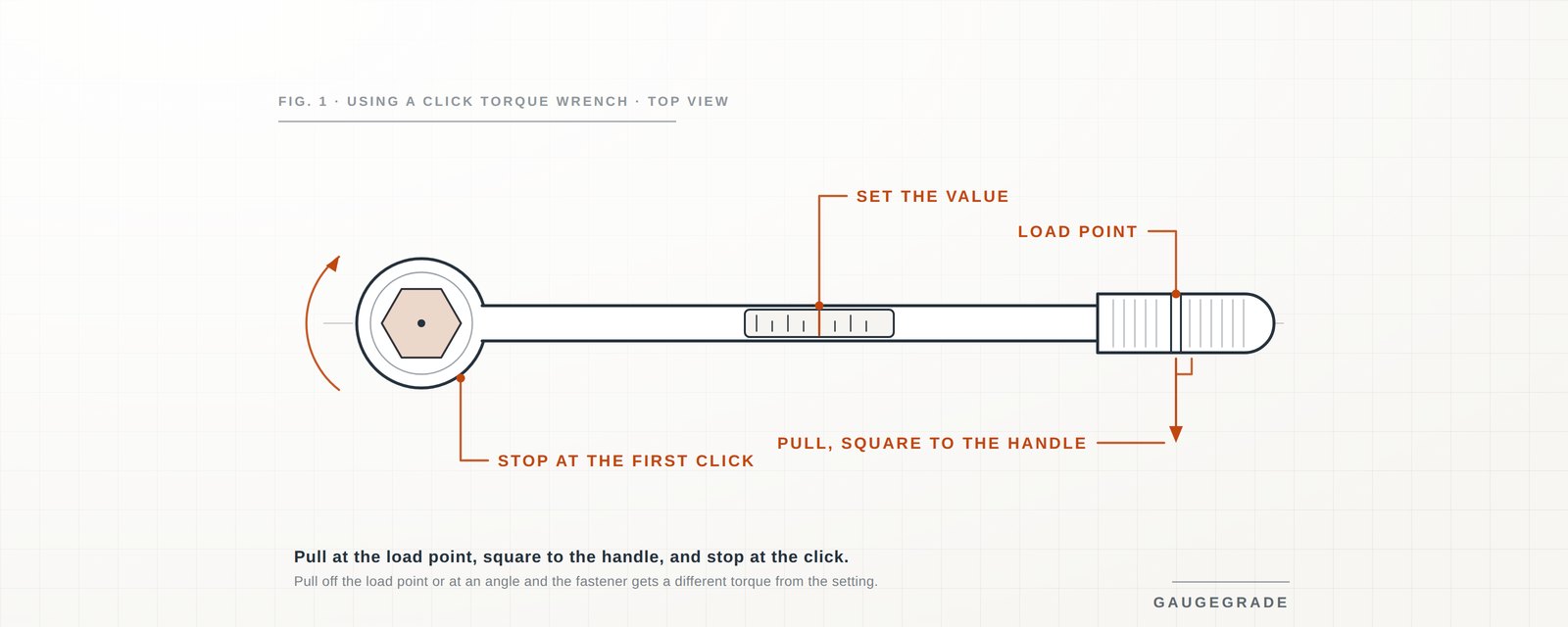
Unlock the handle, turn it until the main scale plus the micrometer marks on the handle add up to your target, then re-lock it so the setting cannot drift.
Hand-snug the fastener first
Run the fastener down by hand or with a plain ratchet until it is just snug. The torque wrench should only be doing the final tightening, not spinning the fastener all the way in.
Pull smoothly to the click
Grip the center of the handle and pull steadily and slowly — no jerking — in one smooth motion until you feel and hear the click.
Stop at the first click
The moment it clicks, stop. One click means you have reached the value. Do not pull again or “double-click” — that over-torques the fastener.
Follow the sequence and passes
On multi-bolt joints — cylinder heads, wheels, flanges — tighten in the specified sequence (usually criss-cross or star) and in steps if the spec calls for it, for example half torque on the first pass and full torque on the second.
Wind it back down before storing
After use, dial the wrench back toward the low end of its range to relax the internal spring, then store it. A wrench left wound up loses calibration faster.
The rules that keep it accurate
A torque wrench is a precision instrument. Treat it like one:
- Never use it to loosen fasteners or as a breaker bar.
- Never exceed its rated range — torque is most accurate in the middle of the range.
- Store it dialed down to the low end, not wound up.
- Have it recalibrated periodically, especially for important work.
- Treat a dropped wrench as suspect until it is checked.
Dry vs lubricated — and why the number matters
A torque figure is really a way of reaching a target clamp load. Lubricated threads reach that same clamp load at a lower torque, because less of your effort is lost to friction.
So follow the spec's dry-or-lubricated note. Torque a lubricated fastener to a dry number and you will over-tension it, which can stretch or snap the bolt. For a general-purpose bolt with no published value, our bolt torque chart gives dry and lubricated starting values by grade. A threadlocker or anti-seize is a thread coating too, so check what the spec assumes before you add one.
Common mistakes
Most torque errors are one of these:
- Jerking the pull instead of a smooth, steady motion.
- Pulling past the click, or clicking twice.
- Using the wrench to break fasteners loose.
- Storing it wound up to a high setting.
- Ignoring the tightening sequence on a multi-bolt joint.
- Mixing up units — in-lb set on an ft-lb spec, or vice versa.
Extensions, swivels and crowfoots: when the setting has to change
Accessories between the wrench and the fastener fall into two groups. A straight socket extension or a drive-size adapter sits in line with the wrench's drive and does not change the lever arm, so the torque at the fastener is the torque you set. Universal joints and wobble extensions are different: used at an angle they can bind and introduce error, so keep them as straight as the job allows.
Anything that moves the fastener further along the wrench's length, such as a crowfoot wrench or an offset adapter, lengthens the lever arm and puts more torque on the fastener than the wrench shows. Correct for it with: wrench setting = desired torque × L ÷ (L + E). L is the wrench's effective length, from the center of the drive to the point where the load is applied on the handle, and E is how far the adapter extends the drive along the wrench's axis.
Example: a wrench with a 16-inch effective length and a crowfoot that adds 2 inches, for a 40 ft-lb target, needs a setting of 40 × 16 ÷ 18, or about 35.6 ft-lb. Turn the crowfoot 90 degrees to the handle and the effective length is essentially unchanged, so no correction is needed. Point it back toward the handle and the arm gets shorter, so the setting must go up instead. Our torque wrench extension calculator does this arithmetic for any angle.
Calibration: what a check involves and when to send a wrench out
A calibration check puts the wrench on a torque tester and compares what it delivers with what it is set to, at several points across its range rather than one. A calibration lab adjusts it if needed and issues a certificate recording the readings, often both as found and as left, which shows how far the wrench had drifted since its last check.
Some events should send a wrench for checking straight away, whatever the schedule says: an accidental overload past full scale, use as a breaker bar, a hard drop, a click that suddenly feels different, or two wrenches that disagree on the same fastener.
Between calibrations you can run a simple sanity check at home. Clamp the square drive in a vise with the handle level, set the wrench to a value near the middle of its range, and hang a known weight from the grip, loading it in the tightening direction. Torque equals weight times horizontal distance from the drive center, so 20 pounds hung 2 feet out is 40 ft-lb. The check ignores the wrench's own weight and friction, so it shows whether a wrench is roughly right, not that it is accurate. A wrench that clicks well away from the expected load needs a proper calibration.
- Aeronautics diploma
- Engineering degree
- BAMEC (DGCA)
- QC-trained
- ~2 yrs tool management
Why you should trust us
SK Kutubuddin spent over two decades maintaining and inspecting aircraft, including almost two years in a dedicated tool bay. Torquing flight-critical fasteners to spec was routine work, and a wrench past its calibration date simply did not get used. The method on this page is the same set of habits he relied on at the flight line: the right spec in the right unit, a smooth pull, one click, and a wrench stored so it stays accurate for the next job.
This guide follows recognized practice for click-type wrenches, including the general guidance in FAA AC 43.13-1B, and applies it to the cars, bikes and small machinery most readers work on. The tools we point to are covered in our torque tool reviews, where every pick was checked against the manufacturer's specifications and current listings per our how-we-test method. Where a step depends on your vehicle or equipment, we send you to the maker's value rather than guessing.
Frequently asked questions
Can I loosen bolts with a torque wrench?
No. A torque wrench is a measuring tool, not a breaker bar. Loosen fasteners with a plain ratchet or breaker bar and save the torque wrench for final tightening.
Should I store a torque wrench set to zero?
Dial it back down to the low end of its range to relax the spring before storage — follow the maker's guidance on whether that is zero or the lowest marked value. The point is to not leave it wound up.
ft-lb, in-lb or N·m — how do they relate?
They are all units of torque. One ft-lb equals 12 in-lb, and one N·m is about 0.74 ft-lb. Always use the unit your spec is written in.
How often should a torque wrench be calibrated?
Periodically, and more often with heavy use or critical work. If accuracy matters and the wrench has been dropped or is well used, have it checked.
One click or two?
One. Stop at the first click — pulling again applies more than the set torque.
Is a beam torque wrench any good?
Yes, for the right user. A beam wrench reads torque from a pointer against a scale and has no spring to wear or wind down, so it tends to hold its accuracy well. Check that the pointer rests at zero before use, read the scale from directly above to avoid misreading it, and expect it to be awkward where you cannot see the scale.
What should I do if I pull past the click?
Stop, loosen the fastener and re-tighten it to spec in one smooth pull. An ordinary bolt that went slightly over is usually fine to re-tighten, but a fastener that may have stretched, a single-use torque-to-yield bolt, or anything safety-critical should be replaced as the service manual directs.
How do I check a fastener that is already tightened?
Set the wrench to the spec and pull slowly in the tightening direction. If the fastener turns before the click, it was below spec and is now at it. If the wrench clicks with no movement, the fastener is at least at spec, though you cannot tell by how much. Static friction makes this an approximate check, not a measurement.
Related reading
- Best Torque Wrenches for Cars
- The Best Torque Screwdrivers
- How to Check and Calibrate a Torque Wrench
- Torque Wrench Extension & Crowfoot Calculator
- Beam vs Click vs Digital Torque Wrenches
- Torque Seal: What It Is and How to Apply It
- Bolt Torque Chart: SAE and Metric
- How Does a Torque Wrench Work?
- All torque tools
- Aeronautics diploma
- Engineering degree
- BAMEC (DGCA)
- QC-trained
- ~2 yrs tool management
SK spent over two decades in aircraft maintenance, working hands-on with aero-engine systems and flight data recorder systems, borescope-inspecting turbine and compressor blades, and spending almost two years in a dedicated tool bay. He holds a diploma in mechanical engineering (aeronautics), an associate degree in science, an engineering degree and a Basic Aircraft Maintenance Engineer's Certificate (BAMEC) from DGCA, and has completed quality-control and aviation fuels & lubricants training. GaugeGrade applies the same inspection, torque and tool-management standards to the tools everyday mechanics, DIYers and trades actually buy.