The Best Borescopes for Engine Inspection
Inspecting inside an engine — cylinder walls, piston crowns, valves, a turbo — is a different job from looking around an engine bay. Two things decide whether a borescope can do it: a probe thin enough to pass through the spark-plug hole, and a way to look at the bore walls, not just the piston top. I spent over two decades inspecting turbine and compressor blades to that kind of standard; these are the scopes that bring it to your engine.

- 5 picks compared
- Specs checked against maker data
- No paid placements
GaugeGrade is reader-supported. When you buy through links on our site we may earn an affiliate commission at no extra cost to you. We only recommend gear we have researched against verified manufacturer specifications.
- 1Probe size first: about 3.9 mm passes almost any spark-plug hole with room to angle it; 5.5 mm passes most car plug holes; an 8 mm-class probe is tight in 12 mm plug holes and may not pass 10 mm ones, so it is better for turbos, intakes and valve covers.
- 2A straight-ahead camera only shows the piston crown. To read the bore walls and valve seats you want articulation or a side view.
- 3A borescope shows you the cause a compression or leak-down test can only hint at.
- 1Best overall for cylindersTeslong 3.9mm 4-Way Articulating Borescope
- 2Best valueDEPSTECH DS300 5.5mm Inspection Camera
- 3Best value articulatingTeslong TD500 3.9mm Two-Way Articulating Borescope
- 4Best budgetNIDAGE 3.9mm WiFi Borescope
- 5Best for turbos & valve coversAutel MaxiVideo MV108S Inspection Camera
What we recommend
Compare the key specs side by side, then read the full notes on each pick below.
- Probe dia
- 3.9mm
- Articulation
- 4-way(360°)
- Display
- 6"IPS screen
- Probe dia
- 5.5mm
- Articulation
- None(semi-rigid)
- Display
- 4.3"screen
- Probe dia
- 3.9mm
- Articulation
- 2-way
- Display
- 5"IPS screen
- Probe dia
- 3.9mm
- Articulation
- None(semi-rigid)
- Display
- Phone(WiFi)
- Probe dia
- 8.5mm
- Articulation
- None(semi-rigid)
- Display
- Autel scan tool or PC


Teslong 3.9mm 4-Way Articulating Borescope
Full cylinder and valve inspection through the spark-plug hole
- Probe dia
- 3.9 mm
- Articulation
- 4-way (360°)
- Display
- 6" IPS screen
- 3.9 mm probe fits most spark-plug holes
- 4-way joystick steering (Teslong lists 360°) around the bore
- 6" IPS screen, LED-lit probe
- 5 ft flexible probe
- The priciest option here
- A fine articulating probe needs a careful hand
This is the scope for looking properly inside a cylinder. The 3.9 mm probe passes even 10 mm plug holes, and four-way steering lets you point the camera at the bore wall, the piston crown and up at the valves from the same hole, which a fixed probe can't do.
The cost is the price, the highest of any pick here, and a delicate tip that punishes rough handling. Teslong sells it as the TF600 with the 3.9 mm single-lens probe.
Based on the maker's specifications and manual and the published reviews linked below, not on our own test of this unit.
Setup, everyday use and what others found
Setup & use · per the maker
- A joystick steers the tip in four directions; Teslong lists 360° of articulation. Center it and make sure the bending section is straight before you pull the probe out, and never force it.
- Single camera with 6 adjustable LEDs, an 80° field of view and a focus range of about 0.8–3.9 in.
- Saves photos and video at up to 1920 × 1080 to the included 32 GB microSD card, although Teslong rates the 3.9 mm camera itself at 1.0 megapixel.
- 6-inch 1920 × 1080 IPS screen, with a mini-HDMI port alongside the USB-C charging port and card slot.
- Teslong rates the 6000 mAh battery at up to 3.5 hours of use.
- The 1.55 m (5.08 ft) probe is IP67, to 1 m for 30 minutes; don't submerge the monitor. Teslong says the probe can't be replaced if it's damaged.
- In the box: monitor, probe, 32 GB card, USB-C cable and a carrying case. The hook and magnet tips come only with the 6.5 mm version.
What others found
We found no independent hands-on test of the 3.9 mm TF600 and no owner reviews outside Amazon. Teslong now also sells the F8 PRO, a pricier model with the same listed specs and a longer warranty.




DEPSTECH DS300 5.5mm Inspection Camera
A thin-probe scope with its own screen at a fair price: no phone, WiFi or app
- Probe dia
- 5.5 mm
- Articulation
- None (semi-rigid)
- Display
- 4.3" screen
- 5.5 mm probe reaches into many cylinders
- 4.3" screen, 1080p photos and video; 32 GB card included
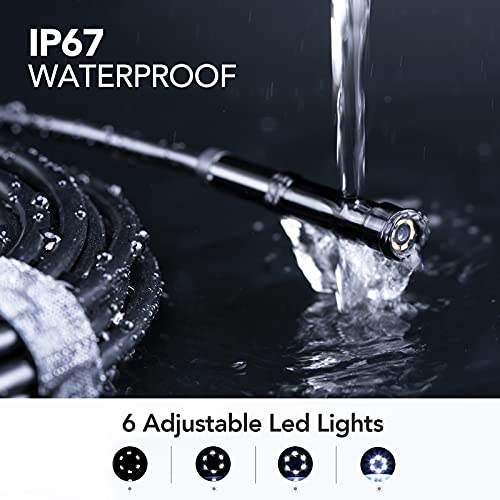
- About 4 hours per charge; IP67 probe on a 16.5 ft semi-rigid cable
- Hook, magnet and side mirror in the box
- Diesels and some small engines may need a thinner probe
- No articulation: you aim the whole probe
An inexpensive way to get a thin probe and a screen of its own. At 5.5 mm it passes most car plug holes, and with a single forward-looking camera there's no app, pairing or lens switching to learn.
You aim it by bending the cable or clipping on the side mirror, and recorded video is choppy, so rely on still photos for close checks.
Based on the maker's specifications and manual and the published reviews linked below, not on our own test of this unit.
Setup, everyday use and what others found
Setup & use · per the maker
- Hold the power button for 2 seconds to switch on. One press of the capture button takes a photo; hold it for 2 seconds to start or stop video. There is no zoom.
- Two buttons brighten and dim the 6 LEDs through three levels, and another flips the image 180°.
- Records 1080p video and 2 MP (1920 × 1080) photos to the included 32 GB card.
- DEPSTECH lists the sharpest focus at about 5–10 cm (2–4 in) from the lens.
- Charges over micro-USB. DEPSTECH rates it at about 4 hours per charge; one version of the manual says 2.5–3 hours.
- Only the probe is waterproof (IP67), and the manual warns it is not heat-resistant, so let an engine cool first. Rated to work from 32 to 113 °F (0–45 °C).
- In the box: hook, magnet and side-mirror tips, a protective cap and a USB cable. The 16.5 ft cable is semi-rigid.
What others found
Digital Camera World found the live screen sharp and bright enough to use in daylight, but recorded video looked closer to three frames a second. The reviewer also found the back of the probe can catch as you pull it out, and that the grip favors right-handed use.
One Walmart buyer liked that it works on its own, with no app or phone to pair, and another used it to look inside a piston cylinder.


Teslong TD500 3.9mm Two-Way Articulating Borescope
Steerable cylinder inspection without the top-tier price
- Probe dia
- 3.9 mm
- Articulation
- 2-way
- Display
- 5" IPS screen
- 3.9 mm probe for spark-plug-hole access
- Two-way articulation to read the cylinder walls
- 5" IPS screen
- Steers in one plane, not all four
- Still costs more than a fixed probe
Steering for about half the list price of Teslong's four-way 3.9 mm TF600. The wheel bends the tip in one plane, and by turning the probe as well you can still sweep the whole bore wall from a plug hole.
It's Teslong's TD500 with the 3.9 mm probe. You give up four-way control and the bigger 6-inch screen.
Based on the maker's specifications and manual and the published reviews linked below, not on our own test of this unit.
Setup, everyday use and what others found
Setup & use · per the maker
- A wheel bends the tip up to 210° in two directions. Return the wheel to neutral before you pull the probe out, and don't turn it aggressively.
- The up button zooms, the down button flips the image 180°, and the light button steps the 6 LEDs through three brightness levels, then off.
- Saves 1920 × 1080 photos and video to the included 32 GB card, though the manual rates the 3.9 mm camera at 1.0 MP.
- 5-inch IPS screen (854 × 480). A long press on Settings turns on WiFi so you can also watch on a phone through the Smart Endoscope app.
- USB-C charging; Teslong rates the 3000 mAh battery at 3–4 hours, and it keeps working while it charges.
- The probe is rated IP67; keep the handset dry. The manual rates the handset for 0–45 °C (32–113 °F) and the probe for up to 70 °C (158 °F).
- The hook and magnet tips don't fit the 3.9 mm probe, and Teslong says the probe can't be replaced if it's damaged.
What others found
We found no independent hands-on test of the 3.9 mm TD500 and no owner reviews outside Amazon.


NIDAGE 3.9mm WiFi Borescope
The cheapest way to see inside a cylinder, using your phone
- Probe dia
- 3.9 mm
- Articulation
- None (semi-rigid)
- Display
- Phone (WiFi)
- 3.9 mm probe passes into most cylinders through the plug hole
- 1080p to iOS 9+ and Android 5+ over the scope's own WiFi
- 6 adjustable LEDs, IP67 probe
- No screen of its own: needs your phone
- Short 5 ft cable; sharpest close in (about 3–10 cm)
- WiFi adds lag
An inexpensive way to see inside a cylinder. The 3.9 mm probe passes even small plug holes, and the semi-rigid cable holds whatever bend you give it, so you can aim the camera at the bore wall.
Everything else depends on your phone and a free app with poor reviews. For an occasional look it's hard to argue with; for regular work, a scope with its own screen is less hassle.
Based on the maker's specifications and manual and the published reviews linked below, not on our own test of this unit.
Setup, everyday use and what others found
Setup & use · per the maker
- Install the HD WiFi app, join the camera's own WiFi network from your phone's settings, then open the app to see the picture.
- Pick 1920 × 1080, 1280 × 720 or 640 × 480. The 2 MP camera is lit by 6 adjustable LEDs.
- Sharpest about 3–10 cm (1.2–3.9 in) from the lens, so work close.
- The 5 ft semi-rigid cable bends and holds its shape; there is no articulation.
- The probe and cable are IP67; keep the WiFi box dry.
- The listing gives iPhone and iPad on iOS 9 or later and Android 5 or later.
What others found
The HD WiFi app has weak ratings in both app stores. Reviewers report the phone saying it has no internet connection while the app shows no picture, along with a stretched image and buttons that sit off-screen. Those reviews cover every camera that uses the app, not only NIDAGE's.
We found no independent hands-on test of this model.




Autel MaxiVideo MV108S Inspection Camera
Turbos, intakes and valve covers on a pro bench (with an Autel scan tool or PC)
- Probe dia
- 8.5 mm
- Articulation
- None (semi-rigid)
- Display
- Autel scan tool or PC
- 8.5 mm 1080p (2 MP) imager with 8 LEDs
- IP67 waterproof head
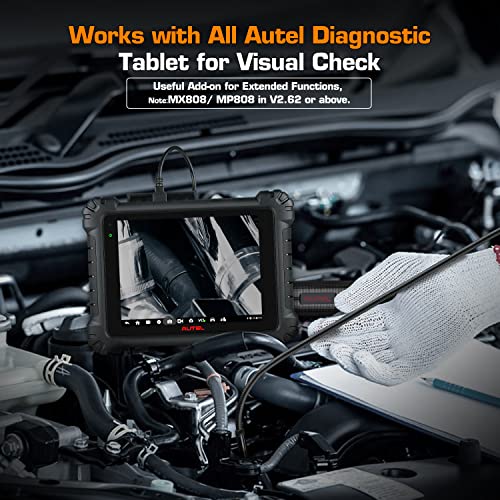
- Turns an Autel scan tool into an inspection scope
- 8.5 mm is tight in 12 mm plug holes and may not pass 10 mm ones
- No screen: needs an Autel scan tool or a PC
The pick for Autel tablet owners working on turbos, intakes and valve covers. The 8.5 mm imager is tight in smaller plug holes, but under a valve cover or in a turbo inlet it adds a camera to the tablet you already use.
Without a compatible Autel tablet it's the wrong buy: no screen, 1 m of cable, and no PC software from Autel.
Based on the maker's specifications and manual and the published reviews linked below, not on our own test of this unit.
Setup, everyday use and what others found
Setup & use · per the maker
- Plugs into the tablet's USB port and draws its power from it. You open MaxiVideo from the tablet's job menu.
- Autel's quick-start guide warns that not every Autel tablet has the MaxiVideo app, so confirm yours supports it before ordering.
- 8.5 mm imager with 8 LEDs, recording 1920 × 1080 (2 MP) stills and video through the tablet, with an 81° field of view.
- Sharpest at 3–8 cm (about 1.2–3.1 in) from the lens.
- The imager head is IP67. Autel rates it to work from 14 to 158 °F (−10 to 70 °C).
- Magnet, hook and mirror tips slip over the head. It carries a one-year limited warranty. A 5.5 mm version, the MV105S, trades resolution (1280 × 720) for a thinner head.
What others found
Six short buyer reviews on Diagmart are all positive, mostly praising a clear picture; one calls it a valuable addition to the scanner.
Compatibility lists disagree for some tablets, including the MaxiSys MS906, so check with Autel for yours. We found no independent hands-on test.
- Aeronautics diploma
- Engineering degree
- BAMEC (DGCA)
- QC-trained
- ~2 yrs tool management
Why you should trust us
Turbine inspection is the standard SK Kutubuddin brings to this page. Over two decades in aircraft maintenance, viewing turbine and compressor blades through a borescope was core daily work, and that job is unforgiving: every blade is seen, each finding is judged against a defined standard, and nothing is signed off on a partial look. This page applies that standard to choosing a scope for the inside of a piston engine.
We narrowed the field to scopes that can do real engine work, which in practice means a probe thin enough for the spark-plug hole and a way to look at the cylinder walls. Probe diameters, articulation and displays were checked against manufacturer specifications and current listings, following the method on our How We Test page. If we could not verify a spec, it is not on the page.
Who this is for
This page is for anyone who needs to know what is happening inside a cylinder without pulling the head: a DIYer with a low compression reading, an owner who suspects coolant is getting where it should not, a buyer checking an engine before committing, or a motorcycle or small-engine owner working with tight plug access.
If you mostly want to look around an engine bay, under a car or into exhaust and intake plumbing, our automotive borescope picks will suit you better. For aircraft piston engines, with their 18 mm plug holes and a rigid-probe procedure of their own, see our aviation borescope picks.
- Diagnosing a weak cylinder flagged by a compression or leak-down test
- Checking for signs of coolant or oil entering a cylinder
- Inspecting valves and piston crowns without a teardown
- Looking into turbos, intakes and valve covers with a larger probe
How we picked
We treated this as an inspection problem first and a shopping problem second: what does a scope need in order to show you the evidence inside a cylinder? Every spec was verified against the manufacturer and the current listing.
- 01
Fits the spark-plug hole
This is the core requirement. We prioritized 3.9 mm probes, which pass into most cylinders through the plug well, and included a 5.5 mm screen scope with its limits stated. A larger 8.5 mm probe appears only for the work it suits: turbos, intakes and valve covers.
- 02
Can see the bore walls
A forward-only camera shows the piston crown, but scoring, wash patterns and valve problems sit off to the side. We gave the most weight to two-way and four-way articulating tips, and flagged the fixed-probe picks so you know you will be aiming the whole probe instead.
- 03
A screen you can read at the engine
Fine detail on a bore wall is hard to judge on a small or laggy image. We favored standalone screens in the 4.3 to 6 inch range for this job, and kept one phone-based option for readers on a tight budget who accept the trade-off.
- 04
A probe you can control
Thin probes are delicate, and a probe that is too floppy will not go where you aim it. We noted where a fine articulating probe needs a careful hand, and where a gooseneck or semi-rigid cable holds its shape for a straighter, more predictable feed.
- 05
Clear steps up in price
Articulation adds cost. We set out a ladder, from a phone-based budget scope through fixed and two-way probes to a four-way scope, and stated what each step up buys you, so you can stop at the level your engine work actually needs.
What to know before you buy
Probe diameter: will it fit the cylinder?
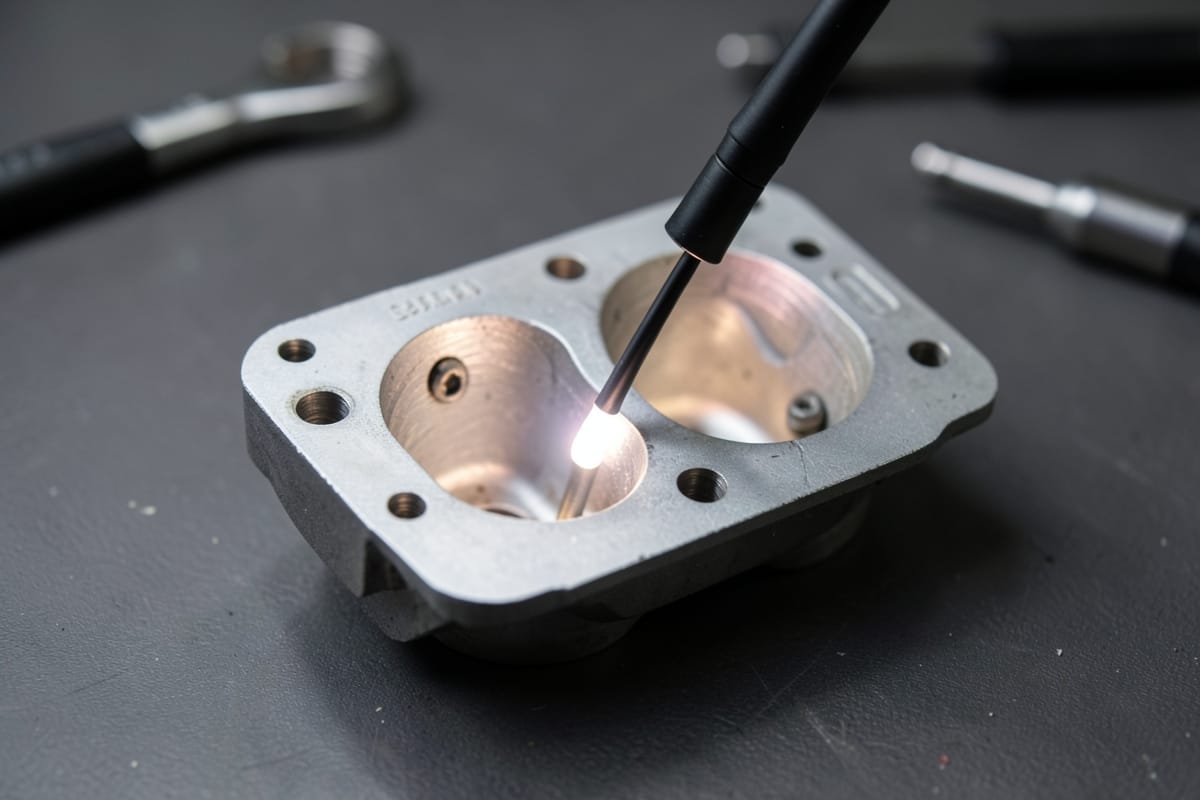
This is the decision that makes or breaks an engine-inspection scope. To look inside a cylinder you feed the probe down the spark-plug well and through the plug threads — a narrow, angled path.
The narrowest point is usually the plug's threaded hole in the head, about 12.6 mm across for a 14 mm plug, 10.6 mm for a 12 mm plug and 8.9 mm for a 10 mm plug. A 3.9 mm probe clears all of them with room to spare, and 5.5 mm passes most car plug holes. An 8 mm-class probe fits a 14 mm hole, is tight in a 12 mm hole and may not pass a 10 mm one, so it is at its best on turbos, intakes, valve covers and general engine-bay work. Decide whether you are buying mainly for cylinder checks or for engine-bay work before you look at anything else.
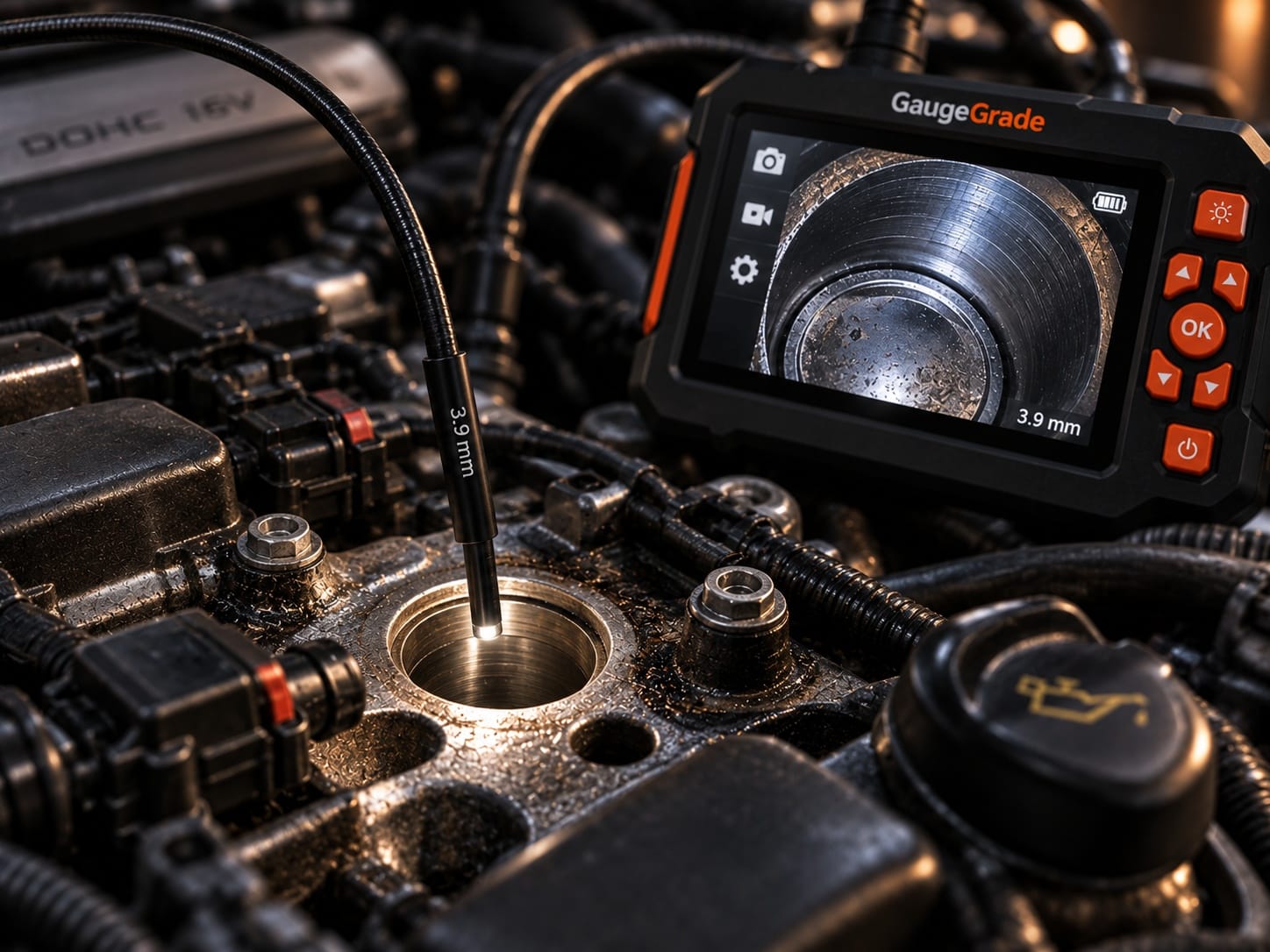
Why articulation matters inside a cylinder
Point a fixed, forward-looking camera down a plug hole and you see the piston crown — and little else. The parts that tell the story, the bore walls and the valve seats, are off to the side.
That is what a side view or a steerable tip is for. A two-way probe bends in one plane; a 4-way probe sweeps the whole bore. If you are diagnosing scoring, a wash pattern or valve condition rather than just glancing at a piston top, articulation is worth paying for.
Turbine-inspection habits that transfer to your engine
On a turbine engine, a borescope inspection is a disciplined routine: you index the compressor and turbine blades, inspect each to a defined standard, look specifically for cracking, erosion, corrosion, foreign-object damage and hot-section distress, and you never sign off a stage you have not fully seen.
The same discipline finds problems in a piston engine. Turn the crank so you view each cylinder at the bottom and top of its stroke; sweep the entire bore rather than glancing at the piston; keep the tip off the walls so you do not smear the lens or scratch anything; and photograph anything suspect so you can compare cylinders side by side. What you are hunting is bore scoring, a wet or oily wall, coolant droplets or discoloration, heavy carbon, a burnt or deposit-caked valve, or a dropped object.
The inspection view
A compression or leak-down test tells you a cylinder is weak; a borescope tells you why. Drop a 3.9 mm scope down the plug hole and the cause is usually right there to see — which is exactly why this is the tool I reach for first. Match the probe to the hole, get a way to look sideways, and the engine stops keeping secrets.
Reading the image: glare, color and scale
A borescope image is easy to misread, and many false alarms come from the image rather than the engine. Three effects cause most of them.
Glare comes first. A bore wall with a film of oil reflects the probe's LEDs straight back at the lens, which can look like a bright scratch or a wet patch. Change the viewing angle slightly, or dim the light if your scope allows it, and watch whether the mark moves. Real damage stays put; reflections slide around.
Color is next. The small sensors and LED lighting in inspection cameras do not reproduce color faithfully, so judge a stain or deposit by comparing it with the same area in another cylinder rather than by its exact shade.
Then scale. A wide-angle lens close to a surface makes small things look large and bends straight lines near the edge of the frame. Scopes in this class do not measure, so use known features, such as a valve head or the edge of the piston, to judge size, and treat any estimate as rough.
When a finding needs a mechanic
A borescope tells you what a surface looks like. It does not tell you how deep a score runs, whether a head is cracked, or whether an engine is safe to keep running.
If you see any of the signs below, do not keep cranking or running the engine to see whether it improves. Save your photos, note which cylinder each came from, and take them to a qualified mechanic along with your compression or leak-down numbers. Good images make that conversation faster and cheaper. The findings that call for a second opinion:
- Coolant droplets, milky residue or other signs that coolant is reaching a cylinder.
- Vertical scoring that is clearly visible across a large part of the bore.
- A badly burnt or damaged valve, or a piston crown that looks cracked, holed or eroded at the edge.
- Metal fragments, a foreign object or anything that looks broken.
- One cylinder that looks clearly different from the rest, especially when it also tested low on compression.
Frequently asked questions
What size borescope do I need for engine cylinder inspection?
Thin is safest: 3.9 mm clears every common plug size, and 5.5 mm suits most car engines. An 8 mm-class probe fits 14 mm plug holes but is tight in 12 mm ones and may not pass 10 mm ones, so it is better for turbos, intakes and valve covers.
Do I really need an articulating borescope?
For a quick look at a piston crown, no. To read the bore walls and valve seats — where scoring, wash and valve problems show — a side view or a steerable (articulating) tip makes the difference.
Can I inspect a turbo with a borescope?
Yes. A turbo, intake or valve cover gives you more room, so a larger 8 mm-class probe like the Autel is fine there. Save the thin 3.9 mm probe for cylinders.
What am I looking for inside a cylinder?
Bore scoring or scratches, a wet or oily wall, coolant droplets or discoloration, heavy carbon, a burnt or deposit-caked valve, and any foreign object. Compare cylinders against each other.
Borescope or a compression / leak-down test?
They complement each other. The pressure test flags a weak cylinder; the borescope shows the cause. If you can only add one tool to a compression tester, a thin borescope is it.
Can a borescope confirm a blown head gasket?
Not on its own. It can show signs consistent with one, such as coolant droplets or a piston crown that looks unusually clean, almost steam-cleaned, next to its neighbors. A cooling-system pressure test or a combustion-leak (block) test is what confirms it, and a mechanic should interpret the results before any teardown.
Can a borescope measure cylinder wear?
No. Scopes in this class show you the surface but cannot measure bore diameter, taper or out-of-round. Those need precision measuring tools such as a bore gauge, used with the engine apart. A scope helps you decide whether that teardown is justified in the first place.
Can I see direct-injection carbon buildup from the spark-plug hole?
Usually not. On direct-injection engines, the well-known carbon buildup forms on the back of the intake valves, on the port side, which a probe in the cylinder cannot see. To view it you need access from the intake side, typically through an intake runner or with the manifold removed, plus a probe that can turn back toward the valve.
Related reading
- Aeronautics diploma
- Engineering degree
- BAMEC (DGCA)
- QC-trained
- ~2 yrs tool management
SK spent over two decades in aircraft maintenance, working hands-on with aero-engine systems and flight data recorder systems, borescope-inspecting turbine and compressor blades, and spending almost two years in a dedicated tool bay. He holds a diploma in mechanical engineering (aeronautics), an associate degree in science, an engineering degree and a Basic Aircraft Maintenance Engineer's Certificate (BAMEC) from DGCA, and has completed quality-control and aviation fuels & lubricants training. GaugeGrade applies the same inspection, torque and tool-management standards to the tools everyday mechanics, DIYers and trades actually buy.