How Does a Torque Wrench Work? Click, Beam, Digital
A torque wrench is a lever that measures how hard you're turning. A typical click wrench does it with a preloaded spring that gives way at the setting; a beam wrench lets you watch a bending bar against a scale; a digital wrench reads a strain gauge. This page shows what happens inside each type, why torque is used to tighten bolts at all, and how accurate the result really is.

- 6 steps
- No paid placements
Torque is force times distance: pull with 50 pounds on a handle 1 foot from the bolt and you apply 50 ft-lb. An ordinary wrench does that too. What a torque wrench adds is a way to measure it, so you can stop at the value the fastener's maker specifies.
ISO 6789-1, the international standard for hand torque tools, splits them into two families. Indicating tools show the torque on a scale, dial or display as you pull; setting tools are set in advance and signal when the setting is reached. Beam and dial wrenches are indicating tools, as are electronic wrenches that measure with a sensor. A click wrench is a setting tool.
What happens inside a click wrench
Setting the handle compresses a spring
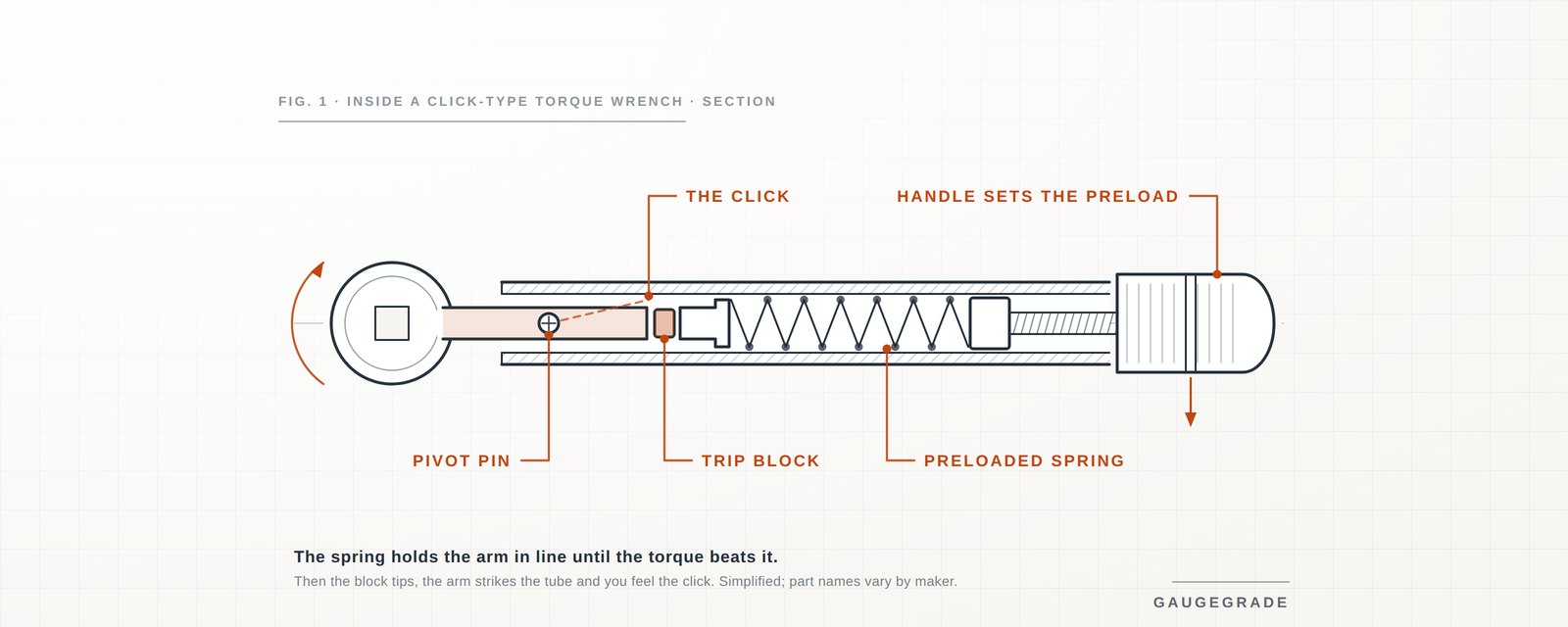
Turning the handle drives a screw that moves a nut or plug along the tube and compresses a coil spring inside it. Norbar's patent for an adjustable torque wrench (US 4,541,313, 1985) describes the arrangement: the rotating handle moves a nut along a screw, which sets the spring's compression and hence the release torque.
The spring holds a block against the head's arm
The head isn't fixed rigidly to the tube. It sits on a short arm that pivots on a pin near the head, and the spring pushes a small block, which makers variously call a pawl, trip block, cam or toggle, against the inner end of that arm. Snap-on's patent describes the spring pressure driving "the trip block axially against the inner end of the pivot arm so as to hold the pivot arm in a position aligned substantially coaxially with the tube."
Below the setting, head and tube act as one lever
As you pull, the fastener resists and the arm tries to swing about its pin, pushing sideways on the block. As long as the spring's force wins, the arm stays in line and the wrench behaves like a rigid bar.
At the setting, the block tips and the arm hits the tube
When the torque is high enough, the arm overcomes the spring and pivots. In Snap-on's words, it moves "its inner end laterally to tip the trip block, camming the cam plunger rearwardly in the tube and allowing the inner end of the pivot arm to strike the inner surface of the tube, creating the click." The handle gives only a few degrees as it happens: Gedore puts the movement of its short-release wrenches at 3°.
Let go, and the spring resets it
When you release the handle, the spring pushes the block and arm back into line, ready for the next pull. As Snap-on's patent puts it, "When torque is released, the spring drives the parts back to their original positions."
The click signals; it doesn't stop you
Nothing inside disconnects the drive. Keep pulling after the click and the fastener keeps turning: Wera warns that further tightening after the click means "the set torque value will be exceeded," and Tohnichi that pulling through the click "may result in applying higher torque." Stop at the click, and pull smoothly so you don't overshoot it.
Split-beam and bending-beam click wrenches
Some click wrenches do without the heavy coil spring. In a split-beam wrench, the load goes through a main beam and a catch holds a second beam alongside it. Olsa Tools' product manager Gus Lange explained it to EngineLabs: "As torque is applied, the force is transferred through the main beam, and the catch keeps the main beam and anchor beam together. Once the desired torque is reached, the catch releases, causing a loud click as the two beams separate."
Because the setting doesn't keep a big spring compressed in the drawer, Precision Instruments, which says it launched the split-beam click wrench market in 1974, says its C series "can be stored at any value." Stahlwille's MANOSKOP 730 uses a bending rod as its measuring element, and Stahlwille says it needs "no reset to '0'" either. The C series has a trade-off: it works clockwise only, apart from the C4D600F series, whose ratchet can be flipped. Our split-beam torque wrench guide covers current models.
How a beam torque wrench works
A beam wrench is the simplest design. Norbar's Philip Brodey describes it: "The body of the wrench is designed to bend as load is applied to the handle while an indicating bar, routed at the head of the wrench, but not bending, moves relative to a scale." The indicating bar carries no load, so it stays straight and points to the torque as the main beam bends away beneath it.
A dial wrench develops the same idea, turning the deflection into the movement of a needle on a dial, usually with a slave pointer that stays at the highest reading. There's no spring to take a set, but you have to watch the scale as you pull. Our beam vs click vs digital guide compares the types in use and picks the best beam wrenches.
How a digital torque wrench works
A digital wrench measures electronically instead of with a spring. "In electronic wrenches, measurement is by means of a strain gauge attached to a beam, which flexes as torque is applied," Brodey explains, and the signal is converted to a torque unit and shown on the display.
Because the reading is electronic, the wrench can warn you as you approach the target. Norbar's NorTronic beeps as the torque approaches the target, slowly at first and then faster, and vibrates when the target is reached. Wrenches such as GEARWRENCH's 85078 offer a peak mode, which holds the highest reading, and a tracking mode that shows the torque live. Many add a gyroscope to measure angle, for torque-plus-angle work such as cylinder head bolts, and some store readings for download. Our digital torque wrench guide compares current models.
Where the torque actually goes
Tightening a bolt stretches it by a tiny amount, and that stretch is what clamps the joint. But most of the torque you apply never becomes stretch. It's used up in friction, under the bolt head or nut and in the threads.
Sources split it slightly differently, but they agree on the scale: Bolt Science says friction usually takes 85–95% of the applied torque, and the commonly quoted split is about 50% under the head, 40% in the threads and 10% stretching the bolt. That's why oil, rust, plating or a dirty thread changes the clamp load you get from the same torque, and why torque is, in Portland Bolt's words, "a very indirect indication of tension." Our bolt torque chart shows how much the thread condition changes the torque to use.
| Source | Under the head or nut | In the threads | Stretches the bolt |
|---|---|---|---|
| Norbar | up to 50% | 30–40% | as little as 10% |
| Nord-Lock | 50% | 40% | 10% |
| CDI Torque Products | 45–55% | 35–45% | 10% |
How accurate is a torque wrench?
Two different accuracies matter. The first is the wrench's own: how close the click or the reading comes to the true torque. ISO 6789-1:2017 sets the limits used to certify hand torque tools, and they depend on the type and on the tool's capacity.
| Tool type (ISO 6789-1 class) | Capacity up to 10 N·m | Capacity over 10 N·m |
|---|---|---|
| Adjustable click wrench, graduated (Type II, A) | ±6% | ±4% |
| Beam wrench, torsion or flexion bar (Type I, A) | ±6% | ±6% |
| Dial wrench (Type I, B) | ±6% | ±4% |
| Electronic wrench (Type I, C) | ±6% | ±4% |
| Adjustable flexion-bar wrench (Type II, G) | ±6% | ±6% |
Capacity is the tool's maximum torque; 10 N·m is about 89 in-lb. Limits from ISO 6789-1:2017, Tables 3 and 4.
Accuracy across the scale, and in the bolt
US makers that rate click wrenches to ASME B107.300 typically quote ±4% clockwise, often ±6% counter-clockwise, from 20% to 100% of the scale. Below 20%, the allowance doesn't shrink with the setting: Snap-on explains that the older ANSI standard allows an error equal to 0.8% of the wrench's capacity there. On a 250 ft-lb wrench that's 2 ft-lb, or ±10% at a 20 ft-lb setting, which is why a wrench is best used in the middle of its range. Some makers rate tighter than the standards: Tohnichi rates its QL-MH click wrench at ±3%, and Norbar its NorTronic electronic wrench at ±1% of reading from 20% to 100% of capacity.
The second accuracy is the clamp load in the bolt, and it's much looser. NASA's Fastener Design Manual quotes the Industrial Fasteners Institute's figure of ±25% for setting bolt load with a torque wrench, against ±35% by feel. Most of that spread comes from friction, which varies from bolt to bolt: a good wrench removes one source of error; it can't remove friction.
What throws a torque wrench out of calibration
Makers' manuals agree on most of this list. If a wrench has suffered any of it, check it before you trust it; our calibration guide shows how.
- Breaking fasteners loose. CDI, Snap-on, Sturtevant Richmont and Precision Instruments all say not to, and Norbar Australia says undoing bolts "can compromise its accuracy and damage the tool." Tohnichi is softer: "Avoid consistently using torque tools to loosen fasteners." Either way, use a breaker bar.
- Cheater bars. CDI says a cheater bar "should NEVER be used on a torque wrench", and Wera that extending one with a pipe "may alter the set value and cause damage to the wrench."
- Going past capacity. Teng Tools draws the line at a 25% overload, after which the tool needs recalibrating before its next job.
- Drops and knocks. The FAA's AC 43.13-1B calls for calibration "at least once a year, or immediately after it has been abused or dropped."
- Storing a coil-spring click wrench wound up. CDI, Tohnichi and TEKTON say to store it at its lowest setting, and CDI and Norbar add never to force it below the lowest mark. Norbar says its testing shows unwinding between uses has minimal effect on calibration, but recommends the minimum setting for long storage. Split-beam and bending-beam wrenches don't need it.
- Soaking it in solvent. Wera: "Never immerse the device in petrol or solvents; otherwise the lubrication of the mechanics will be compromised."
Who invented the torque wrench?
Torque wrenches appear in US patents from the 1930s. John H. Sharp filed for a "torque-measuring wrench" in 1931, granted in 1935, and Conrad Bahr and George Pfefferle filed theirs in 1935: a ratchet wrench for bolted pipe joints, assigned to S.R. Dresser Manufacturing. Sturtevant Richmont credits Walter P. Chrysler with inventing the beam torque wrench and licensing Paul Sturtevant to make it, and dates that to 1924.
You'll often read that Bahr invented the torque wrench in 1918, while working for New York City's water department. We found no primary source for that: the magazine article Wikipedia cites says only that he was working there in 1918.
Where the explanations come from
The mechanism, accuracy and care guidance on this page comes from these documents.
- US patents 7,174,818 (Snap-on, click-type torque wrench cam assembly, 2007) and 4,541,313 (Norbar, adjustable torque wrench, 1985); US 2,007,880 (Sharp, 1935) and 2,074,079 (Bahr and Pfefferle, 1937).
- ISO 6789-1:2017, hand torque tools: classes and maximum permissible deviations (Tables 3 and 4).
- NASA Reference Publication 1228, Fastener Design Manual (1990), Table VII.
- Philip Brodey (Norbar), on selecting and using a manual torque wrench, Fastener + Fixing (2021).
- EngineLabs (2025) interview with Olsa Tools; Precision Instruments FAQ and split-beam manual; Stahlwille MANOSKOP 730 product data.
- Norbar NorTronic manual; GEARWRENCH 85078/85079 manual; Snap-on UK torque brochure; CDI Torque Facts.
- Sturtevant Richmont 2024 catalogue and company timeline; Tohnichi, Wera, Gedore, TEKTON, Teng Tools and Norbar Australia guidance; Norbar, Nord-Lock, CDI, Bolt Science and Portland Bolt on friction and tension.
- FAA AC 43.13-1B, paragraph 7-40.
- Aeronautics diploma
- Engineering degree
- BAMEC (DGCA)
- QC-trained
- ~2 yrs tool management
Why you should trust us
In the dedicated tool bay where SK Kutubuddin spent almost two years, within over two decades of aero-engine maintenance, every torque wrench carried a calibration label and was checked for serviceability when it came back. This page treats a torque wrench the way that tool bay did: as a measuring instrument whose mechanism is worth understanding.
The mechanism descriptions come from the makers' own patents, manuals and trade-press interviews, quoted and attributed, and the accuracy figures from ISO 6789-1:2017 and NASA's Fastener Design Manual. Where makers disagree, as they do on storage and on loosening, we say so. We didn't dismantle or test any wrench for this page.
Frequently asked questions
How does a click torque wrench know when to click?
A spring inside the tube holds a small pivoting block against the head's arm, and turning the handle sets how hard the spring pushes. When the torque you apply pushes the arm hard enough to overcome the spring, the block tips, the arm snaps against the tube and you hear and feel the click.
Does a torque wrench stop you over-tightening?
No. A click wrench only signals the setting; keep pulling and the fastener keeps turning. Stop at the click, and pull smoothly so you don't overshoot it.
Do you need to wind a torque wrench back to zero?
Wind a coil-spring click wrench back to its lowest setting for storage, as CDI, Tohnichi and TEKTON advise, but never force it below the lowest mark. Split-beam and bending-beam click wrenches don't need it, and beam and digital wrenches have no spring to relax.
How accurate is a click torque wrench?
ISO 6789-1 allows ±4% for an adjustable click wrench with a capacity over 10 N·m (about 89 in-lb), and ±6% for smaller ones. US makers typically rate theirs at ±4% clockwise from 20% to 100% of the scale.
Can you use a torque wrench to loosen bolts?
Most makers say no: CDI, Snap-on, Sturtevant Richmont and Precision Instruments all say not to break fasteners loose with one, and Norbar Australia says it can damage the tool and its accuracy. Use a breaker bar and keep the torque wrench for tightening.
What is a torque wrench used for?
Tightening nuts and bolts to a specified torque, so each fastener gets the clamp load its designer intended: wheel nuts, engine and suspension bolts, bicycle parts and any other joint with a published torque value.
Is a beam torque wrench more accurate than a click wrench?
Not by the standard. ISO 6789-1 allows a beam wrench ±6% at any capacity, against ±4% for an adjustable click wrench over 10 N·m. Some makers rate their beam and dial wrenches tighter, such as Snap-on's TQ series at ±4%, and with no spring there's nothing to take a set.
What does the slave pointer on a dial torque wrench do?
It stays at the highest reading after you let go, so you can check the peak torque reached. Norbar's Philip Brodey notes that dial wrenches are usually fitted with one.
Related reading
- Aeronautics diploma
- Engineering degree
- BAMEC (DGCA)
- QC-trained
- ~2 yrs tool management
SK spent over two decades in aircraft maintenance, working hands-on with aero-engine systems and flight data recorder systems, borescope-inspecting turbine and compressor blades, and spending almost two years in a dedicated tool bay. He holds a diploma in mechanical engineering (aeronautics), an associate degree in science, an engineering degree and a Basic Aircraft Maintenance Engineer's Certificate (BAMEC) from DGCA, and has completed quality-control and aviation fuels & lubricants training. GaugeGrade applies the same inspection, torque and tool-management standards to the tools everyday mechanics, DIYers and trades actually buy.