The Best Articulating Borescopes
An articulating borescope lets you steer the camera tip around valves, bends and obstructions instead of only looking straight ahead — the difference between guessing and seeing. Here are the best, from 4-way steerable scopes to budget two-way probes.

- 4 picks compared
- Specs checked against maker data
- No paid placements
GaugeGrade is reader-supported. When you buy through links on our site we may earn an affiliate commission at no extra cost to you. We only recommend gear we have researched against verified manufacturer specifications.
- 1Articulation means you steer the tip. 4-way (every direction) beats 2-way for genuinely blind pockets.
- 2Probe diameter still decides access: 3.9 mm for cylinders and tight holes, ~6 mm for general work.
- 3A standalone screen is faster than a phone under a hood.
What we recommend
Compare the key specs side by side, then read the full notes on each pick below.
- Articulation
- 4-way(joystick)
- Probe dia
- 6.5mm
- Display
- 6" IPS(1080p)
- Articulation
- 4-way(360°)
- Probe dia
- 3.9mm
- Display
- 6"IPS
- Articulation
- 2-way(210°)
- Probe dia
- 6.2mm
- Display
- 5"screen
- Articulation
- 2-way
- Probe dia
- 3.9mm
- Display
- 5"IPS


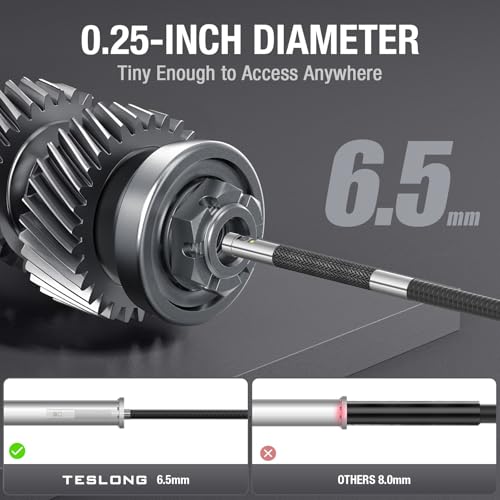


Teslong TF600 4-Way Articulating Borescope (6.5 mm, dual lens)
Steering into blind pockets with joystick control, a side camera and a big screen
- Articulation
- 4-way (joystick)
- Probe dia
- 6.5 mm
- Display
- 6" IPS (1080p)
- Joystick steering: 360° rotation and 210° bend
- Front and side cameras with 6+1 LEDs
- 6" 1920 × 1080 IPS screen, 6000 mAh battery
- 32 GB card; mic and speaker for voice notes
- Thicker 6.5 mm probe; a 3.9 mm model slips into small openings more easily
- Costs more than a two-way or fixed scope
The most capable steerable scope here. A joystick bends the tip four ways and locks it, a side camera reads the wall you're passing, and split-screen shows both views at once on a 6-inch 1080p screen.
At 6.5 mm it's thicker than the 3.9 mm TF600, leaving less room to steer inside small holes.
Based on the maker's specifications and manual and the published reviews linked below, not on our own test of this unit.
Setup, everyday use and what others found
Setup & use · per the maker
- A joystick steers the tip four ways and can lock it in position. Center it and let the bending section straighten before you withdraw the probe.
- Front camera with 6 LEDs and a side camera with 1, each 1.0 MP, with split-screen viewing. Photos and video save at up to 1920 × 1080 to the included 32 GB card.
- 6-inch 1920 × 1080 IPS screen, plus a built-in microphone and speaker.
- Charges over USB-C. B&H lists about 4 hours to charge the 6000 mAh battery and up to 4 hours of use.
- The 1.55 m probe is IP67; B&H rates the unit for 0–45 °C (32–113 °F). Teslong says the probe can't be replaced if it's damaged.
- In the box: 32 GB card, USB-C cable, hook and magnet tips and a carrying case.
What others found
We found no independent hands-on test and no owner reviews outside Amazon. B&H no longer lists this dual-lens version, and Teslong's own store now sells the F6 PRO as its four-way dual-lens model.


Teslong 3.9mm 4-Way Articulating Borescope
4-way steering with a probe thin enough for cylinders
- Articulation
- 4-way (360°)
- Probe dia
- 3.9 mm
- Display
- 6" IPS
- 3.9 mm probe fits spark-plug holes
- 4-way (360°) articulation
- 6" IPS screen
- The priciest of the small-probe scopes
- Fine probe needs a careful hand
Pick this when the opening is small and what you need to see is around the corner: spark-plug holes, small access ports, holes drilled in panels. It pairs a 3.9 mm probe with full four-way joystick steering.
It gives up the side camera of the dual-lens 6.5 mm version, and its 1.0 MP camera is modest for the money.
Based on the maker's specifications and manual and the published reviews linked below, not on our own test of this unit.
Setup, everyday use and what others found
Setup & use · per the maker
- A joystick steers the tip in four directions; Teslong lists 360° of articulation. Center it and make sure the bending section is straight before you pull the probe out, and never force it.
- Single camera with 6 adjustable LEDs, an 80° field of view and a focus range of about 0.8–3.9 in.
- Saves photos and video at up to 1920 × 1080 to the included 32 GB microSD card, although Teslong rates the 3.9 mm camera itself at 1.0 megapixel.
- 6-inch 1920 × 1080 IPS screen, with a mini-HDMI port alongside the USB-C charging port and card slot.
- Teslong rates the 6000 mAh battery at up to 3.5 hours of use.
- The 1.55 m (5.08 ft) probe is IP67, to 1 m for 30 minutes; don't submerge the monitor. Teslong says the probe can't be replaced if it's damaged.
- In the box: monitor, probe, 32 GB card, USB-C cable and a carrying case. The hook and magnet tips come only with the 6.5 mm version.
What others found
We found no independent hands-on test of the 3.9 mm TF600 and no owner reviews outside Amazon. Teslong now also sells the F8 PRO, a pricier model with the same listed specs and a longer warranty.
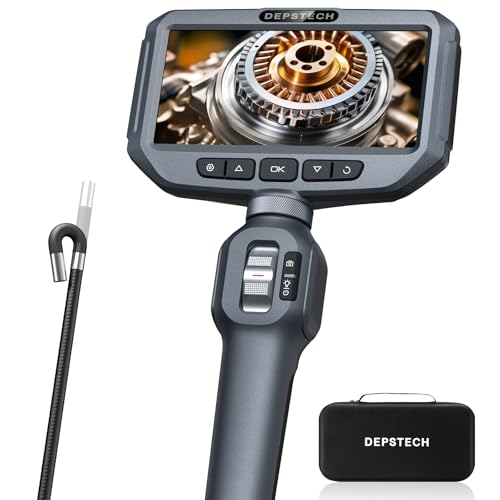


DEPSTECH 5" Articulating Borescope (210°)
Two-way steering with recording at a fair price
- Articulation
- 2-way (210°)
- Probe dia
- 6.2 mm
- Display
- 5" screen
- 210° two-way articulating tip
- 1080p photo and video, 32 GB card included
- 3350 mAh battery
- Two-way only, not four
- 5 ft cable
An affordable way into steerable inspection. A wheel bends the 6.2 mm tip up and down while you watch the 5-inch screen, enough to look past a valve or behind a bracket.
It steers in one plane, the cable is short at about 1.5 m, and only the probe is waterproof.
Based on the maker's specifications and manual and the published reviews linked below, not on our own test of this unit.
Setup, everyday use and what others found
Setup & use · per the maker
- Slide the steering wheel on the handle up or down and the tip bends to match, in one plane. DEPSTECH rates the range at 210°.
- Return the wheel to center before you pull the probe out, as the manual instructs.
- Buttons cover power and light, photo and video, zoom, 180° image rotation and a menu. It records at 1920 × 1080 to a microSD card; a 32 GB card is included.
- Sharpest at about 5 cm (2 in), with a 78° field of view. The screen also shows the probe temperature.
- Charges over USB-C. The 3350 mAh battery is rated for about 3.5 hours, and the manual says to charge it every three months even when the scope sits unused.
- The probe is IP67; the body is not waterproof. It is rated to work from 32 to 113 °F (0–45 °C) and shuts itself off if the probe or surrounding air reaches 80 °C (176 °F).
What others found
A Garage Journal member posting about his DS630SL in March 2025 said he was pleasantly surprised by its build quality and how simple it is to operate.
BGR's reviewer, using a DS630 (not the SL model) that DEPSTECH supplied, reported clear 1080p video and a tip you turn with a dial on the handle.
Owner reports outside Amazon are few, and we found no independent test of the DS630SL itself.


Teslong TD500 3.9mm Two-Way Articulating Borescope
Steerable 3.9 mm inspection for about half the list price of the 4-way 3.9 mm TF600
- Articulation
- 2-way
- Probe dia
- 3.9 mm
- Display
- 5" IPS
- 3.9 mm probe for cylinder access
- Two-way articulation
- 5" IPS screen
- Steers in one plane, not all four
- Hook and magnet tips don't fit the 3.9 mm probe
The simplest way to get a steerable 3.9 mm probe. A wheel bends the tip in one plane, which covers most cylinder and small-hole work when you turn the probe as well.
It isn't cheap in absolute terms: about half the list price of the four-way 3.9 mm TF600, but far more than any fixed probe.
Based on the maker's specifications and manual and the published reviews linked below, not on our own test of this unit.
Setup, everyday use and what others found
Setup & use · per the maker
- A wheel bends the tip up to 210° in two directions. Return the wheel to neutral before you pull the probe out, and don't turn it aggressively.
- The up button zooms, the down button flips the image 180°, and the light button steps the 6 LEDs through three brightness levels, then off.
- Saves 1920 × 1080 photos and video to the included 32 GB card, though the manual rates the 3.9 mm camera at 1.0 MP.
- 5-inch IPS screen (854 × 480). A long press on Settings turns on WiFi so you can also watch on a phone through the Smart Endoscope app.
- USB-C charging; Teslong rates the 3000 mAh battery at 3–4 hours, and it keeps working while it charges.
- The probe is rated IP67; keep the handset dry. The manual rates the handset for 0–45 °C (32–113 °F) and the probe for up to 70 °C (158 °F).
- The hook and magnet tips don't fit the 3.9 mm probe, and Teslong says the probe can't be replaced if it's damaged.
What others found
We found no independent hands-on test of the 3.9 mm TD500 and no owner reviews outside Amazon.
- Aeronautics diploma
- Engineering degree
- BAMEC (DGCA)
- QC-trained
- ~2 yrs tool management
Why you should trust us
Much of borescope work on an aircraft engine is steering: pointing the camera at a blade surface that is rarely straight ahead of the access port. In over two decades of aircraft maintenance, borescope inspection of turbine and compressor blades was part of SK Kutubuddin's daily work, and that experience shapes how we judge tip control on a consumer scope, from how precisely it aims to how easily it can be damaged.
For this page we compared articulating scopes on the specs that decide how useful the steering is: the number of directions, the probe diameter the mechanism is packed into, and the screen you steer by. Each figure was checked against the manufacturer's specifications and current listings, as our How We Test page describes, and each pick is matched to a specific job.
Who this is for
An articulating scope is for the moment a straight view is not enough: when the thing you need to see sits behind a valve, around a bend or on the far wall of a cavity. That includes engine work, but also machinery, ducts and plumbing, where the probe has to look back at a joint or a weld.
If your inspections are mostly straight down a hole, a fixed or side-lens scope costs less and does the job. Articulation pays off when you repeatedly need to look sideways or back.
- Reading cylinder walls and valve seats through a spark-plug hole
- Looking around corners in engine bays, ducts and machinery
- Inspecting welds, joints and the back side of parts you cannot turn over
- Anyone who has used a fixed scope and kept wishing it could turn
How we picked
We considered only scopes with a steerable tip, then sorted them by how they steer and what they can fit into. All specs were checked against the manufacturer's data and the live listing.
- 01
A spread of steering types
We wanted both four-way and two-way scopes on the list, because buyers need to see what each costs and what it does. Every pick states its steering type, so you are not paying for directions you will not use or buying too little for a blind pocket.
- 02
Probe diameter
Packing steering wires into a thin probe is harder and costs more. We included 3.9 mm probes for the tightest openings alongside 6.1 to 6.5 mm probes for general work, and gave every probe's diameter, since articulation is useless on a probe that cannot enter the space.
- 03
Stated bend range
We recorded the articulation figure where the maker publishes one, such as a stated 210 degrees on the two-way DEPSTECH, and did not estimate one where the maker does not. A spec we cannot verify is left off the page rather than guessed.
- 04
A screen to steer by
You steer an articulating tip by watching the image, so the display is part of the control system. All four picks use a standalone 5 or 6 inch screen rather than a phone, and we noted joystick control where the maker specifies it.
- 05
Price against capability
We set out picks from a budget two-way probe to four-way joystick control, so the extra cost of each step is tied to something you will see on the screen, not to a longer feature list.
What to know before you buy
4-way vs 2-way vs fixed
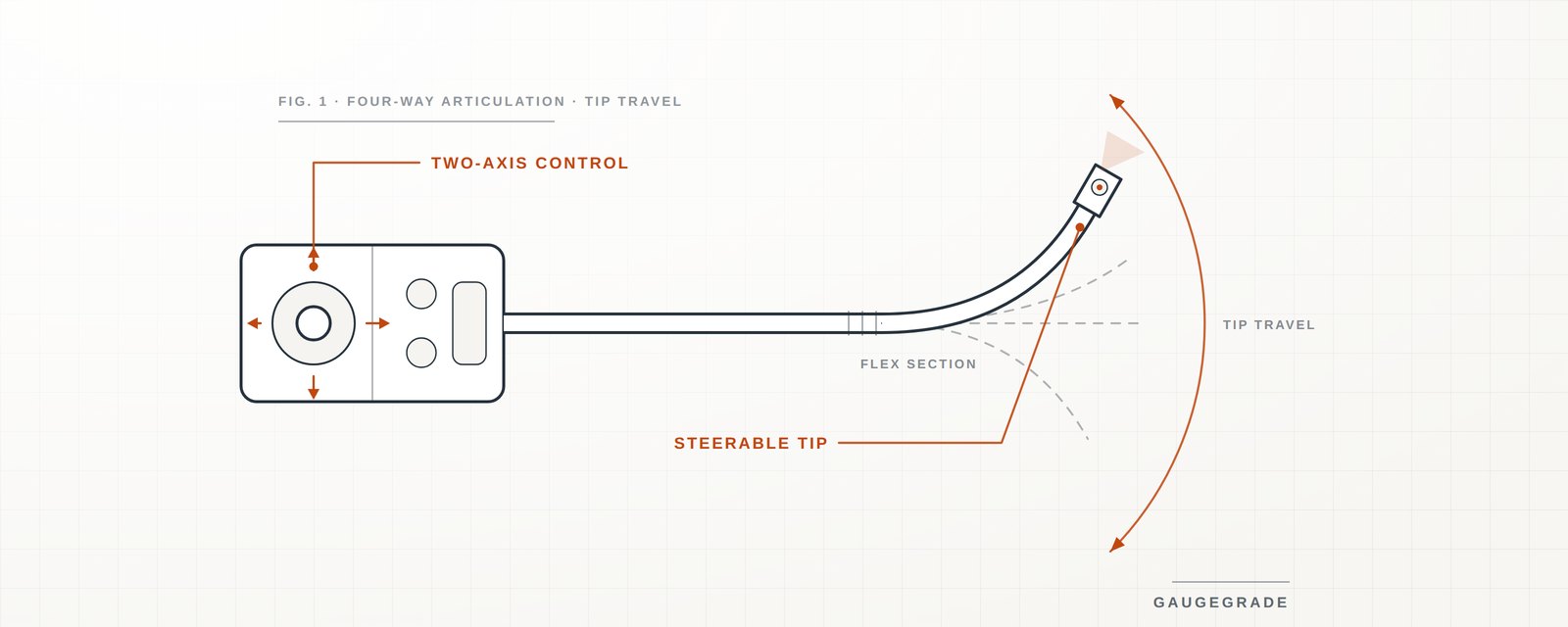
A 4-way (or 360°) probe steers in every direction, which is what you want for a genuinely blind pocket — around a valve, past a bend. A 2-way probe bends in a single plane, enough to read a cylinder wall or look just off-axis. A fixed or side-lens scope does not steer at all and is cheaper, but you aim the whole probe.
Buy the least articulation that reaches what you need to see: 4-way for real blind work, 2-way for walls and slight offsets, fixed for straight looks.
Don't forget probe diameter
Articulation is useless if the probe will not fit. A 3.9 mm probe passes almost any spark-plug hole and other tight openings; a 6 mm-class probe passes most car plug holes with less room to spare, and suits engine bays, intakes and general work. Match the diameter to the smallest space you need to enter, then pick the articulation.
The inspection view
Steering earns its price the moment you use it to read a cylinder wall or a valve seat instead of just the piston crown. Go slowly, keep the tip off surfaces so you do not smear the lens, and sweep a consistent pattern rather than hunting at random.
Looking after the steering mechanism
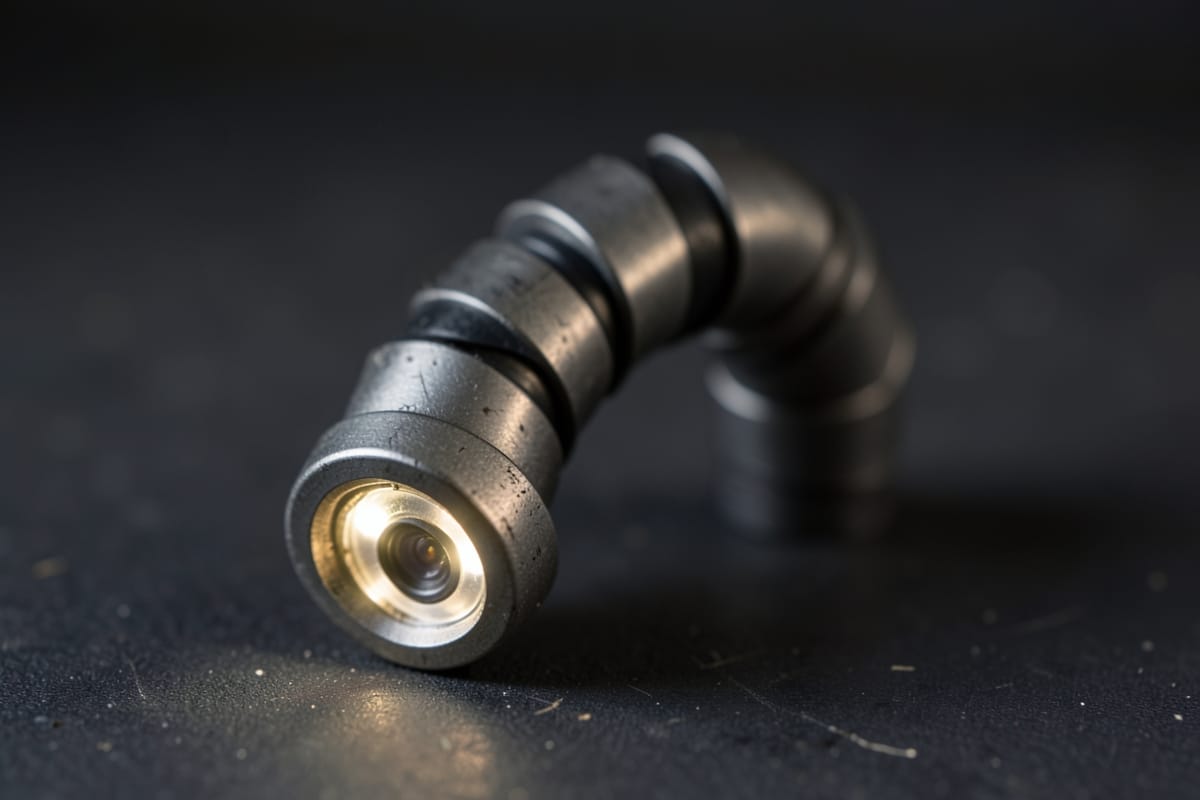
An articulating tip is moved by thin control wires that run the length of the probe. They are the most delicate part of the scope, and most failures come from handling rather than age. A few habits protect them:
- Return the tip to straight before you insert it and before you pull it out. Withdrawing a bent tip drags the bending section against the edge of the hole.
- If the tip meets resistance, stop steering. Forcing the control against an obstruction strains the wires and can kink the bending section.
- Never pull the probe out by the tip, and do not use it to push or lever parts.
- Store the probe in large, loose loops, never kinked or wrapped tightly around the handle.
- Wipe the probe clean before storing it, and fit any tip cap or protective sleeve that came with the scope.
- If the tip starts to feel gritty, sticks in one direction or no longer straightens fully, stop using it and contact the maker. Continuing can turn a repair into a replacement.
Steering without getting lost
The first time you use an articulating scope, the hard part is not steering the tip. It is knowing which way you are looking once you have.
The image on the screen is fixed to the camera, not to the world. Twist the cable a little as you feed it and the picture rotates with it, so up on the screen may no longer be up in the engine. Before you go in, note a landmark near the entry point, such as the edge of the plug hole or a valve, and come back to it whenever you lose your bearings.
Make small, slow control inputs and pause after each one. Through a long probe the tip can lag slightly behind the control, and big movements overshoot. Steer with the control and advance with the cable, but try not to do both at once.
Finally, sweep in a fixed pattern: tip straight, then through each direction your scope offers, returning to straight between each. A routine like that is how you know you have seen the whole surface, not just the interesting part.
Frequently asked questions
What does “articulating” mean on a borescope?
The camera tip bends on command, so you steer where it looks instead of only seeing straight ahead.
4-way or 2-way articulation?
4-way steers in every direction for truly blind pockets; 2-way bends in one plane, which is enough for cylinder walls and slight offsets and costs less.
Do I actually need articulation?
For looking around valves and bends, yes. For a straight look down a hole, a fixed or side-lens scope is cheaper and fine.
What probe size do I need for cylinders?
About 3.9 mm passes almost any spark-plug hole with room to angle it. A 6 mm-class probe passes most car plug holes, with less room to spare.
Screen or phone?
A standalone screen is faster and steadier under a hood; a phone scope is cheaper but adds pairing and lag.
Why has my scope's tip stopped bending as far as it used to?
First check how you are holding the probe. Loops or tight bends in the cable add friction to the control wires and eat into the tip's travel, so keep it as straight as you can between the handle and the entry point. If range is still reduced with the probe straight, the control wires may have stretched or worn, which is a job for the maker's repair service.
Can I twist a two-way probe to cover the other directions?
Partly. Rotating the whole probe turns the plane the tip bends in, so a two-way scope can reach most directions with some patience. A flexible cable does not transmit twist precisely, though, and the image rotates as you turn it. For frequent blind-pocket work, four-way control is quicker and more predictable.
Does an articulating tip need room to bend?
Yes. The bending section is a short length of probe behind the camera, and it needs clearance to swing. In a narrow bore or pipe the tip cannot reach its full rated angle, which describes movement in open space. Expect less usable articulation in tight cavities than the spec sheet suggests.
Related reading
- Aeronautics diploma
- Engineering degree
- BAMEC (DGCA)
- QC-trained
- ~2 yrs tool management
SK spent over two decades in aircraft maintenance, working hands-on with aero-engine systems and flight data recorder systems, borescope-inspecting turbine and compressor blades, and spending almost two years in a dedicated tool bay. He holds a diploma in mechanical engineering (aeronautics), an associate degree in science, an engineering degree and a Basic Aircraft Maintenance Engineer's Certificate (BAMEC) from DGCA, and has completed quality-control and aviation fuels & lubricants training. GaugeGrade applies the same inspection, torque and tool-management standards to the tools everyday mechanics, DIYers and trades actually buy.