The Best Safety Wire Pliers
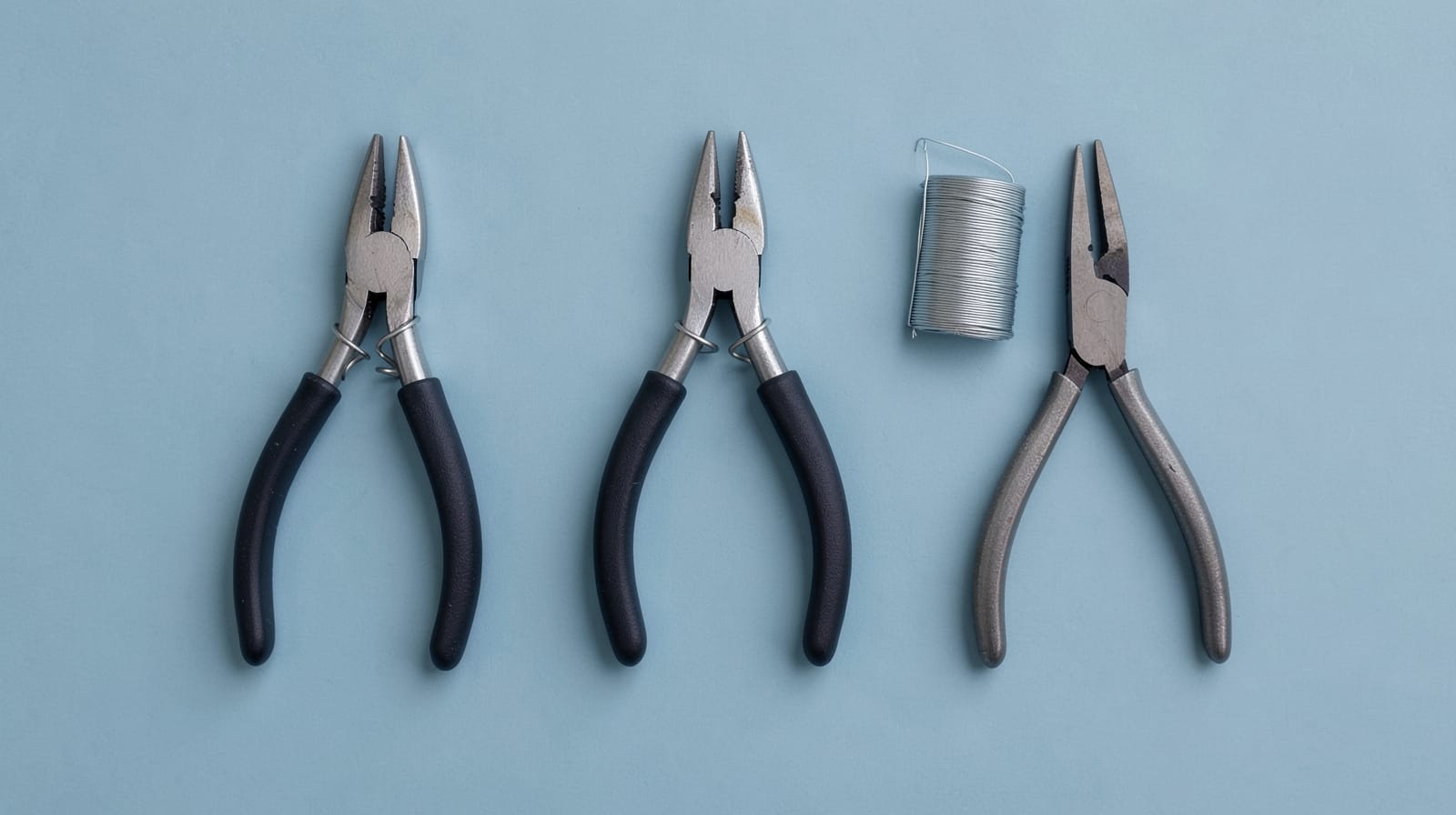
Safety-wire (lockwire) pliers grip, twist and cut lockwire in one tool. The reversible, automatic-return kind make the even, repeatable twists that pass an inspection. With Milbar now discontinued, here are the best currently available, by use.

- 4 picks compared
- Specs checked against maker data
- No paid placements
GaugeGrade is reader-supported. When you buy through links on our site we may earn an affiliate commission at no extra cost to you. We only recommend gear we have researched against verified manufacturer specifications.
- 1Two features matter most: reversible (clockwise or counter-clockwise) and automatic (spring) return.
- 26-inch for tight, general work; 9-inch for reach and heavier wire.
- 3The long-time standard, Milbar, is discontinued — every pick below is currently available.
What we recommend
Compare the key specs side by side, then read the full notes on each pick below.
- Length
- 9in
- Reversible
- Yes
- Auto return
- Yes
- Length
- 9in
- Reversible
- Yes
- Auto return
- Yes
- Length
- 9 in(11 in overall)
- Reversible
- Yes
- Auto return
- Yes
- Length
- 6in
- Reversible
- Yes
- Auto return
- Yes

American Aviator Reversible Safety Wire Pliers
Aviation-shop twists, from the brand retailers point Milbar buyers to
- Length
- 9 in
- Reversible
- Yes
- Auto return
- Yes
- Reversible for either twist direction
- Spring (automatic) return and a jaw lock
- Precision diagonal nose jaw
- Chrome-vanadium, heat-treated cutters
- Priciest of the group
- No wire rating, country of origin or warranty is published
- 9-inch size only at this listing
The aviation-shop choice among these, sold as the SWP8-REV: a 9-inch reversible twister with a locking diagonal nose jaw, a chrome-vanadium body and heat-treated cutting blades, carried by pilot supply houses at roughly twice the price of the general-purpose tools here.
It's the tool retailers point Milbar buyers towards. Be clear about what isn't published, though: American Aviator has no maker website we could find, and no wire rating, country of manufacture or warranty is stated anywhere.
Based on the maker's specifications and manual and the published reviews linked below, not on our own test of this unit.
Setup, everyday use and what others found
Setup & use · per the maker
- Reversible: the same tool makes right-hand (clockwise) or left-hand twists, so one plier covers fasteners wired in either direction.
- Spring return, so the twist rod pulls back on its own between twists, and a jaw lock that holds the wire while you twist.
- Precision diagonal nose jaw that grips, twists and trims, with heat-treated cutting blades in a chrome-vanadium body.
- 9 inches tip to tip. This listing is the 9-inch reversible model only; a shorter 8.5-inch non-reversible SWP8 exists separately.
- Retailers describe American Aviator as the aviation line previously sold as CruzTools. We couldn't confirm that from the maker, because we found no American Aviator website.
- No wire-gauge rating, country of manufacture or warranty is published for this tool by anyone we could find.
What others found
We found no owner reviews of this model at the retailers carrying it, and no independent test of it. Forum advice about safety wire pliers is largely about avoiding the cheapest imports and doesn't name this tool.




OEMTOOLS 22662 9" Reversible Wire Twister Pliers
Everyday reversible, auto-return pliers without the aviation price
- Length
- 9 in
- Reversible
- Yes
- Auto return
- Yes
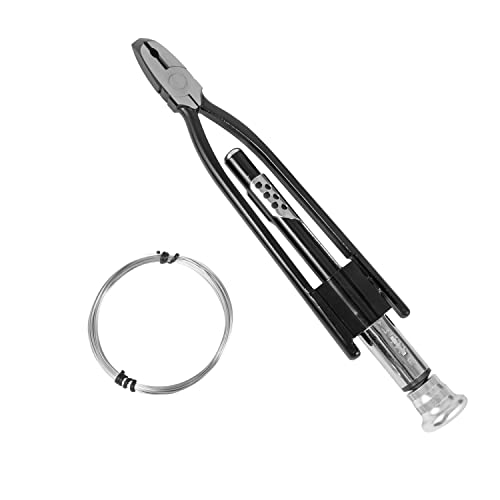
- Reversible for left and right twists, with a heavy-duty spring-loaded automatic return
- Locking jaws and a chromed retainer slide to stop the wire slipping mid-twist
- Forged alloy steel, with tapered jaws and mated cutters
- The wire in the box is zinc-plated steel at about 0.020 in, not the 0.032 in stainless aircraft lockwire
- OEMTOOLS names aircraft as an application but publishes no standard, material grade or wire rating
- How the reversing mechanism works is not described by OEMTOOLS
The general-purpose 9-inch reversible twister: the mechanism reverses for left and right twists, a heavy spring returns the rod, and mated cutters trim the wire once it's twisted. OEMTOOLS is a brand of Great Neck Saw Manufacturers, of Memphis, Tennessee.
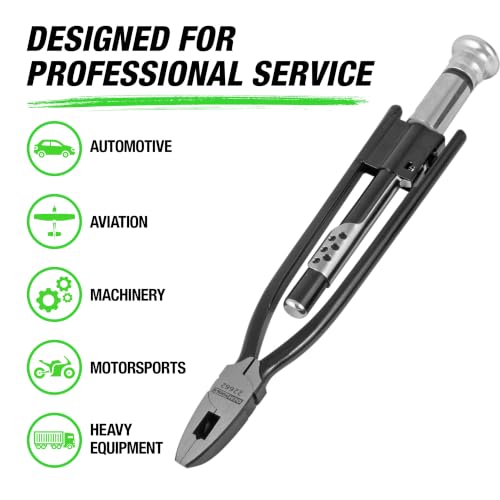
It is sold for automotive, machinery and aircraft work, but OEMTOOLS certifies nothing: no standard, no steel grade, no hardness and no wire-gauge rating. The wire supplied in the box is zinc-plated, not stainless.
Based on the maker's specifications and manual and the published reviews linked below, not on our own test of this unit.
Setup, everyday use and what others found
Setup & use · per the maker
- Reversible for right-hand or left-hand twists. OEMTOOLS states only that the twisting mechanism reverses; it doesn't describe how, so we can't tell you whether it's a sleeve, a collar or a switch.
- Heavy-duty spring-loaded automatic return with a chromed retainer slide, which OEMTOOLS says prevents the wire slipping while you twist. Locking jaws hold the wire.
- Tapered jaws for confined areas and mated cutter jaws: grip and twist, then squeeze to cut the wire.
- Forged alloy steel, per OEMTOOLS. That is the maker's own term, with no grade, heat treatment or hardness published behind it. 9 inches overall; the 22661 is the 6-inch version and the 22663 is both in one set.
- The wire in the box is about 10 m of 0.5 mm zinc-plated steel, per the listings that describe it. That is roughly 0.020 inch, against the 0.032 inch stainless of MS20995C32, the common aircraft size. Treat it as practice wire and buy lockwire separately.
- OEMTOOLS publishes a brand-wide limited lifetime warranty against defects in materials and workmanship, excluding misuse and repairs made outside its own facilities. It doesn't cover bits, blades, files, batteries or calibration.
What others found
OEMTOOLS markets the tool for "automotive, machinery and aircraft" applications in its own product copy, and the Amazon title goes further and calls them aviation pliers. No aviation standard, material specification or wire rating appears anywhere in the maker's documentation.
We found no independent test of this tool and no owner reviews outside the retail listings, which we haven't treated as owner feedback. The 10 m / 0.5 mm / zinc-plated figures for the included wire come from retailer listings rather than OEMTOOLS, which mentions the wire only in the product title.

Wicks Aircraft 9" Reversible Safety Wire Pliers
Longer reach and heavier wire, from an aircraft-supply house
- Length
- 9 in (11 in overall)
- Reversible
- Yes
- Auto return
- Yes
- Reversible, with an automatic spring return, per Wicks
- Rated to cut stainless wire up to .041", per the listing
- Sold by a US aircraft parts house at economy-tool prices
- Bulkier for fine, close work
- No manufacturer, country of origin or warranty is published
An economy-class 9-inch reversible twister sold by Wicks Aircraft, a US aircraft parts house, at well under what the aviation-branded tools cost. Wicks confirms the reversible action and the automatic spring return.
Everything that distinguishes it on paper — the 11-inch overall length, the locking jaws and the .041-inch cutting capacity — comes from the Amazon listing alone. Wicks names no manufacturer, origin, material or warranty.
Based on the maker's specifications and manual and the published reviews linked below, not on our own test of this unit.
Setup, everyday use and what others found
Setup & use · per the maker
- Reversible action for clockwise or counter-clockwise twists, with an automatic spring return, per Wicks.
- The Amazon listing adds an 11-inch overall length, locking jaws that let the tool spin in both directions or lock in place, and a rating to cut stainless safety wire up to .041 inch. Wicks's own page states none of these.
- Wicks lists this in its economy tool range, and a comparable 9-inch reversible twister sells there for about $61 against roughly $70–$125 for aviation-branded equivalents elsewhere.
- Wicks catalogues its 9-inch reversible twister as the RSWT-9. The Amazon listing carries the part number SW-09, and we couldn't confirm the two are the same tool.
- No manufacturer, country of manufacture, materials or warranty is published for this tool by anyone we could find.
- There's no published standard for safety wire pliers themselves. The specifications cover the wire (MS20995 and related) and the practice, which for aircraft work is FAA AC 43.13-1B, Chapter 7.
What others found
Builders on Van's Air Force disagree about length rather than brand. One prefers the 9-inch, saying its extra weight and geometry work the wire more easily; several prefer a 6-inch for access in tight spots; and one whose 6-inch plier failed on .041 wire relays a supplier's advice to keep 6-inch tools to .030 and under.
We found no owner reviews of this exact tool and no independent test of it. Builders do report the locking mechanism failing on budget twisters generally, but the reports we found are about other tools, so we haven't applied them here.


WINTOWIN 6" Reversible Safety Wire Pliers Kit (with 50 ft wire)
Starting from nothing — pliers plus a spool of wire in one box
- Length
- 6 in
- Reversible
- Yes
- Auto return
- Yes
- Includes 50 ft of .032" stainless safety wire
- Reversible, with automatic spring return
- Takes .012"–.032" wire
- Amazon-only brand, with no maker documentation we could find
- Rated only to .032" wire, not the .041" heavier work uses
The cheapest way to get pliers and wire in one box: a 6-inch reversible twister with a spring return, plus a 50-foot spool of .032-inch stainless. If you've never safety-wired anything, this is everything you need to start.
It's an Amazon-only brand with no documentation behind it. The listing's .032-inch ceiling is the common general-purpose size, so there's no headroom for the .041-inch wire heavier work calls for.
Based on the maker's specifications and manual and the published reviews linked below, not on our own test of this unit.
Setup, everyday use and what others found
Setup & use · per the maker
- 6-inch reversible twister with an automatic spring-loaded return and tapered jaws, per the listing.
- Rated for 0.3–0.8 mm wire, which the listing gives as .012–.032 inch. The arithmetic is close: 0.8 mm is about .0315 inch, so .032 is rounded up.
- A 50-foot spool of wire, described as .032-inch 304 stainless, is in the box. Nothing we found confirms the grade, and the listing makes no MS20995 or NASM20995 claim.
- .032 inch is one of the two common safety-wire sizes for general hardware; the other, .041 inch, is above what this tool is rated for.
- The WINTOWIN trademark is registered to a Shanghai import and export company. There is no maker website, no stated country of manufacture and no warranty that we could find.
- Chrome-vanadium steel with a chrome finish, per the listing.
What others found
We found no owner reviews of this kit and no independent test of it. Nearly identical listings exist with 25-foot and 164-foot spools, which is the usual sign of a white-label product.
- Aeronautics diploma
- Engineering degree
- BAMEC (DGCA)
- QC-trained
- ~2 yrs tool management
Why you should trust us
SK Kutubuddin, who writes our aviation-tools coverage, is a former aviation professional with over two decades of hands-on experience maintaining and inspecting aircraft, where safety wiring is routine, inspected work. He holds a diploma in mechanical engineering (aeronautics), an engineering degree, a BAMEC and a qualification in aviation fuels and lubricants. He knows what a finished lockwire run has to look like to pass, and which plier faults make that harder: a jaw that slips, a return that sticks, a cutter that leaves a ragged end.
For this guide we started from the features that make a consistent twist possible, then checked each pick's length, twist direction and return mechanism against the manufacturer's specification and the current listing, following the method on our How We Test page. Where a listing did not confirm a feature, the table shows a dash rather than a guess. Every pick is on sale today; discontinued favorites were left out.
Who this is for
This guide is for anyone who has to stop a torqued fastener from backing out under vibration: aircraft owners and mechanics, racers whose rulebook calls for lockwired drain and fill plugs, and fabricators building anything that shakes. Wire a handful of fasteners a year and a value plier will do. Wire every week and the aviation-focused pick earns its price.
On certificated aircraft the plier is only one part of the job. The wire, the routing and the finished run follow the aircraft's approved maintenance data, and this page is buying advice, not a substitute for that data or for an A&P mechanic's sign-off.
- Aircraft owners and A&P students building a first toolkit
- Motorsport riders and drivers who lockwire fasteners for tech inspection
- Fabricators and restorers securing fasteners on anything that vibrates
- Mechanics replacing a worn or discontinued Milbar twister
How we picked
We narrowed the field to reversible safety-wire pliers that are in production and on sale now, then matched each one to the job it suits best rather than ranking them on a single overall score.
- 01
Reversible action
A plier that twists only one way forces awkward routing on some runs. Every pick here is reversible, so the same tool makes clockwise and counter-clockwise twists and you can keep each leg pulling its fastener toward tightening.
- 02
Return mechanism
An automatic (spring) return retracts the twist rod on its own, which makes long runs quicker and more even. We credited it only where the maker or the listing states it; where it is not confirmed, the comparison table shows a dash.
- 03
Length for the work
A 6-inch plier suits close work and most bench jobs, while a 9-inch plier adds reach and leverage for longer, heavier twists. We included both lengths so you can buy for where you actually wire, not for the spec sheet.
- 04
Jaws, cutter and budget
The jaw has to grip without nicking the wire and the nose has to trim the pigtail cleanly, because wire fails where it is damaged. We gave weight to makers who describe that construction, and covered budgets from aviation-focused to a starter kit with wire.
What to know before you buy
What to look for
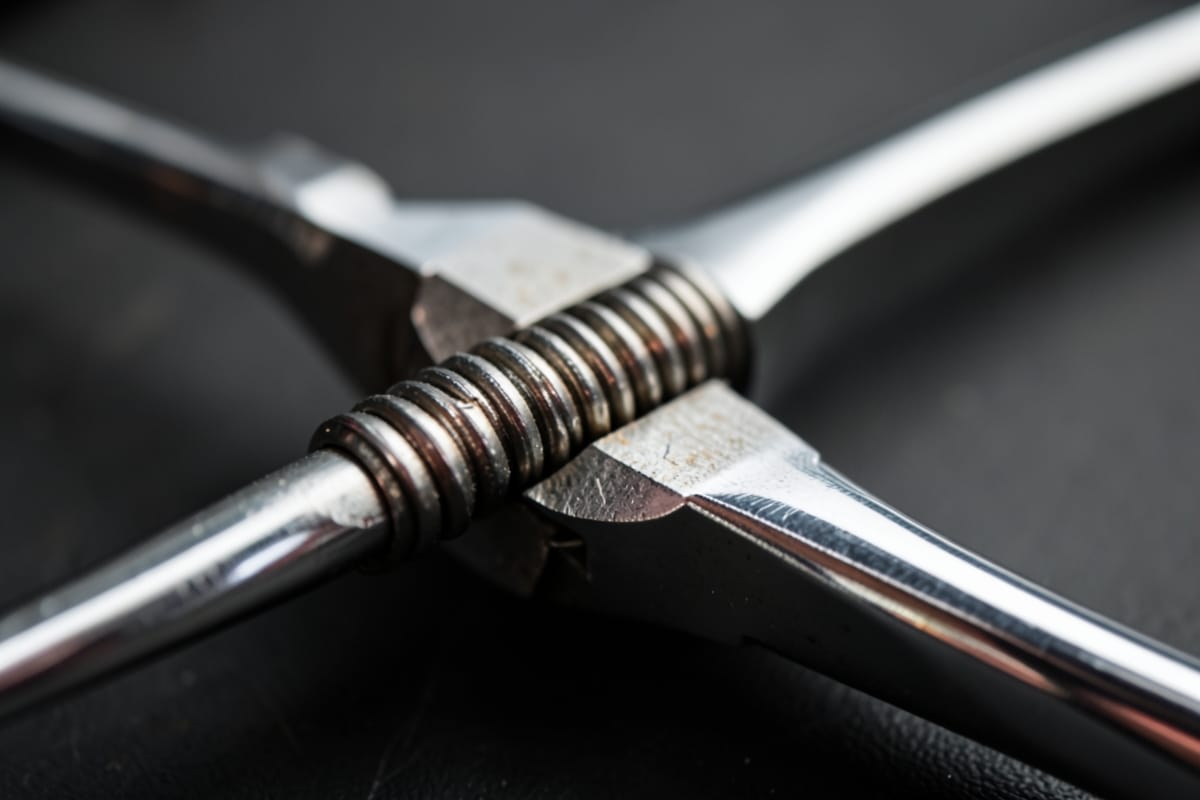
The features that separate a good safety-wire plier from a frustrating one:
- Reversible action — the same tool makes clockwise or counter-clockwise twists.
- Automatic (spring) return — the twist rod retracts on its own for faster work.
- Length — 6 inch for tight and general work, 9 inch for reach and heavier wire.
- A jaw that grips and a nose that cuts the wire cleanly.
- Rated for the wire you run — commonly .032" or .020" stainless.
A note on Milbar
For decades the Milbar 25W and 45W were the shop default, but the line was discontinued in 2025 and retailers are selling out. If you were looking specifically for Milbar, the picks above are what to buy now instead — our full explanation is on the Milbar page.
The flight-line view
What passes an inspection is a consistent twist rate with the wire in tension, routed so it pulls each fastener toward tightening. Reversible, automatic-return pliers are what make that easy and repeatable, run after run. The technique itself is in our safety-wire guide.
Caring for safety-wire pliers
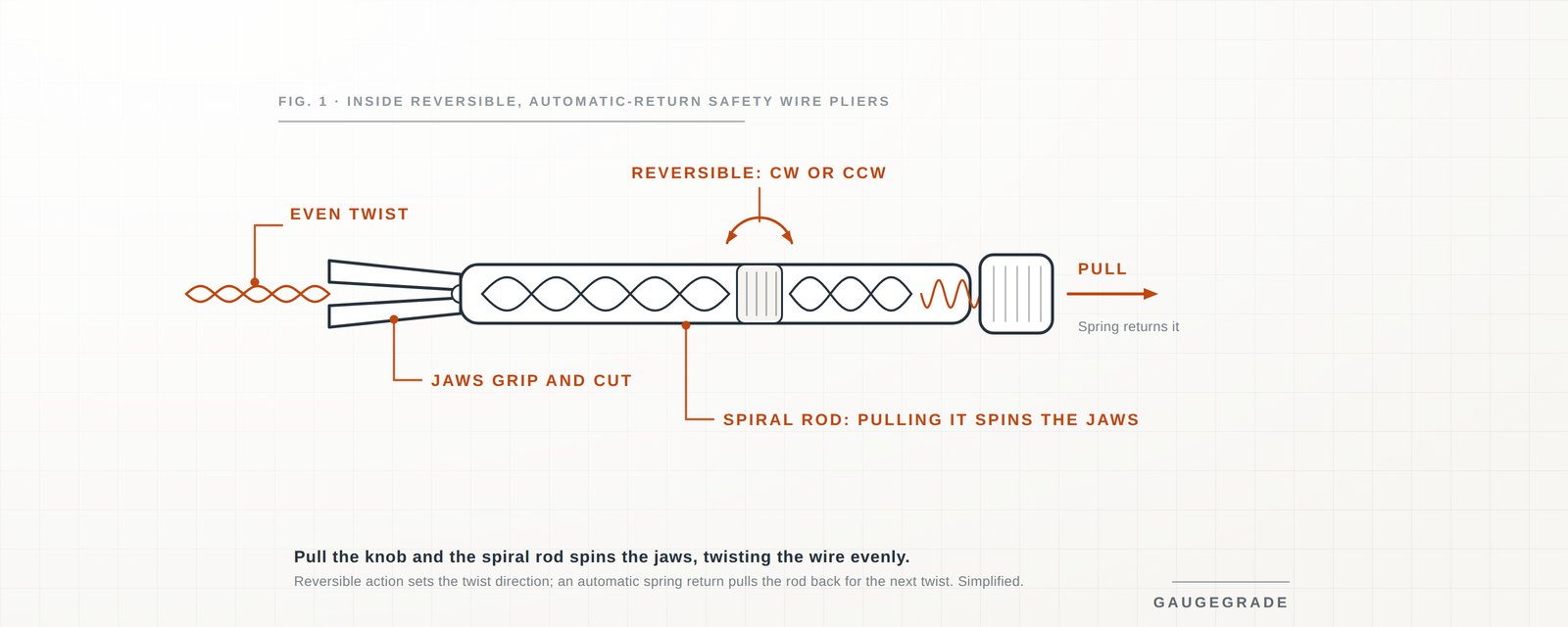
A safety-wire plier has more working parts than an ordinary pair of pliers: a pivot, a lock that holds the jaws shut on the wire, and a spiral rod that spins the whole head when you pull the knob. Each needs a little attention if the tool is to keep making even twists.
Wipe the plier down after use and keep oil off the jaws so they grip cleanly. Put a drop of light machine oil on the pivot and along the spiral rod, work it in, then wipe off the excess. Heavy grease holds grit and drilling chips, which wear the mechanism and slow the return. Store the tool closed, in a drawer or pouch, away from damp and solvents.
Inspect it the way you would any tool used on critical work. Look for burrs or chipped teeth that could nick wire, confirm the lock holds under a firm pull, and check that the cutter shears cleanly rather than crushing. Do not use it for prying or for cutting beyond what the maker rates it for. A plier that slips, sticks or marks the wire should be repaired or replaced, not tolerated.
Buying and storing safety wire
The pliers get the attention, but the wire does the locking, and it is easy to ruin before it ever reaches a fastener. For general work that means stainless safety wire in the gauge the job calls for. On aircraft, the material and gauge come from the maintenance data, and some applications, such as high-temperature areas or easily broken seal wire on emergency controls, call for a different material entirely.
Buy wire on a spool or in a dispenser that feeds it out straight, and keep it in that container so it stays clean, dry and free of kinks. Pull off only what you need and cut a fresh length for every run. Discard any length that has been kinked, nicked or crushed; a kink is a weak point you cannot straighten out. Offcuts and wire removed from a job are scrap, never stock for the next one, because safety wire is never reused.
Label each spool with its material and gauge, and store different gauges apart so the wrong one does not end up on a fastener by mistake.
Frequently asked questions
What makes a good pair of safety wire pliers?
Reversible action and an automatic (spring) return. Those two features let you make even, repeatable twists in either direction without fighting the tool.
Should I get 6-inch or 9-inch?
6-inch for tight and general work; 9-inch for reach and heavier wire. Many people keep a 6-inch as their main tool.
Do safety wire pliers cut the wire too?
Yes. The diagonal nose grips, twists and trims the wire, so one tool does the whole job.
What gauge safety wire do they use?
0.032" stainless is common for general work, with a lighter 0.020" for small fasteners. Match the tool and wire to your application.
Are Milbar safety wire pliers still available?
No — the line was discontinued in 2025 and stock is selling out. See our Milbar page for the full story and replacements.
Are lockwire pliers and wire twisters the same thing as safety wire pliers?
Yes. Safety-wire pliers, lockwire pliers and wire twisters are names for the same tool: locking jaws plus a spiral rod that spins the head when you pull the knob, twisting both strands together. Reversible action and automatic return are the features that separate models.
Do safety wire pliers need to be calibrated?
No. Unlike a torque wrench, a safety-wire plier has no calibrated setting. What matters is condition: jaws that grip without nicking, a lock that holds, a cutter that shears cleanly and a twist mechanism that runs smoothly. Inspect it periodically and replace it when it starts to slip or mark the wire.
Are safety wire pliers only for aircraft?
No. Motorcycle and car racers lockwire drain plugs and other fasteners, often because their race organization's rules require it, and fabricators use lockwire on anything exposed to vibration. The tool and the technique are the same as on aircraft; only the specification governing the job changes.
Related reading
- Aeronautics diploma
- Engineering degree
- BAMEC (DGCA)
- QC-trained
- ~2 yrs tool management
SK spent over two decades in aircraft maintenance, working hands-on with aero-engine systems and flight data recorder systems, borescope-inspecting turbine and compressor blades, and spending almost two years in a dedicated tool bay. He holds a diploma in mechanical engineering (aeronautics), an associate degree in science, an engineering degree and a Basic Aircraft Maintenance Engineer's Certificate (BAMEC) from DGCA, and has completed quality-control and aviation fuels & lubricants training. GaugeGrade applies the same inspection, torque and tool-management standards to the tools everyday mechanics, DIYers and trades actually buy.