The Best Automotive Borescopes
An automotive borescope lets you see inside a cylinder, down an intake, behind a timing cover or into any space you can't get eyes on. The right one depends on two things: how it displays (its own screen or your phone) and its probe diameter — the spec that decides whether it fits a spark-plug hole. These are the picks by use.

- 5 picks compared
- Specs checked against maker data
- No paid placements
GaugeGrade is reader-supported. When you buy through links on our site we may earn an affiliate commission at no extra cost to you. We only recommend gear we have researched against verified manufacturer specifications.
- 1Probe diameter decides cylinder access: a probe of about 5.5 mm or smaller passes most car spark-plug holes with room to angle it. A 7.9–8.5 mm probe fits a 14 mm plug hole, is tight in a 12 mm one and may not pass a 10 mm one, so it does its best work in engine bays, exhausts and general inspection.
- 2A standalone screen is faster and more reliable under a hood; a phone (WiFi) scope is cheaper but adds lag.
- 3Articulation lets you steer the tip around valves and bends; dual/triple lenses give side views without steering.
- 1Best overallTeslong 5" Dual-Lens Inspection Camera (8 mm, 16.5 ft)
- 2Best articulatingDEPSTECH 5" Articulating Borescope
- 3Best coverageTeslong NTS300 Triple-Lens Inspection Camera (7.9 mm, 9.8 ft)
- 4Best budgetBlueFire 1080p WiFi Borescope (5.5 mm)
- 5Best professionalAutel MaxiVideo MV108S Inspection Camera
What we recommend
Compare the key specs side by side, then read the full notes on each pick below.
- Display
- 5"IPS screen
- Probe dia
- 8mm
- Cable
- 16.5ft
- Display
- 5"screen
- Probe dia
- 6.2 mm(0.24")
- Cable
- 5ft
- Display
- 5"IPS screen
- Probe dia
- 7.9mm
- Cable
- 9.8 ft(3 m)
- Display
- Phone(WiFi)
- Probe dia
- 5.5mm
- Cable
- 11.5ft
- Display
- Autel scan tool or PC
- Probe dia
- 8.5mm
- Cable
- 1m


Teslong 5" Dual-Lens Inspection Camera (8 mm, 16.5 ft)
A do-everything engine-bay scope with its own screen — no phone, WiFi or app
- Display
- 5" IPS screen
- Probe dia
- 8 mm
- Cable
- 16.5 ft
- Front and side cameras, each with its own LEDs (6 front, 1 side)
- Standalone 5" IPS screen; just power on
- 5000 mAh battery, about 4.5 hours of use
- IP67 probe; hard case with hook, magnet and mirror
- 8 mm probe is tight in 12 mm plug holes and may not pass 10 mm ones
- Fixed probe (does not articulate); about 5 hours to recharge
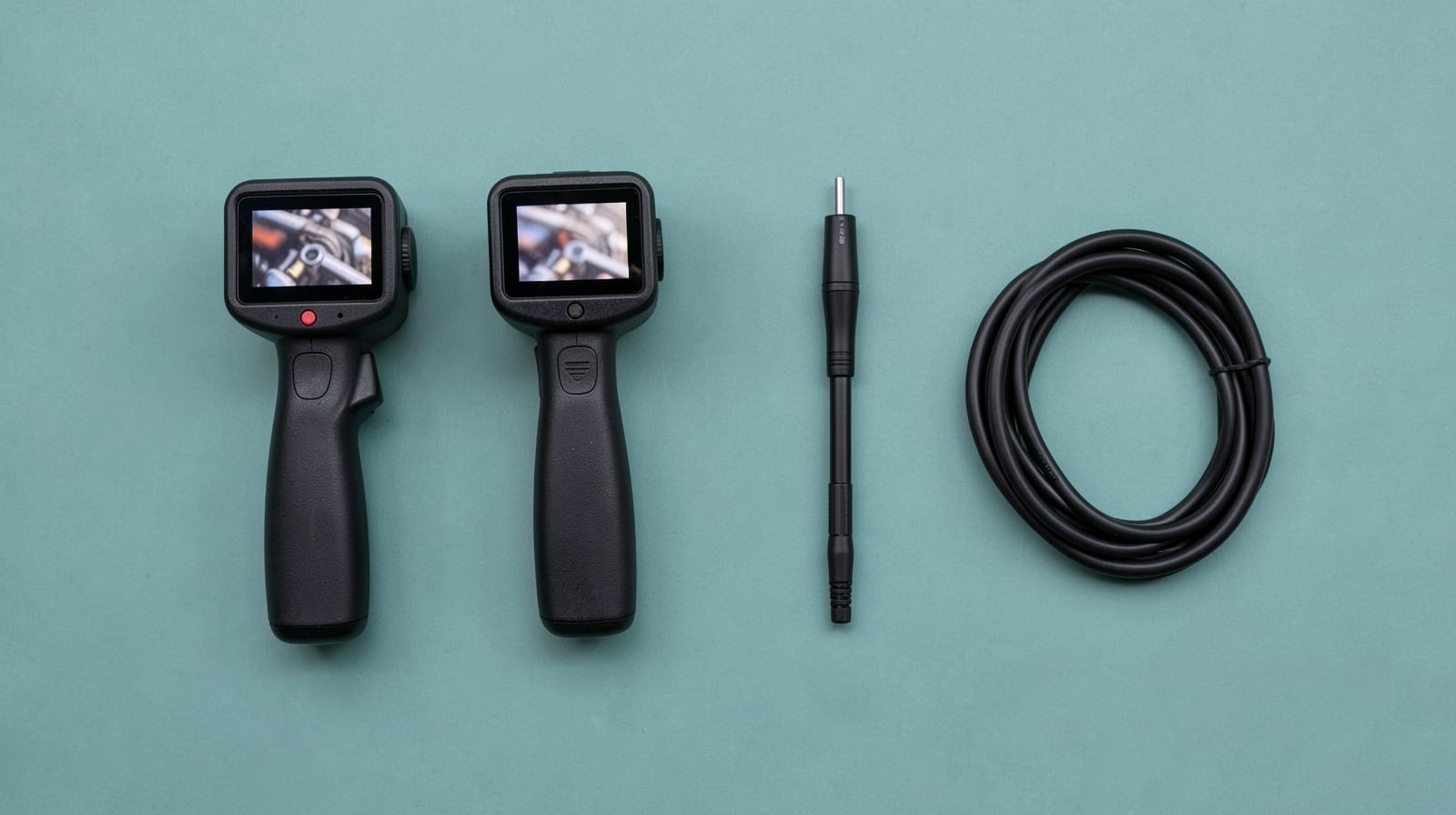
This is the scope to hand someone who has never used one. It powers on straight to a live picture on its own 5-inch screen, and one button swaps between the front and side cameras, so there is no app, pairing or steering to learn.
The limit is the probe. At 8 mm it fits 14 mm plug holes, is tight in 12 mm ones and may not pass 10 mm ones, so treat it as an engine-bay, exhaust and frame-rail scope first. Teslong sells it as the NTS300 dual-lens.
Based on the maker's specifications and manual and the published reviews linked below, not on our own test of this unit.
Setup, everyday use and what others found
Setup & use · per the maker
- Hold the power button for a few seconds and it opens to a live picture. There is no app or WiFi.
- A button just above the probe's plug cycles between the front and side cameras, one view at a time.
- Photos save at 1920 × 1080 and video at 1280 × 720 to the included 32 GB microSD card. The handle adds 1.5× digital zoom and a 180° image flip.
- Sharpest about 1.2–3.2 in from the front lens and 0.8–2 in from the side lens, so work close.
- Charges over USB-C. Teslong rates the 5000 mAh battery at 4–5 hours of use, and the listing gives about 5 hours to recharge.
- Only the probe is waterproof (IP67, to 1 m for 30 minutes). The handset is IP45: fine for splashes, but never submerge it.
What others found
Bob Vila's testers named this listing their best overall borescope. They used it down a car's spark-plug hole and a shower P-trap, switched to the side lens to check brake-pad wear, and fished a dropped screw out of a drain with the magnet tip. Their one complaint was that the 16-foot cable is cumbersome.
Older reviews on this Amazon listing may describe an earlier version with a 4.5-inch screen, so read them with that in mind.
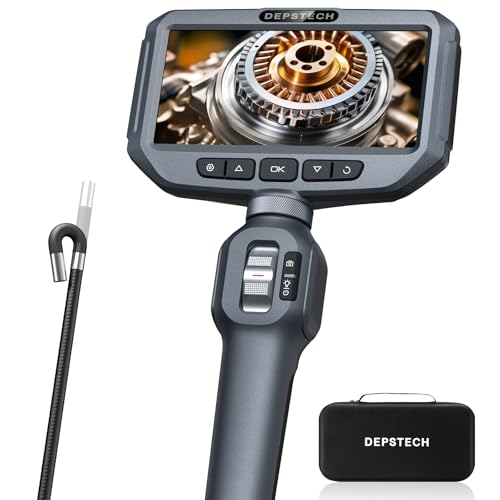


DEPSTECH 5" Articulating Borescope
Steering around valves, pistons and bends a fixed probe cannot see past
- Display
- 5" screen
- Probe dia
- 6.2 mm (0.24")
- Cable
- 5 ft
- 210° two-way articulating tip you steer as you go
- 1080p photo and video; 32 GB card included
- 3350 mAh battery (about 3.5 hours); IP67 probe
- Shorter 5 ft cable
- Articulating scopes cost more than fixed ones
Pick this one when what you need to see is around a corner: behind a valve, past a bend in an intake, or on the underside of something. A wheel on the handle bends the tip up and down as you watch the screen, which no fixed or multi-lens scope can do.
The trade-offs are reach and protection. The cable is about 1.5 m (5 ft), fine under a hood but short for frame rails, and only the probe is waterproof. The model is the DEPSTECH DS630SL.
Based on the maker's specifications and manual and the published reviews linked below, not on our own test of this unit.
Setup, everyday use and what others found
Setup & use · per the maker
- Slide the steering wheel on the handle up or down and the tip bends to match, in one plane. DEPSTECH rates the range at 210°.
- Return the wheel to center before you pull the probe out, as the manual instructs.
- Buttons cover power and light, photo and video, zoom, 180° image rotation and a menu. It records at 1920 × 1080 to a microSD card; a 32 GB card is included.
- Sharpest at about 5 cm (2 in), with a 78° field of view. The screen also shows the probe temperature.
- Charges over USB-C. The 3350 mAh battery is rated for about 3.5 hours, and the manual says to charge it every three months even when the scope sits unused.
- The probe is IP67; the body is not waterproof. It is rated to work from 32 to 113 °F (0–45 °C) and shuts itself off if the probe or surrounding air reaches 80 °C (176 °F).
What others found
A Garage Journal member posting about his DS630SL in March 2025 said he was pleasantly surprised by its build quality and how simple it is to operate.
BGR's reviewer, using a DS630 (not the SL model) that DEPSTECH supplied, reported clear 1080p video and a tip you turn with a dial on the handle.
Owner reports outside Amazon are few, and we found no independent test of the DS630SL itself.
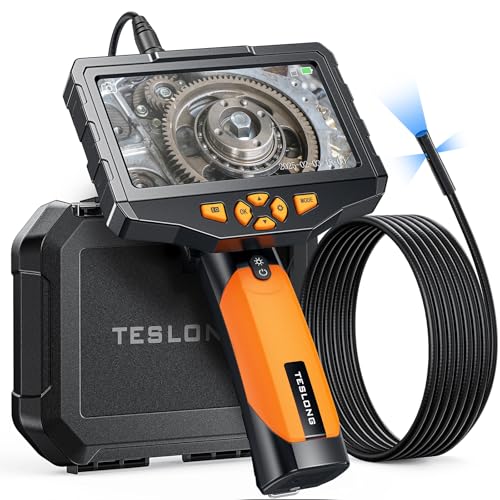


Teslong NTS300 Triple-Lens Inspection Camera (7.9 mm, 9.8 ft)
Seeing ahead and to the side without steering, in engine bays, frame rails and pipes
- Display
- 5" IPS screen
- Probe dia
- 7.9 mm
- Cable
- 9.8 ft (3 m)
- Front camera plus two side-view cameras (one for close focus), switched with one button
- Standalone 5" IPS screen; no phone, WiFi or app
- 5000 mAh battery, about 4–5 hours; 32 GB card included
- IP67 probe; hook and magnet included
- 7.9 mm probe is tight in 12 mm plug holes and may not pass 10 mm ones
- Video records at 720p (photos at 1080p)
Three fixed cameras stand in for a steerable tip. One looks ahead, one looks sideways and a third side lens focuses very close for reading fine surface detail. One button cycles through them, so you get most of the views an articulating scope gives you without its delicate steering section.
What you give up is video quality and cylinder access: video records at 720p, and the 7.9 mm probe is tight in 12 mm plug holes.
Based on the maker's specifications and manual and the published reviews linked below, not on our own test of this unit.
Setup, everyday use and what others found
Setup & use · per the maker
- Press the button above the probe's thread-on plug to cycle through the front, side and close-focus side views. There is no split-screen view.
- Each lens has its own focus band: about 1.2–3.2 in straight ahead, 0.8–2 in to the side and 0.6–1.2 in on the close-focus lens. The front camera has 8 LEDs and each side lens has one.
- Photos save at 1920 × 1080 and video at 1280 × 720 to the included 32 GB microSD card, viewed on a 5-inch IPS screen.
- Charges over USB-C. Teslong rates the 5000 mAh battery at about 4–5 hours.
- The probe is IP67 (to 1 m for 30 minutes). The handset is IP45, so keep it out of water.
- Teslong lists a 32 GB card, USB-C cable, hook and magnet tips and a carrying case in the box. Some retailer listings also show a mirror, so contents may vary by batch.
What others found
We found no independent hands-on test of the triple-lens NTS300, and too few owner reviews outside Amazon to call a pattern.
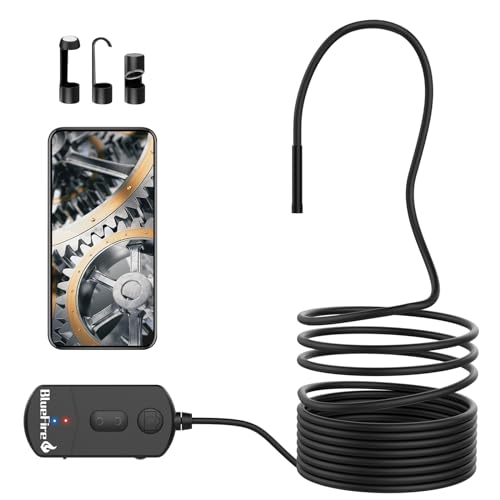


BlueFire 1080p WiFi Borescope (5.5 mm)
The cheapest way in: streams to an iPhone or Android, with a probe thin enough for many cylinders
- Display
- Phone (WiFi)
- Probe dia
- 5.5 mm
- Cable
- 11.5 ft
- 5.5 mm semi-rigid probe fits many spark-plug holes
- 1080p, with three-step zoom
- 1800 mAh battery, about 3–4 hours; iOS 9+ and Android 7+
- No screen of its own: needs your phone
- WiFi adds lag, and the WiFi box itself is not waterproof
The least expensive pick here, and the easiest way into a cylinder: the 5.5 mm probe passes most spark-plug holes with room to angle it, and the semi-rigid cable holds a bend you put in it.
The catch is everything between the probe and your eyes. There is no screen: the camera makes its own WiFi network, your phone joins it, and you watch through an app. For an occasional check that is a fair trade. If you inspect every week, a scope with its own screen will save you frustration.
Based on the maker's specifications and manual and the published reviews linked below, not on our own test of this unit.
Setup, everyday use and what others found
Setup & use · per the maker
- Join the camera's WiFi network from your phone's WiFi settings, then open the viewing app. Older versions of the listing name the app as Scope View.
- Plus and minus buttons step through three levels of digital zoom, and the listing says the 6 LEDs are adjustable.
- Resolution can be set to 1920 × 1080, 1280 × 720 or 640 × 480. Photos and video are saved through the app on your phone.
- Sharpest about 1–4 in (3–10 cm) from the lens, with a 60° view. Zoom does not extend that range.
- The 1800 mAh battery is listed at about 3–4 hours; a micro-USB cable comes in the box, along with hook, magnet and mirror tips.
- Only the lens and cable are waterproof (IP68, under 10 minutes submerged), so keep the WiFi box dry.
What others found
The viewing app named in the listing has weak ratings in both app stores. Complaints there include confusing setup, a WiFi link that will not connect and settings that do not stick. Those reviews cover every camera that uses the app, not only BlueFire's.
We found no independent hands-on test of this model.




Autel MaxiVideo MV108S Inspection Camera
Pros who already run an Autel diagnostic tablet
- Display
- Autel scan tool or PC
- Probe dia
- 8.5 mm
- Cable
- 1 m
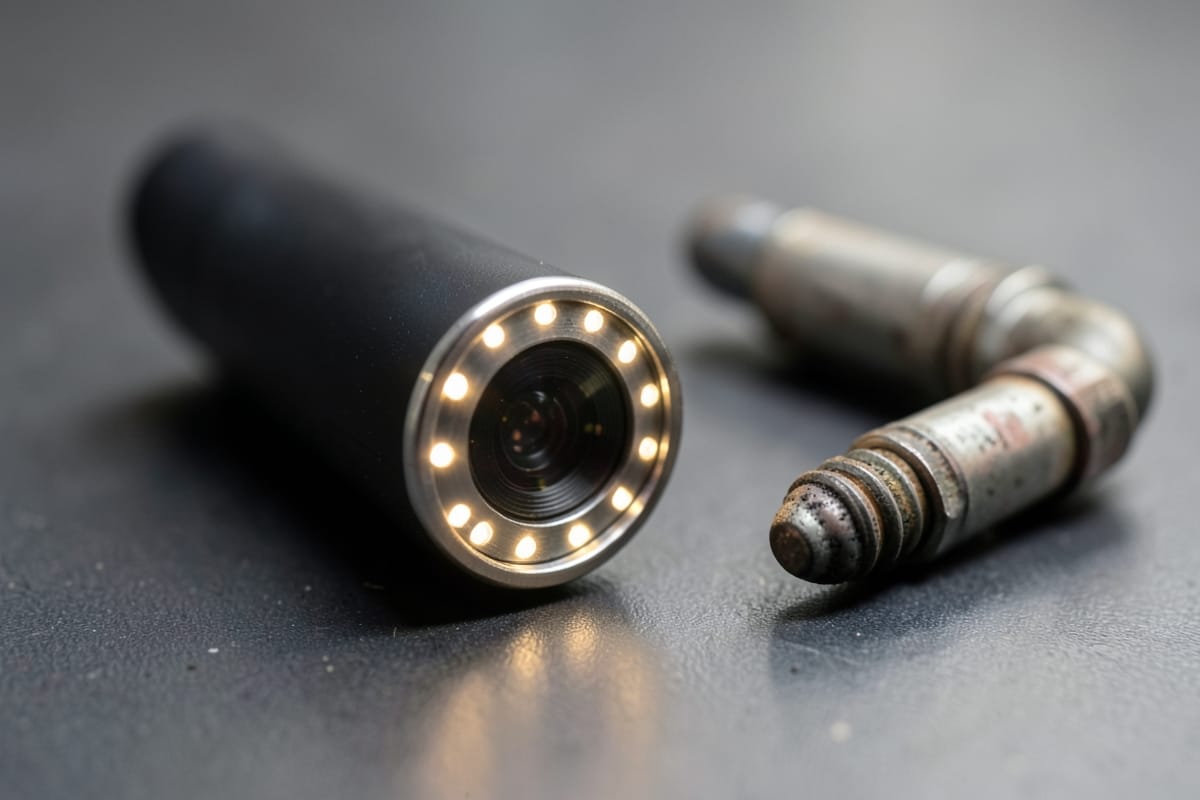
- 8.5 mm 1080p (2 MP) imager with 8 LEDs
- IP67 waterproof imager head
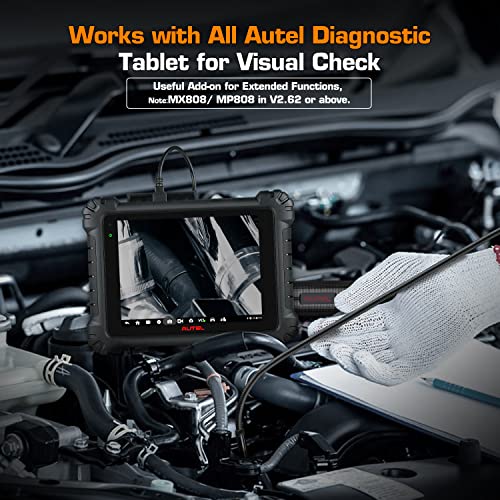
- Turns an Autel scan tool into a video inspection scope
- No standalone screen: needs an Autel scan tool or a PC
- Short 1 m cable
Only worth buying if you already own an Autel diagnostic tablet that runs the MaxiVideo function. Then it is an inexpensive way to add a camera: the picture comes up on the tablet you already carry, with no second battery to charge.
On its own it is a poor buy. There is no screen, the cable is 1 m (about 3.3 ft), and although Autel's store lists PC use, it gives no PC software or instructions.
Based on the maker's specifications and manual and the published reviews linked below, not on our own test of this unit.
Setup, everyday use and what others found
Setup & use · per the maker
- Plugs into the tablet's USB port and draws its power from it. You open MaxiVideo from the tablet's job menu.
- Autel's quick-start guide warns that not every Autel tablet has the MaxiVideo app, so confirm yours supports it before ordering.
- 8.5 mm imager with 8 LEDs, recording 1920 × 1080 (2 MP) stills and video through the tablet, with an 81° field of view.
- Sharpest at 3–8 cm (about 1.2–3.1 in) from the lens.
- The imager head is IP67. Autel rates it to work from 14 to 158 °F (−10 to 70 °C).
- Magnet, hook and mirror tips slip over the head. It carries a one-year limited warranty. A 5.5 mm version, the MV105S, trades resolution (1280 × 720) for a thinner head.
What others found
Six short buyer reviews on Diagmart are all positive, mostly praising a clear picture; one calls it a valuable addition to the scanner.
Compatibility lists disagree for some tablets, including the MaxiSys MS906, so check with Autel for yours. We found no independent hands-on test.
- Aeronautics diploma
- Engineering degree
- BAMEC (DGCA)
- QC-trained
- ~2 yrs tool management
Why you should trust us
SK Kutubuddin spent over two decades maintaining and inspecting aircraft, and borescope inspection of turbine and compressor blades was part of his daily work on the flight line. That trains an eye for what a probe can and cannot show in a dark, oily space, which is exactly the situation under a hood, whether you are looking down a plug well, behind a timing cover or into a frame rail.
For this page we sorted automotive scopes by the two decisions that matter most in a garage: how the image is displayed and whether the probe fits the access point. Every spec listed was checked against the manufacturer's own data and the current retail listing, as described on our How We Test page, and each pick is tied to a specific job rather than a generic ranking.
Who this is for
This page is for people who work on their own cars, trucks and motorcycles and want to see a problem before they start unbolting parts: a home mechanic chasing a misfire, someone checking a used engine before buying it, or a DIYer who dropped a bolt somewhere behind the intake. It also suits working technicians who want a second scope for the toolbox.
If your main goal is looking inside cylinders, our engine-inspection page goes deeper on thin 3.9 mm probes. If you want to steer the tip around corners, start with our articulating picks.
- Home mechanics who want to see inside an engine before paying for a teardown
- Buyers checking a used car or engine they are considering
- Anyone hunting a leak, a rattle or a dropped fastener in a crowded engine bay
- Technicians who already run an Autel diagnostic tablet and want to add a camera
How we picked
We started from the jobs an automotive scope actually does, then narrowed the field on the specs that decide whether it can do them. Every figure was checked against the maker's specifications and the live listing.
- 01
Probe diameter for the access point
A scope that cannot reach the problem is no use at any price. We wanted a spread of probe sizes, from about 5.5 mm for spark-plug-hole work up to 8.5 mm for engine bays, exhausts and intakes, where a bigger camera head is not a handicap.
- 02
How the image is displayed
We included both standalone-screen scopes and phone-based WiFi models, because they suit different people. A built-in screen is quicker under a hood; a phone scope costs less. Each pick states plainly which it is, so nobody is surprised by an app or a tablet they did not expect to need.
- 03
A way to see sideways
Engine problems rarely sit straight ahead of the lens. We gave weight to scopes that add side-view lenses or an articulating tip, since a forward-only view down a plug hole shows the piston crown and misses the bore walls, where the evidence usually is.
- 04
Cable length and reach
Plug-hole work needs little cable, while frame rails, exhausts and the back of an engine need more. We checked each listed cable length against the jobs we assign that scope to, and called out where a short cable limits a pick.
What to know before you buy
Probe diameter: the spec that decides cylinder access
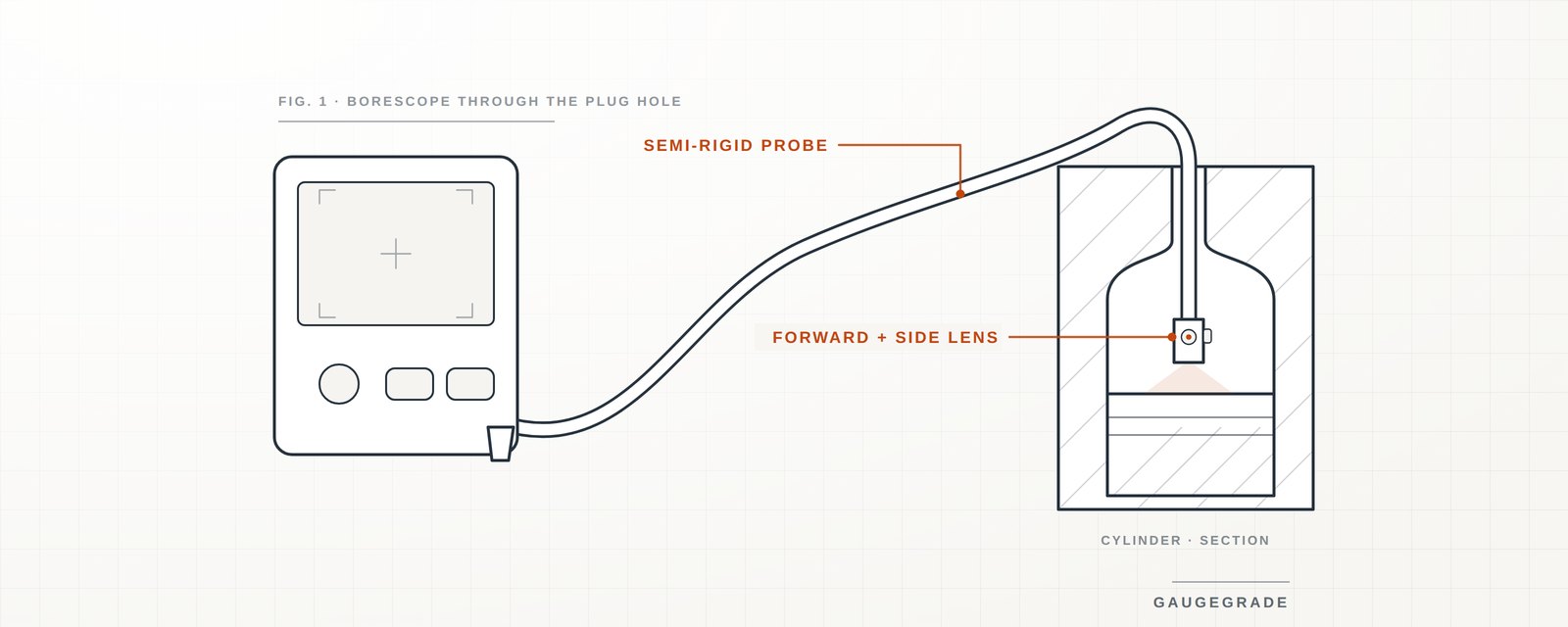
If you want to inspect a cylinder — piston crown, bore walls, valves — you go in through the spark-plug hole, and the probe has to pass down the plug well and through the threads. That is a tight path.
The threaded hole in the head is usually the narrowest point: roughly 12.6 mm across for a 14 mm plug, 10.6 mm for a 12 mm plug and 8.9 mm for a 10 mm plug. A probe of about 5.5 mm or smaller passes most of them with room to angle it. A 7.9–8.5 mm probe fits a 14 mm hole with a few millimeters to spare and is tight in a 12 mm hole, but a 10 mm hole leaves it a millimeter or less, so it may not go in at all. Larger probes are still the right tool for engine bays, exhausts, intakes and general "look behind that" work, where reach and a bigger, brighter image matter more than fitting a narrow hole. Check your plug's thread size in the service information, then decide which job you are buying for.
Screen or phone?
A scope with its own 5-inch screen is faster to use under a hood: no pairing, no app, no phone balanced on a fender, and no wireless lag while you fish the probe into place. A phone-based WiFi scope is cheaper and lighter, and fine for occasional checks, but the lag and the juggling get old if you inspect often. For most people who work on their own vehicles regularly, the standalone screen is worth it.
Articulating vs dual/triple lens
The hardest part of borescope work is seeing what is not straight ahead. Two designs solve that differently.
An articulating probe lets you steer the tip — you actively point the camera around a valve or a bend. Dual- and triple-lens scopes instead add fixed side-view cameras, so you switch views rather than steer. Articulation is more capable in a genuinely blind pocket; multi-lens is simpler, cheaper and quicker for cylinder-wall and general views.
The inspection view
On an engine, a borescope earns its keep the moment you drop it down a spark-plug hole and see the bore and piston crown: scoring on a wall, a wet or oily cylinder, coolant where it should not be, carbon on a valve, or a dropped object you are hunting. The habits that matter are simple — keep the lens clean, use the side view (or steer the tip) to read the cylinder walls rather than just the piston top, and go slowly so you do not snag the probe. A cheap scope shows you plenty; you pay up for better optics, articulation and a probe that reaches where you actually need to look.
Automotive jobs beyond the cylinder
Cylinder checks get the attention, but most of the time an automotive scope earns its place on smaller, everyday jobs. The common thread is a space you could only see into by removing parts, and a scope that lets you decide whether removing them is worth it.
The larger probes on this page do their best work here, where a brighter image and a longer cable matter more than squeezing through a narrow hole:
- Tracing a leak to its source: follow a wet trail of oil or coolant up to the seal or joint it starts from, instead of guessing from the drip on the floor.
- Finding a dropped socket, bolt or clip that has fallen behind a manifold or into a pocket in the subframe.
- Checking inside frame rails, rocker panels and door bottoms for rust that starts on the inside and shows on the outside last.
- Looking into intake runners and the throttle body for carbon or oil buildup.
- Viewing the front face of a catalytic converter through the upstream oxygen-sensor port, with the exhaust fully cold, to look for melting, cracking or blockage.
Where not to put the probe
A borescope is a camera on a cable, not a tool designed to touch moving, hot or electrical parts. A few rules keep the scope, and you, out of trouble under the hood:
- Never insert the probe into a running engine, or near a belt, pulley or fan that could turn. Electric cooling fans on many cars can switch on by themselves with the key off, so keep the probe and your hands clear of the fan.
- Let the engine, exhaust and turbo cool before you probe them. A hot surface can damage the camera head and burn you.
- Keep the scope out of fuel tanks and anywhere fuel vapor can collect. Consumer inspection cameras are battery-powered electronics and are not generally rated for flammable atmospheres.
- On hybrids and electric vehicles, stay clear of the orange high-voltage cables and the components they connect to. That work belongs to someone trained for it.
- Do not use the probe as a pry bar or a pick. Forcing it past an obstruction is how cables kink and lenses crack.
- If what you see points to internal engine damage, coolant in a cylinder or a fault near high-voltage parts, stop there and have a qualified mechanic confirm it before the car is driven or taken apart.
Frequently asked questions
What size borescope fits down a spark-plug hole?
Check your plug's thread size first. A probe of about 5.5 mm or smaller suits most car engines. A 7.9–8.5 mm probe fits 14 mm plug holes, is tight in 12 mm ones and may not pass 10 mm ones.
Do I need a borescope with its own screen, or is a phone one fine?
A standalone 5-inch screen is faster and more reliable under a hood — no app, pairing or wireless lag. A phone (WiFi) scope is cheaper and fine for occasional use. If you inspect often, the screen is worth it.
What is the difference between dual-lens, triple-lens and articulating?
Dual- and triple-lens scopes add fixed side-view cameras so you switch views. An articulating scope lets you steer the tip to point the camera around obstructions. Articulation is more capable in blind pockets; multi-lens is simpler and cheaper.
Are cheap automotive borescopes good enough?
For visual checks — spotting scoring, carbon, leaks or a dropped part — an inexpensive scope does the job. You pay more for better optics, articulation, longer reach and a probe small enough for cylinder access.
Does the waterproof rating matter?
Yes. Engines mean oil, coolant and fuel, so an IP67-rated probe you can wipe down or dip without worry is worth having. Note that the rating applies to the probe, not necessarily the whole unit.
How long a cable do I need for car work?
For looking into a cylinder you only need enough cable to reach from the plug hole to wherever you hold the screen. Longer cables help with frame rails, exhausts and the back of an engine, but they are harder to guide and to coil away, so buy for the longest job you actually do rather than the longest cable offered.
Is a borescope worth taking to look at a used car?
It can be, if the seller agrees to let you pull a plug or look into accessible spaces. A quick look can reveal rust inside frame rails, fresh leaks or a scored cylinder wall. It does not replace a professional pre-purchase inspection, which covers far more of the car than a camera can.
Can I retrieve a dropped part with a borescope?
Sometimes. Some scopes include small hook or magnet tips that clip over the camera head and can lift a light washer or clip. For anything heavier, use the scope to find the part and a separate magnetic pickup tool to lift it out. If the part may have gone into a cylinder, do not crank the engine until you have found it.
Related reading
- Aeronautics diploma
- Engineering degree
- BAMEC (DGCA)
- QC-trained
- ~2 yrs tool management
SK spent over two decades in aircraft maintenance, working hands-on with aero-engine systems and flight data recorder systems, borescope-inspecting turbine and compressor blades, and spending almost two years in a dedicated tool bay. He holds a diploma in mechanical engineering (aeronautics), an associate degree in science, an engineering degree and a Basic Aircraft Maintenance Engineer's Certificate (BAMEC) from DGCA, and has completed quality-control and aviation fuels & lubricants training. GaugeGrade applies the same inspection, torque and tool-management standards to the tools everyday mechanics, DIYers and trades actually buy.