The Best Torque Wrench Calibrators and Testers
A torque wrench is a measuring instrument, and the only way to know it still reads true is to put it against something that reads truer. That is what a torque tester does: you pull the wrench into it, it records the torque at the click, and it shows you the error. These are the bench testers and checkers worth buying, what accuracy you actually need, and when to send the wrench to a lab instead.

- 6 picks compared
- Specs checked against maker data
- No paid placements
GaugeGrade is reader-supported. When you buy through links on our site we may earn an affiliate commission at no extra cost to you. We only recommend gear we have researched against verified manufacturer specifications.
- 1A tester checks a wrench; a calibration laboratory certifies one. CDI draws the line itself: "Unlike a torque calibration system, which can be used to generate a torque wrench certification, the ETT is a portable, battery powered stand-alone torque tester."
- 2Look for first-peak mode. It captures the moment a click wrench releases, which ordinary peak mode can miss.
- 3Match the range, not just the drive: a tester's rated accuracy usually starts at 10% or 20% of its full scale, so a wrench tested near the bottom of a big tester is tested in its worst zone.
- 1Best overallGEARWRENCH 1/2" Drive Bench Top Torque Tester, 25–250 ft-lb (89634)
- 2Best professionalCDI 2503-F-ETT 1/2" Drive Electronic Torque Tester, 25–250 ft-lb
- 3Best certificate in the boxCDI 2503-F-DTC 1/2" Digital Torque Checker, 25–250 ft-lb
- 4Best for inch-pound wrenchesGEARWRENCH 1/4" Drive Bench Top Torque Tester, 10–100 in-lb (89631)
- 5Best with no batteriesPrecision Instruments TC3F175F 1/2" Torque Comparator
- 6Best for 3/4-inch wrenchesGEARWRENCH 3/4" Drive Bench Top Torque Tester, 75–750 ft-lb (89635)
What we recommend
Compare the key specs side by side, then read the full notes on each pick below.
- Drive
- 1/2"
- Range
- 25–250 ft-lb(33.9–339 N·m)
- Rated accuracy
- ±1% CW, 20–100% of range
- Drive
- 1/2"
- Range
- 25–250ft-lb
- Rated accuracy
- ±0.5% of indicated value, CW and CCW, 10–100% of full scale + 1 increment
- Drive
- 1/2"(3/8" adapter included)
- Range
- 25–250 ft-lb(34–339 N·m)
- Rated accuracy
- ±1%CW and CCW
- Drive
- 1/4"
- Range
- 10–100 in-lb(1.1–11.3 N·m)
- Rated accuracy
- ±1% CW, 20–100% of range
- Drive
- 1/2"square
- Range
- 35–175 ft-lb, 5 ft-lb graduations
- Rated accuracy
- ±2% of reading, 20% of full scale to full scale
- Drive
- 3/4"
- Range
- 75–750 ft-lb(101.7–1016.9 N·m)
- Rated accuracy
- ±1% CW, 20–100% of range


GEARWRENCH 1/2" Drive Bench Top Torque Tester, 25–250 ft-lb (89634)
Checking the 1/2-inch click wrench you use for wheels, suspension and chassis bolts
- Drive
- 1/2"
- Range
- 25–250 ft-lb (33.9–339 N·m)
- Rated accuracy
- ±1% CW, 20–100% of range
- Covers the range most 1/2-inch wrenches live in, so test points land mid-scale
- Shows the percentage error against the value you set, with no arithmetic to do
- Track, peak and first modes; first is the one for click wrenches
- Reads in ft-lb, in-lb, N·m and kg-cm, and uploads readings over USB
- Runs on AC or its own rechargeable battery
- Clockwise only: GEARWRENCH rates it in one direction
- Bolts to a bench through four holes, so it is not a tool you carry around
- GEARWRENCH warrants the calibration for 90 days, the parts for a year
The tester to buy if you own one 1/2-inch click wrench. Its 25–250 ft-lb span is the range most of them cover, so wheel and chassis values land in the middle of the scale rather than at an end, and the display does the arithmetic: it shows the percentage error between what the wrench delivered and the value you set.
Know the two limits before you buy. GEARWRENCH rates it clockwise only, and the ±1% applies from 20% of the range upward, which is 50 ft-lb here. Below that it still reads, but it is outside its own stated tolerance.
Based on the maker's specifications and manual and the published reviews linked below, not on our own test of this unit.
Setup, everyday use and what others found
Setup & use · per the maker
- Range 25–250 ft-lb (33.9–339 N·m) on a 1/2-inch drive.
- GEARWRENCH's accuracy statement: "± 1% Clockwise", applied from 20% to 100% of the full range.
- Three modes: track, peak and first. First is the one that catches a click wrench's release.
- Four units: ft-lb, in-lb, N·m and kg-cm. Readings upload over USB.
- Runs from AC or a built-in rechargeable lithium-ion battery, with a 10-minute auto shutdown.
- Bolts to a bench or base plate through four holes. Backlit LCD.
- GEARWRENCH says the line meets or exceeds ANSI and ASME specifications, and warrants calibration accuracy for 90 days and parts for one year.
- Siblings share the same body and rating: the 89632 is 3/8-inch drive at 3–30 ft-lb, and the 89633 is 1/2-inch at 10–100 ft-lb.
What others found
We found no independent test of this tester, and no dated owner review we could attribute to it.

CDI 2503-F-ETT 1/2" Drive Electronic Torque Tester, 25–250 ft-lb
A shop that checks wrenches often and needs counter-clockwise readings too
- Drive
- 1/2"
- Range
- 25–250 ft-lb
- Rated accuracy
- ±0.5% of indicated value, CW and CCW, 10–100% of full scale + 1 increment
- Tightest rating here, and CDI rates it both clockwise and counter-clockwise
- Rated from 10% of full scale, so more of the dial is usable
- Four modes: peak, first peak, track and a power-tool mode
- Portable and battery powered, so it can go to the tool rather than the tool to it
- Made in the USA, and CDI cites ASME's testing protocol
- A professional instrument, and specified like one: there is no consumer version of it
- CDI positions it as a tester, not a calibration system: it will not produce a wrench certification
- CDI says it is unsuitable for impact or pulse tools
The instrument a shop buys. CDI rates it at ±0.5% of the indicated value in both directions from 10% to 100% of full scale, which is tighter than anything else here and usable lower down the dial, and it offers four modes including first peak and a power-tool mode.
It is a tester, not a calibration system, and CDI is explicit about that. If you need a certificate at the end, this is not the tool that produces one.
Based on the maker's specifications and manual and the published reviews linked below, not on our own test of this unit.
Setup, everyday use and what others found
Setup & use · per the maker
- Range 25–250 ft-lb on a 1/2-inch drive; CDI's ETT line runs from 10–100 in-oz to 60–600 ft-lb across eight models.
- CDI's accuracy statement: "± 0.5% of indicated value, CW & CCW, from 10% to 100% of full scale + 1 increment or least significant digit".
- Four modes: peak, first peak, track and power tool.
- Rechargeable NiCad batteries with an optional AC adapter, so it can be carried to the tool.
- CDI's own scope statement: "Unlike a torque calibration system, which can be used to generate a torque wrench certification, the ETT is a portable, battery powered stand-alone torque tester."
- With a joint simulator it can assess stall and clutch pneumatic and electronic tools. CDI says it is not suitable for impact or pulse tools.
- The Amazon listing states it is manufactured in the United States and cites ASME's testing protocol.
What others found
We found no independent test of this model and no dated owner report we could attribute to it.

CDI 2503-F-DTC 1/2" Digital Torque Checker, 25–250 ft-lb
A bench check before a job, with paperwork showing the checker itself was calibrated
- Drive
- 1/2" (3/8" adapter included)
- Range
- 25–250 ft-lb (34–339 N·m)
- Rated accuracy
- ±1% CW and CCW
- Ships with a certificate of calibration, so the reference has provenance
- First peak, peak hold and tracking selected by push button
- Beeps on over-torque at 125% of full scale, so an overload announces itself
- Mounts flat in either orientation, horizontal or vertical
- A 3/8-inch adapter is in the box, so it takes 3/8-inch wrenches too
- The Amazon listing omits the accuracy figure; it comes from CDI's own distributor spec sheet
- Each checker is fixed to one range; the 5–100 ft-lb 1003-F-DTC is the lower-range sibling
- A checker, not a calibrator: it tells you the error, it does not correct it
The one that arrives with paperwork. CDI ships the digital checker with a certificate of calibration, so the reference you are judging your wrenches against has a documented starting point — which is more than most bench testers give you.
Its accuracy is ±1% clockwise and counter-clockwise, which is the same class as the GEARWRENCH bench testers and half a point behind CDI's own ETT. The Amazon listing leaves the figure out entirely; it comes from CDI's distributor spec sheet, which is worth knowing if you are comparing listings side by side.
Based on the maker's specifications and manual and the published reviews linked below, not on our own test of this unit.
Setup, everyday use and what others found
Setup & use · per the maker
- Range 25–250 ft-lb (34–339 N·m) on a 1/2-inch square drive, with a 3/8-inch adapter in the box.
- Push-button mode select: first peak, peak hold and tracking.
- Audio beep on over-torque at 125% of full scale.
- Large backlit LCD. Compact enough to mount on any flat surface, horizontal or vertical.
- Accuracy ±1% clockwise and counter-clockwise, per CDI's distributor specification sheet. The Amazon listing gives no figure.
- A certificate of calibration is included.
- CDI describes it as being for "checking Mechanical and digital torque wrenches regularly before use".
- The DTC family runs well beyond this one model. The 1003-F-DTC is the same 1/2-inch tool at 5–100 ft-lb (6.7–135.5 N·m), which covers the values a 3/8-inch wrench works at, and CDI's distributor lists hex-drive and larger models up to 1,500 ft-lb.
What others found
We found no independent test of this checker. CDI's own Amazon listing omits the accuracy figure, so ours comes from its distributor specification sheet.


GEARWRENCH 1/4" Drive Bench Top Torque Tester, 10–100 in-lb (89631)
Checking a 1/4-inch inch-pound wrench or a torque screwdriver, where a foot-pound tester reads almost nothing
- Drive
- 1/4"
- Range
- 10–100 in-lb (1.1–11.3 N·m)
- Rated accuracy
- ±1% CW, 20–100% of range
- The right scale for small fasteners: a 100 in-lb check is mid-range here, not a rounding error
- Same percentage-error readout, modes and units as its bigger siblings
- GEARWRENCH lists it for torque screwdrivers as well as wrenches
- AC or battery, with USB upload
- Clockwise only
- Tops out at 100 in-lb, about 8.3 ft-lb
- 90-day calibration warranty, as with the rest of the line
The small-fastener answer. A 1/4-inch inch-pound wrench or a torque screwdriver checked on a foot-pound tester is being read in the bottom fraction of a scale that was never rated there. This one runs 10–100 in-lb, so a 60 in-lb check sits mid-range.
The same caveats as the rest of the line apply: clockwise only, and the ±1% starts at 20% of range, which is 20 in-lb here.
Based on the maker's specifications and manual and the published reviews linked below, not on our own test of this unit.
Setup, everyday use and what others found
Setup & use · per the maker
- Range 10–100 in-lb (1.1–11.3 N·m) on a 1/4-inch drive.
- GEARWRENCH's accuracy statement: "± 1% Clockwise", from 20% to 100% of the full range.
- Track, peak and first modes; four units; percentage-error readout; USB upload.
- AC or built-in rechargeable lithium-ion battery, with a 10-minute auto shutdown.
- Four-bolt mounting to a bench or base plate; backlit LCD.
- GEARWRENCH describes the line as for testing and verifying the accuracy of torque wrenches and screwdrivers, and says it meets or exceeds ANSI and ASME specifications.
- Calibration accuracy warranted 90 days; parts one year.
What others found
We found no independent test of this tester, and no dated owner review we could attribute to it.

Precision Instruments TC3F175F 1/2" Torque Comparator
A quick mechanical check on a shop wall, with nothing to charge and nothing to fail
- Drive
- 1/2" square
- Range
- 35–175 ft-lb, 5 ft-lb graduations
- Rated accuracy
- ±2% of reading, 20% of full scale to full scale
- No power of any kind — a mechanical dial with nothing to charge and no battery to go flat
- Mounts flat in either orientation and weighs under 4 lb
- Precision Instruments says it meets or exceeds GGG-W-686C and ANSI B107.14M
- A certificated version, the TC3F175FC, is sold for buyers who need the paperwork
- ±2% is the loosest rating here: against a ±4% wrench that is a 2:1 margin, not the 4:1 the rest of this page manages
- 5 ft-lb graduations, so you read a band rather than a number
- Sources disagree on the bottom of its range: Precision Instruments lists 35 ft-lb, some retailers show 0
- No first-peak mode, and no memory: you watch the dial
The one with nothing to go flat. It is a mechanical comparator with a dial and a square drive, it needs no power of any kind, and it mounts on a wall or a bench for a check that takes seconds. Precision Instruments describes the comparators as a way to work out which tools need to go away for calibration before you send them.
The reason it is not higher up this page is the rating. Precision Instruments quotes "Accurate within 2% of reading from 20% of full scale to full scale", which against a ±4% click wrench is a 2:1 margin rather than the 4:1 the electronic testers here manage. Read it as a go/no-go check, not a measurement.
Based on the maker's specifications and manual and the published reviews linked below, not on our own test of this unit.
Setup, everyday use and what others found
Setup & use · per the maker
- 1/2-inch square drive. Precision Instruments lists the drive type as fixed; retailer listings describe the input as female square, with a sleeve adapter.
- Precision Instruments lists the capacity as 35–175 ft-lb in 5 ft-lb graduations. Some retailers show the range as 0–175 ft-lb; we could not reconcile the two.
- Accuracy, from Precision Instruments' comparator page: "Accurate within 2% of reading from 20% of full scale to full scale." The figure is on the category page rather than this model's own listing.
- 13.5 in long, 4.75 in wide, about 3.75 lb, nickel and chrome finish. No power of any kind.
- Retailer listings say it mounts on any flat surface, horizontal or vertical, for a quick check before use; Precision Instruments itself describes the comparators as a way to spot-check other wrenches.
- Precision Instruments says it meets or exceeds GGG-W-686C and ANSI B107.14M.
- Made in the USA, per Precision Instruments. A TC3F175FC version ships with a calibration certificate.
- Siblings: the TC3F250N covers 50–250 N·m on the same drive, and the 3/4-inch TC4F600F covers 120–600 ft-lb.
What others found
We found no independent test of this comparator, and no dated owner report we could attribute to it.


GEARWRENCH 3/4" Drive Bench Top Torque Tester, 75–750 ft-lb (89635)
Truck, plant and structural wrenches that a 250 ft-lb tester cannot take
- Drive
- 3/4"
- Range
- 75–750 ft-lb (101.7–1016.9 N·m)
- Rated accuracy
- ±1% CW, 20–100% of range
- Takes the 3/4-inch wrenches the rest of this page cannot
- GEARWRENCH describes it as built for inspecting wrenches in a production workshop
- Same readout, modes, units and USB upload as the smaller models
- Rated accuracy starts at 150 ft-lb, so it is the wrong tool for a car wrench
- Clockwise only
- Needs solid bolting: it is reacting up to 750 ft-lb
The one for wrenches the rest of this page cannot take. A 3/4-inch drive and a 75–750 ft-lb span cover truck, plant and structural wrenches, and GEARWRENCH describes it as built for inspecting wrenches in a production workshop.
It is the wrong tool for a car wrench. The ±1% applies from 20% of range, which is 150 ft-lb, so anything you would use on an engine bay is below its rated zone.
Based on the maker's specifications and manual and the published reviews linked below, not on our own test of this unit.
Setup, everyday use and what others found
Setup & use · per the maker
- Range 75–750 ft-lb (101.7–1016.9 N·m) on a 3/4-inch drive tang.
- GEARWRENCH's accuracy statement: "± 1% Clockwise", from 20% to 100% of the full range.
- Track, peak and first modes; ft-lb, in-lb, N·m and kg-cm; percentage-error readout; USB upload.
- AC or built-in rechargeable lithium-ion battery, with a 10-minute auto shutdown.
- Four-bolt mounting to a bench or base plate.
- Meets or exceeds ANSI and ASME specifications, per GEARWRENCH. Calibration warranted 90 days, parts one year.
What others found
We found no independent test of this tester, and no dated owner review we could attribute to it.
- Aeronautics diploma
- Engineering degree
- BAMEC (DGCA)
- QC-trained
- ~2 yrs tool management
Why you should trust us
In a dedicated tool bay, no torque wrench goes back on the shelf unchecked: every one carries a calibration label, and a wrench that has been dropped or overloaded comes out of service until it has been looked at. SK Kutubuddin spent almost two years in one, within over two decades of aero-engine maintenance, and that is the standard behind this page — a reference instrument with a known tolerance, used on a schedule, not a gadget bought once and trusted forever.
Every range, accuracy figure and mode below was checked against the maker's product page, catalogue or specification sheet, and against the Amazon listing wherever that listing carries specifications. Where a figure comes from somewhere other than the maker's own page — CDI's checker accuracy, which its Amazon listing omits, or the description of the Precision Instruments comparator's drive — we say where it came from. We have not measured any of these instruments.
Who this is for
This page is for anyone who owns torque wrenches they rely on and wants to know whether they still read true: home mechanics with a wrench that has been in a drawer for three years, workshops running several wrenches across a week, and anyone who has just dropped one.
If you only need a rough sanity check on a single wrench, a digital torque adapter will do it, without a bench to bolt to. If you need a certificate at the end, you need a calibration laboratory, not any tool on this page.
- Checking a wrench after it has been dropped, overloaded or stored wound up
- Deciding which wrenches in a shop need to go out for calibration, and how soon
- Verifying a new wrench against its maker's stated tolerance before it goes to work
- Checking torque screwdrivers and inch-pound wrenches, where the values are too small for a foot-pound tester
How we picked
We started from what a reference instrument has to do — read more accurately than the tool it judges, and capture the right moment on a click wrench — then checked every candidate against the maker's own documents.
- 01
A published accuracy figure, and where it applies
We printed each maker's figure and the part of the scale it covers, because a rating that starts at 20% of full scale means something different from one that starts at 10%, and a ±2% reference is a far weaker check than a ±0.5% one.
- 02
First-peak mode
A click wrench releases and the torque falls away. We favoured instruments that capture that first release rather than the highest value in the pull.
- 03
A range that brackets real wrenches
We picked across drive sizes so the tester's rated zone covers the wrench you actually own, rather than leaving it to be read at the bottom of a much larger scale.
- 04
Provenance for the reference itself
A tester is only as good as its own calibration. We noted which ones ship with a certificate and what each maker warrants.
What to know before you buy
Tester, calibrator, or calibration service?
The three words get used interchangeably in listings, and they are not the same thing. A tester or checker measures what your wrench actually delivers and shows you the error. A calibration system applies known torque and produces a certificate. A calibration service is a laboratory that does the second one for you and issues the paperwork.
CDI puts its own instrument on one side of that line: "Unlike a torque calibration system, which can be used to generate a torque wrench certification, the ETT is a portable, battery powered stand-alone torque tester." Every product on this page is a tester in that sense. They will tell you a wrench has drifted. None of them produces the certificate.
That is still most of the value. A check takes minutes, it catches the wrench that has been dropped or left wound up, and it tells you whether the annual lab visit is due early. Our calibration guide covers the procedure, including the three test points and the error arithmetic.
How accurate does the tester have to be?
More accurate than the wrench, by a margin. The long-standing rule of thumb is a 4:1 test uncertainty ratio, which puts the reference about four times inside the tolerance of the tool being checked: a ±1% tester against a ±4% click wrench, or a ±0.5% instrument against the ±2% and ±3% wrenches. It is a rule of thumb rather than a requirement — accredited laboratories now work from a documented uncertainty budget instead — but it is a sound way to shop.
Read the small print on where the rating applies. GEARWRENCH rates the bench testers here at ±1% clockwise from 20% to 100% of the range, so on the 25–250 ft-lb model that is 50 ft-lb upward; its touchscreen models are rated differently again. CDI rates the ETT at ±0.5% of indicated value, clockwise and counter-clockwise, from 10% to 100% of full scale. Below those points the tester is not lying to you, but it is no longer inside its stated tolerance, and neither is the wrench you are judging.
- Pick a tester whose range brackets your wrench's own range, rather than the biggest one you can get.
- Check the direction: the GEARWRENCH testers here are rated clockwise only.
- A wrench tested at the very bottom of a big tester is being judged in that tester's worst zone.
First peak is the mode that matters
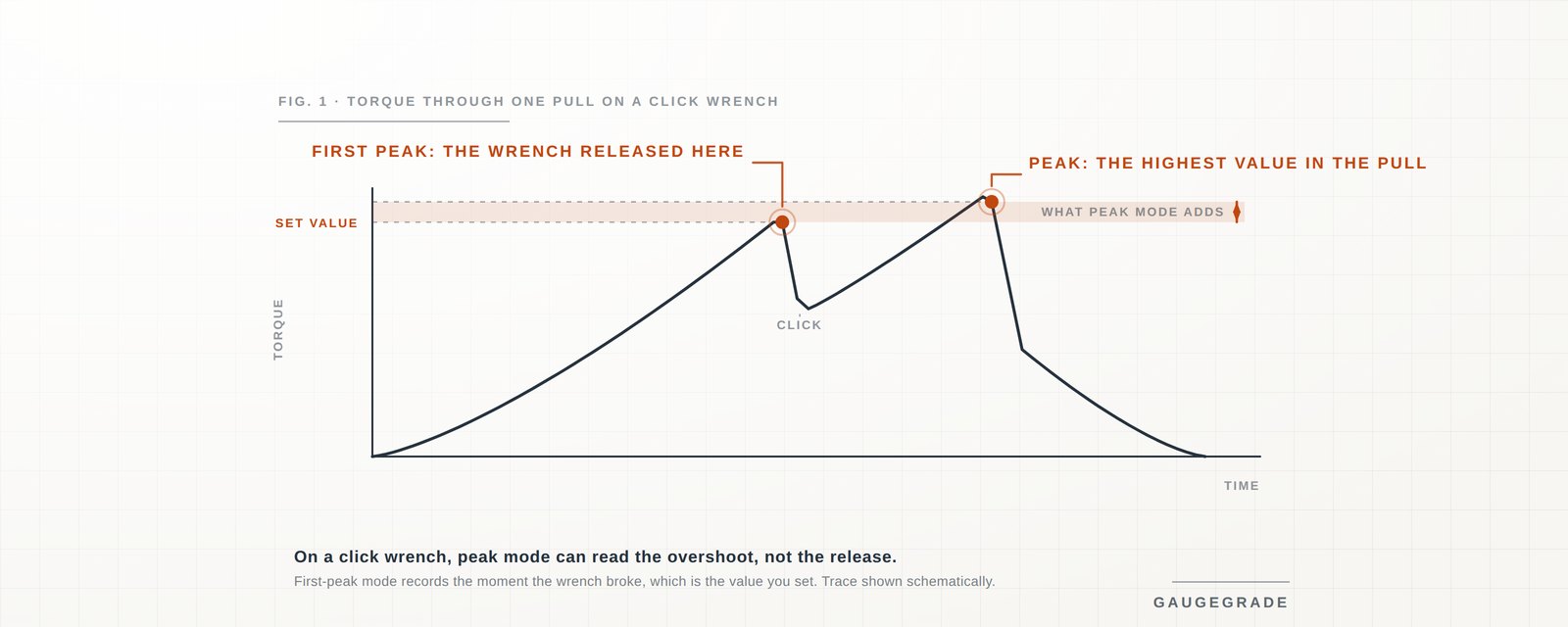
A click wrench releases and the torque immediately falls away. Ordinary peak mode records the highest value it saw, which on a click wrench can be the overshoot after the break rather than the break itself. First-peak mode captures that first release instead, which is what you set the wrench to.
All the electronic instruments here have it: GEARWRENCH calls the modes track, peak and first; CDI's checker offers first peak, peak hold and tracking, and its ETT adds a power-tool mode. A digital torque adapter is the simplest way to get a reading, but adapters generally offer peak and tracking only, which is the main reason they are a sanity check rather than a test.
The tester needs calibrating too
A reference instrument drifts like any other. GEARWRENCH warrants the calibration accuracy of its bench testers for 90 days and the parts for a year, which is a fair signal of how the maker views the interval. CDI ships its digital checker with a certificate of calibration in the box, and Precision Instruments sells a certificated version of its comparator for buyers who need the paperwork.
So treat the tester as the thing you protect: keep it bolted down, do not overload it, and have it recalibrated on a schedule. A reference that has quietly drifted is worse than no reference, because it makes a bad wrench look fine.
When to use a laboratory instead
Send the wrench out when the answer has to be documented or when the wrench is outside tolerance. A calibration laboratory applies known torque, adjusts the wrench where the design allows it, and issues a certificate with the readings on it. That is what an employer, an auditor or an airworthiness process wants to see, and no bench tester substitutes for it.
Send it out, too, when a check says the wrench is off. Unless the maker publishes an adjustment procedure, do not open the handle: on most click wrenches the spring preload is set at the factory and re-set against a reference you do not have. Use your tester to decide which wrenches make the trip, and how urgently.
What we left out, and why
Several things that come back under these search terms are not torque wrench testers at all, and a couple that are were not buyable:
- Bottle-cap torque testers. A large share of the "torque tester" listings measure the opening torque of caps and lids for packaging work. They do not take a square drive.
- Dial-indicator torque wrenches. These are indicating wrenches, useful tools in their own right, but they are the thing being checked, not the reference.
- Used instruments. One professional torque verifier came back described by its seller as used; a reference tool with no known history is not a reference.
- Unbranded calibrators with no maker documentation. Several listings quote an accuracy figure with nothing behind it that we could read.
- CDI's older DTT testers, which were unavailable or on long lead times across the models we checked, and which one distributor describes as discontinued and replaced.
Where the guidance comes from
The specifications and statements on this page come from these documents. Product sources are listed under each pick.
- GEARWRENCH product pages for the 89631, 89634 and 89635 bench-top torque testers.
- CDI Torque Products catalogue, for the ETT electronic torque tester's accuracy, modes and scope.
- Torque Products Canada's specification sheet for the CDI DTC digital torque checkers.
- Precision Instruments' torque comparator pages, for the TC3F175F's capacity and accuracy.
- Amazon listings for each pick, checked against the maker's figures.
- Our own calibration guide for the test-point and error method.
Frequently asked questions
What is a torque wrench calibrator?
In tool listings it usually means a torque tester: an instrument with a square drive and a load cell that measures what a wrench delivers and shows the error. A true calibrator applies known torque and produces a certificate, which is laboratory work.
Can I calibrate a torque wrench myself?
You can check one yourself, with a tester or a known weight on a measured arm, and that tells you whether it is still inside tolerance. Calibrating it — adjusting it against a traceable reference and certifying the result — is a laboratory job unless the maker publishes an adjustment procedure.
How accurate should a torque wrench tester be?
The rule of thumb is four times inside the wrench's tolerance, the 4:1 test uncertainty ratio. A ±1% tester suits the ±4% click wrenches most people own; a ±0.5% instrument covers the ±2% and ±3% wrenches as well. Accredited laboratories work from an uncertainty budget rather than the ratio.
What is first peak mode on a torque tester?
It records the torque at the moment a click wrench first releases, instead of the highest value seen during the pull. On a click wrench the two are different, and first peak is the one that matches the setting.
Do digital torque adapters work as testers?
As a rough check, yes. They read torque through the drive and hold a peak, but they generally lack a first-peak mode, so on a click wrench the reading can catch the overshoot after the break rather than the break itself. They are also handheld rather than fixed, which adds its own error.
How often should a torque wrench be checked?
Check it whenever it has been dropped, overloaded or left wound up, and on a routine you set yourself between lab calibrations. Makers' recalibration intervals run from six months to a year or around 5,000 cycles; our calibration guide collects what each one publishes.
Is a torque tester worth it for one wrench?
Probably not. For a single wrench, a digital torque adapter or a known weight on a measured arm will tell you whether it has drifted badly, and a laboratory calibration when it has. A bench tester earns its place when you have several wrenches, or check them often.
Can a torque tester certify my wrench?
No. CDI draws the line itself, calling its ETT a stand-alone tester rather than a calibration system. A tester tells you the error; a laboratory applies known torque, adjusts the wrench where the design allows it, and issues the certificate with the readings on it.
Related reading
- Aeronautics diploma
- Engineering degree
- BAMEC (DGCA)
- QC-trained
- ~2 yrs tool management
SK spent over two decades in aircraft maintenance, working hands-on with aero-engine systems and flight data recorder systems, borescope-inspecting turbine and compressor blades, and spending almost two years in a dedicated tool bay. He holds a diploma in mechanical engineering (aeronautics), an associate degree in science, an engineering degree and a Basic Aircraft Maintenance Engineer's Certificate (BAMEC) from DGCA, and has completed quality-control and aviation fuels & lubricants training. GaugeGrade applies the same inspection, torque and tool-management standards to the tools everyday mechanics, DIYers and trades actually buy.