The Best Digital Torque Wrenches
A digital (electronic) torque wrench shows the live value and alerts you at the target — useful when you work to many different specs, and some add a torque-angle mode a click wrench cannot do. Here are the best, by drive and range.

- 4 picks compared
- Specs checked against maker data
- No paid placements
GaugeGrade is reader-supported. When you buy through links on our site we may earn an affiliate commission at no extra cost to you. We only recommend gear we have researched against verified manufacturer specifications.
- 1Match drive and range to the work: a 1/2" 25–250 ft-lb for lug nuts and suspension; a 3/8" 10–100 ft-lb for general engine work; a low-range 3/8" for small fasteners.
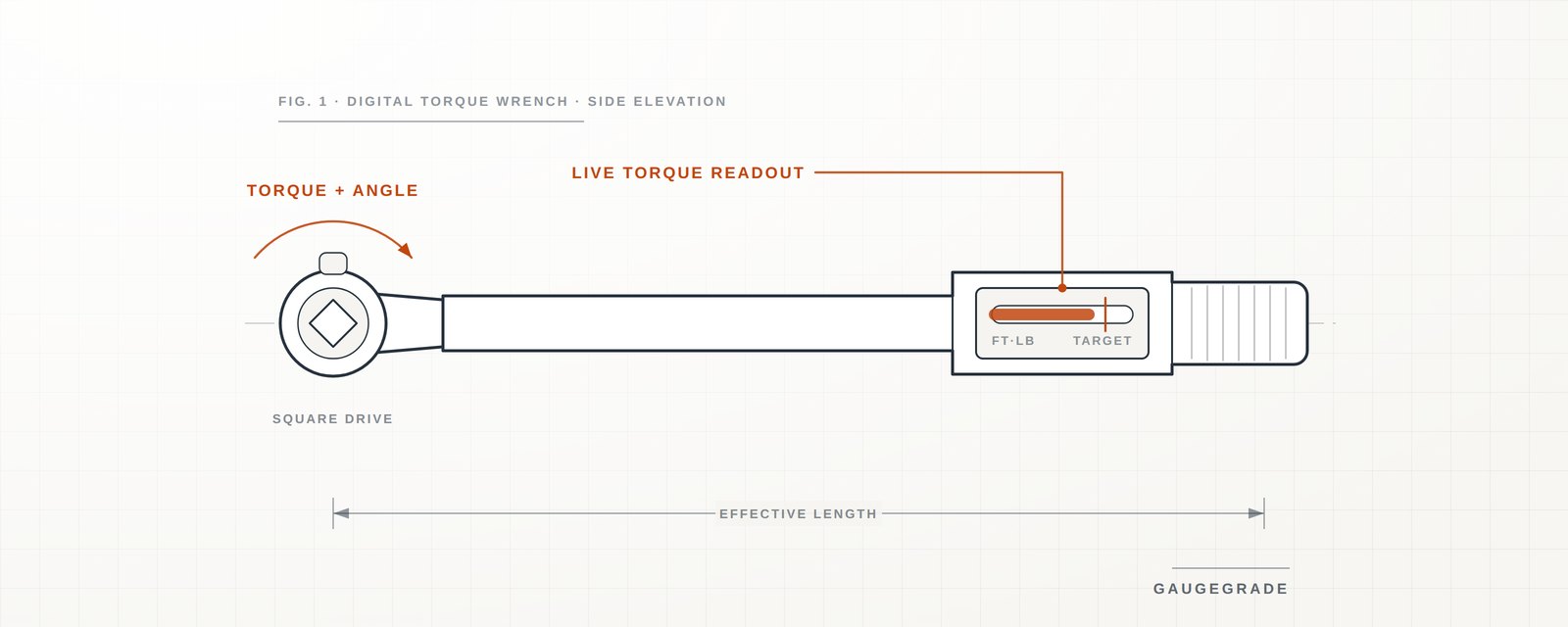
- 2Digital adds a live readout, a buzzer/LED at target and, on some models, a torque-angle mode.
- 3They run on batteries and need periodic calibration — store them per the maker.
What we recommend
Compare the key specs side by side, then read the full notes on each pick below.
- Drive
- 1/2"
- Torque range
- 25–250ft-lb
- Drive
- 3/8"
- Torque range
- 10–100ft-lb
- Drive
- 1/2"
- Torque range
- 14.8–147.5ft-lb
- Drive
- 3/8"
- Torque range
- 3.7–37ft-lb
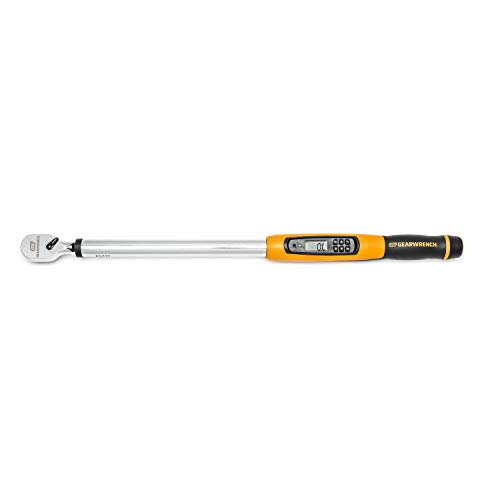


GEARWRENCH 85077 Electronic Torque Wrench
Lug nuts, suspension and larger fasteners
- Drive
- 1/2"
- Torque range
- 25–250 ft-lb
- Wide 25–250 ft-lb range
- Buzzer, LED and vibrating handle at the target
- Rated ±2% clockwise, ±3% counter-clockwise (20–100% of range)
- Range is overkill for small fasteners
- Battery-powered
The 1/2-inch digital to buy. It has the biggest range here at 25–250 ft-lb, and a vibrating handle as well as the buzzer and LED; Bob Vila's testers named it their upgrade pick and said the vibration made the target hard to miss.
Rated accuracy starts at 50 ft-lb (20% of scale), there's no angle mode, and GEARWRENCH says not to use it to loosen fasteners. Keep smaller bolts for a 3/8-inch wrench.
Based on the maker's specifications and manual and the published reviews linked below, not on our own test of this unit.
Setup, everyday use and what others found
Setup & use · per the maker
- Hold the power button for 3 seconds, pick the unit, press SET and key in the target with + and −. There are five units: ft-lb, in-lb, N·m, kg-m and kg-cm.
- Peak mode is the default and shows the highest torque reached for 15 seconds. A button combination switches to tracking mode for a live reading.
- Set an alert tolerance and it warns early: at a 90 ft-lb target with a 10% tolerance, the tone starts at 81 ft-lb. At the target a red LED lights, the buzzer sounds and the handle vibrates.
- Rated ±2% clockwise and ±3% counter-clockwise from 20% to 100% of full scale. The ratchet has 72 teeth and a 5° swing arc.
- Batteries aren't included. The manual and Amazon listing say 2 AA while GEARWRENCH's product page says 3 AAA, so check the battery compartment. It turns itself off after 90 seconds at zero.
- Never exceed its capacity or pull with the power off. The warranty is one year, with calibration accuracy warranted for 90 days, and GEARWRENCH says periodic recalibration is required.
What others found
Bob Vila's testers made it their upgrade pick. They found the buttons had a positive click even in gloves and said the vibration meant they didn't miss the target, but noted the value can be hard to set quickly. Their test didn't measure accuracy.
A Garage Journal owner who torques wheels for work (2019) said his 1/2-inch 85077 works well, but finds changing the target with the up and down buttons jumpy when he resets it often.
We couldn't read Home Depot's review text for the 85077.


TEKTON TRQ81122 3/8" Electronic Torque Wrench
General engine work that calls for torque-plus-angle
- Drive
- 3/8"
- Torque range
- 10–100 ft-lb
- Torque, angle, or torque-plus-angle modes
- Rated ±2% torque and ±1% angle in both directions, with a serialized certificate
- Lights, beeps and a vibrating handle at the target
- 3/8" range is not for big lug nuts
- Needs 3 AA batteries (not included)
The only pick here with an angle mode, which is the main reason to buy a digital wrench for engine work: torque each bolt, then turn it the specified degrees with the reading on screen. It's also the tightest-rated tool on this page, at ±2% on torque and ±1% on angle in both directions.
It's a 3/8-inch wrench, so lug nuts and the bigger chassis bolts still belong on the 1/2-inch GEARWRENCH above. It needs three AA batteries, which aren't included.
Based on the maker's specifications and manual and the published reviews linked below, not on our own test of this unit.
Setup, everyday use and what others found
Setup & use · per the maker
- 10–100 ft-lb in 1 ft-lb steps, with three modes: torque only, angle only, or torque plus angle.
- Rated ±2% on torque and ±1% on angle, clockwise and counter-clockwise, to ISO 6789-1:2017 and ASME B107.300-2021. The certificate tests torque at 10, 60 and 100 ft-lb and angle at 45°, 90°, 135° and 180°. TEKTON states the angle figure at a reference of 90° at 30° per second.
- 90-tooth head with a 4° swing arc and a 15° flex. 20.0 in long, an effective length of 15.9 in, 2.71 lb, made in Taiwan.
- Backlit screen with large buttons, and feedback from lights, beep patterns and handle vibration as you approach and reach the target. Auto shut-off is user-set to 2, 5, 10, 30, 60 or 120 minutes.
- Runs on three AA batteries, not included. In the box: a case, the manual, the serialized certificate and a 3/8-to-1/4-inch reducer.
- There's no winding down to do: the manual says to store it in its case and take the batteries out for long storage. Don't use it to break fasteners loose or add an extension to the handle, and verify its accuracy after a drop. It's covered by TEKTON's no-time-limit warranty and its paid recertification service.
What others found
It's a new model. We found no owner reviews we could read and no independent test, so everything here comes from TEKTON's published data and manual.


ACDelco ARM601-4 Digital Torque Wrench
A do-most 1/2" digital with peak and trace modes
- Drive
- 1/2"
- Torque range
- 14.8–147.5 ft-lb
- Beeps from 90% of the target, rapid beep at it
- Serialized calibration certificate, per the listing
- 14.8–147.5 ft-lb covers lug nuts
- Lower maximum than the 85077
- Rated accuracy starts at about 29.5 ft-lb
- 4 AAA batteries not included
The value 1/2-inch digital here: a live or peak readout, an early-warning beep from 90% of the target and a rapid one at it, over a shorter 14.8–147.5 ft-lb range than the GEARWRENCH 85077, one that still covers common lug-nut values.
Rated accuracy starts at about 29.5 ft-lb, it has no vibration alert, and the same model number was once sold with a 4–99 ft-lb range, so check the range on the listing you buy.
Based on the maker's specifications and manual and the published reviews linked below, not on our own test of this unit.
Setup, everyday use and what others found
Setup & use · per the maker
- Press Power to switch on; once it's on, a press of Power zeroes the reading, so never zero it with load applied. The Up and Down buttons switch between Peak, which holds the highest reading, and Trace, which shows live torque.
- To set a target, hold SET for 2 seconds, adjust with Up and Down, then hold SET again or wait 5 seconds. Units are ft-lb, in-lb, N·m and kg-cm.
- An intermittent beep starts at 90% of the target, and a rapid beep at the target means stop pulling.
- Rated ±2% clockwise and ±3% counter-clockwise from 20% to 100% of full scale. Apply the force at the centre of the handle grip.
- It runs on 4 AAA batteries (not included) and switches off after 60 seconds unused. A counter logs how many times the target has been reached.
- Overloading can damage it and its accuracy; if you suspect an overload, have the calibration checked. Remove the batteries for long storage and keep it in its protective case. The calibration certificate is described in the Amazon listing; ACDelco's manuals don't mention one.
What others found
A Walmart reviewer (2026) found the instructions complicated and the learning curve steeper than expected.
Another Walmart owner (2025) said it arrived with a plastic case and seemed a little more accurate than the manual wrench they had been using.
We found no independent hands-on test of the ARM601-4, and many of the Walmart reviews are marked incentivized. The same model number has also been sold with a 4–99 ft-lb range, so check the range on the listing you buy.
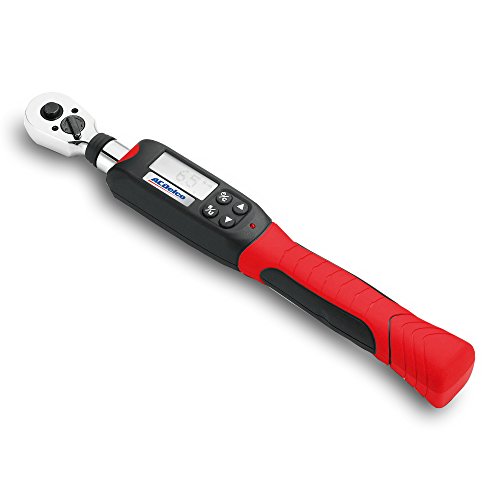


ACDelco ARM601-3 Digital Torque Wrench
Small fasteners and interior work
- Drive
- 3/8"
- Torque range
- 3.7–37 ft-lb
- Targets from 3.7 ft-lb (rated from about 7.4 ft-lb)
- Beeps from 90% of the target, rapid beep at it
- Calibration certificate, per the listing
- Far too little for lug nuts
- One Bob Vila test unit kept shutting off, then wouldn't turn on
The small-fastener digital: a 3/8-inch drive that takes targets from 3.7 ft-lb, with the same 90% warning beep and peak and trace modes as the 1/2-inch ARM601-4.
Its ±2% clockwise, ±3% counter-clockwise rating starts at 20% of scale, about 7.4 ft-lb, so the lowest settings sit outside the rated band. Bob Vila's test unit kept shutting off and then wouldn't turn on at all.
Based on the maker's specifications and manual and the published reviews linked below, not on our own test of this unit.
Setup, everyday use and what others found
Setup & use · per the maker
- Targets can be set from 3.7 to 36.9 ft-lb (5–50 N·m). An older manual gives the measuring range as 2–37 ft-lb.
- Press Power to switch on; once it's on, a press of Power zeroes the reading, so never zero it with load applied. Up and Down choose Peak (holds the highest reading) or Trace (live torque). Hold SET for 2 seconds to enter a target. Units are ft-lb, in-lb, N·m and kg-cm.
- An intermittent beep starts at 90% of the target, and a rapid beep at the target means stop.
- Rated ±2% clockwise and ±3% counter-clockwise from 20% to 100% of full scale.
- 3/8-inch quick-release ratchet, 12-3/8 in long and 1.41 lb. It runs on 4 AAA batteries (not included) and switches off after 60 seconds unused.
- Remove the batteries for long storage, and have the calibration verified after any overload. The Amazon listing describes a calibration certificate; the manuals don't mention one.
What others found
In Bob Vila's digital torque wrench test, this ACDelco kept shutting off. New batteries didn't help, and at the time of writing it would not turn on, so they couldn't recommend it. That's one unit.
Two Walmart reviewers, both marked incentivized, found the instructions poor, though one of them hadn't opened the package. The other said it was finicky to set but checked out against their other torque wrenches.
- Aeronautics diploma
- Engineering degree
- BAMEC (DGCA)
- QC-trained
- ~2 yrs tool management
Why you should trust us
Over two decades of aircraft maintenance taught SK Kutubuddin to work to torque values that are written, applied and recorded, never estimated. That discipline is exactly what a digital torque wrench is built around: a live reading, a clear signal at the target and, on many models, an angle mode for the torque-plus-angle procedures modern engines use. Work on flight data recorder systems, where a reading is only as good as the instrument behind it, shapes how he weighs a digital tool's stated accuracy against the job it has to do.
To choose these picks we grouped digital wrenches by drive and range, the two decisions that matter most, then checked each model's range, drive and listed features against the manufacturer's specifications and the current retail listing, per our how-we-test method. Where a wrench ships with calibration paperwork, we note it. The page rests on verified specs and long experience with the category, and we do not present it as a bench test.
Who this is for
A digital torque wrench suits people who work to many different specs in one session, who need torque-angle for head, main or rod bolt procedures, or who simply want to watch the torque build rather than wait for a click. It also helps at the low end of a range, where a mechanical click can be faint and easy to miss.
If you set one value and tighten a set of lug nuts twice a year, a good click wrench does the same job with no batteries. Digital earns its price when you use what it adds.
- Engine rebuilds and head-gasket jobs with torque-plus-angle steps
- Home mechanics who switch between many specs in a single job
- Anyone who finds a click hard to feel or hear at low settings
- Owners who want calibration paperwork from day one
How we picked
We sorted digital wrenches by the work they will be asked to do, then checked every figure against the manufacturer's specifications and the current listing before a model made the page.
- 01
Drive and range matched to real jobs
We looked for a 1/2-inch wrench for wheels and chassis, a 3/8-inch for general engine work and a low-range 3/8-inch for small fasteners, so each pick's useful middle falls on one common group of fasteners instead of straddling several.
- 02
Angle capability where it counts
Torque-plus-angle procedures are the main reason to choose digital over click for engine work. We gave an angle mode real weight for engine-bay use and noted which pick offers it, since without one you need a separate angle gauge.
- 03
Clear target alerts
A digital wrench is only easier than a click if its signal is unmistakable. We favored models with both an audible and a visual alert at the target, which helps in a noisy garage or when you cannot see the display mid-pull.
- 04
Calibration documentation
A certificate of calibration gives you a verified starting point and a record to compare against at the next check. Where a pick ships with one, we say so, and we weighed that alongside range and price.
What to know before you buy
Digital vs click
A click wrench is simple, needs no batteries, and clicks at the value you set. A digital wrench shows the reading as you pull and beeps and flashes at the target; some, like the TEKTON TRQ81122 here, add a torque-angle mode.
Digital earns its place when you work to many different specs or need torque-angle; a click wrench is fine when you set one value and go.
Which range do you need?
Buy a wrench whose range is centered on your fasteners, because a torque tool is most accurate in the middle of its range.
- 1/2", 25–250 ft-lb — lug nuts, suspension, big fasteners.
- 3/8", 10–100 ft-lb — general engine work, and torque-angle jobs.
- 3/8", low range (about 4–37 ft-lb) — small fasteners and interior work.
Keeping it honest
A digital wrench is only as good as its calibration. Keep fresh batteries in it, have it checked periodically (some ship with a certificate), never exceed its range, and store it per the maker's guidance. Modern engines often specify torque-then-angle on head and rod bolts — a digital wrench handles that; a plain click wrench does not. The full method is in our torque-wrench guide.
Using torque-angle mode, step by step
Torque-angle tightening, sometimes called torque-turn, is how many modern engines specify head, main and rod bolts, and it is the standard method for torque-to-yield bolts. It controls clamp load more consistently than torque alone, because thread and underhead friction affect the final rotation far less than they affect a torque reading.
The procedure is always the engine maker's, but the pattern is similar. Tighten every bolt to an initial torque in the specified sequence, then switch the wrench to angle mode and turn each bolt the specified number of degrees in the same sequence. Some specs call for two or more angle stages. Set up the socket and your stance before each pull so you can make the turn in one smooth, continuous motion, rather than stopping and repositioning partway through.
- Fit new bolts wherever the manual says they are single-use.
- Prepare threads and bolt heads exactly as the spec requires, including any oil.
- Follow the maker's instructions for starting the angle reading, and keep the wrench steady while it measures.
Units, modes and alerts: set it up before you pull
A digital wrench does exactly what its settings tell it, so most digital errors happen in the menu, not on the fastener. Before each job, confirm three things: the unit, the mode and the target. Many models switch between ft-lb, in-lb and N·m, and some add kgf·cm. A target entered in the wrong unit still beeps, just at the wrong torque.
Most digital wrenches also offer two ways to show a reading. Track (real-time) mode shows the live value and falls back when you stop pulling. Peak-hold mode freezes the highest value reached, which is useful when you cannot see the display during the pull and want to confirm what you applied. Clear the peak before moving to the next fastener. Some wrenches also warn as you approach the target; treat that as the point to slow down, and the final alert as the point to stop.
- 1 ft-lb = 12 in-lb ≈ 1.356 N·m
- 1 N·m ≈ 0.738 ft-lb ≈ 8.85 in-lb
- 1 kgf·cm ≈ 0.098 N·m ≈ 0.868 in-lb
Frequently asked questions
Digital or click torque wrench — which is better?
Digital for a live readout, target alerts, varied specs and torque-angle; click for a simple, battery-free tool when you set one value and go.
What is torque-angle?
You tighten to a torque value, then turn a further set number of degrees. It is common on modern head and rod bolts, and digital wrenches with an angle mode can do it.
What range should a digital torque wrench have?
A 1/2" 25–250 ft-lb for lug nuts and suspension; a 3/8" 10–100 ft-lb for general engine work; a low-range 3/8" for small fasteners. Center the range on your work.
Do digital torque wrenches need calibration?
Yes, periodically — some ship with a certificate of calibration. Accuracy is best in the middle of the range.
Are digital torque wrenches accurate?
Quality models hold to within a few percent. Keep fresh batteries, avoid the extreme ends of the range, and recalibrate over time.
Do I need to wind a digital torque wrench down before storing it?
A fully electronic wrench measures torque with a strain gauge rather than a preloaded spring, so there is usually nothing to wind down. Store it clean, in its case, away from moisture and knocks, and remove the batteries for long storage if the maker recommends it. If your wrench also has a mechanical click, treat that part like a click wrench.
What happens if the battery dies mid-job?
The display and alerts stop, and a fully electronic wrench gives no other signal, so you lose all indication of torque. Stop, fit fresh batteries and recheck the fastener you were working on. Keep spares with the wrench, and replace them at the first low-battery warning if yours shows one.
Can I use a torque angle gauge instead of a digital wrench?
Yes. A separate angle gauge fits between the wrench and the socket and shows degrees of rotation, which covers occasional torque-angle jobs at low cost alongside a click wrench. A digital wrench with a built-in angle mode is quicker to set up and easier to read, which matters if you do engine work often.
Related reading
- Aeronautics diploma
- Engineering degree
- BAMEC (DGCA)
- QC-trained
- ~2 yrs tool management
SK spent over two decades in aircraft maintenance, working hands-on with aero-engine systems and flight data recorder systems, borescope-inspecting turbine and compressor blades, and spending almost two years in a dedicated tool bay. He holds a diploma in mechanical engineering (aeronautics), an associate degree in science, an engineering degree and a Basic Aircraft Maintenance Engineer's Certificate (BAMEC) from DGCA, and has completed quality-control and aviation fuels & lubricants training. GaugeGrade applies the same inspection, torque and tool-management standards to the tools everyday mechanics, DIYers and trades actually buy.